
Official statement
What you need to understand
How does Google's reconsideration request system actually work?
When a site receives a manual action from Google, it is possible to submit a reconsideration request via Search Console after correcting the identified issues. This process is governed by strict rules to prevent abuse and ensure fair treatment.
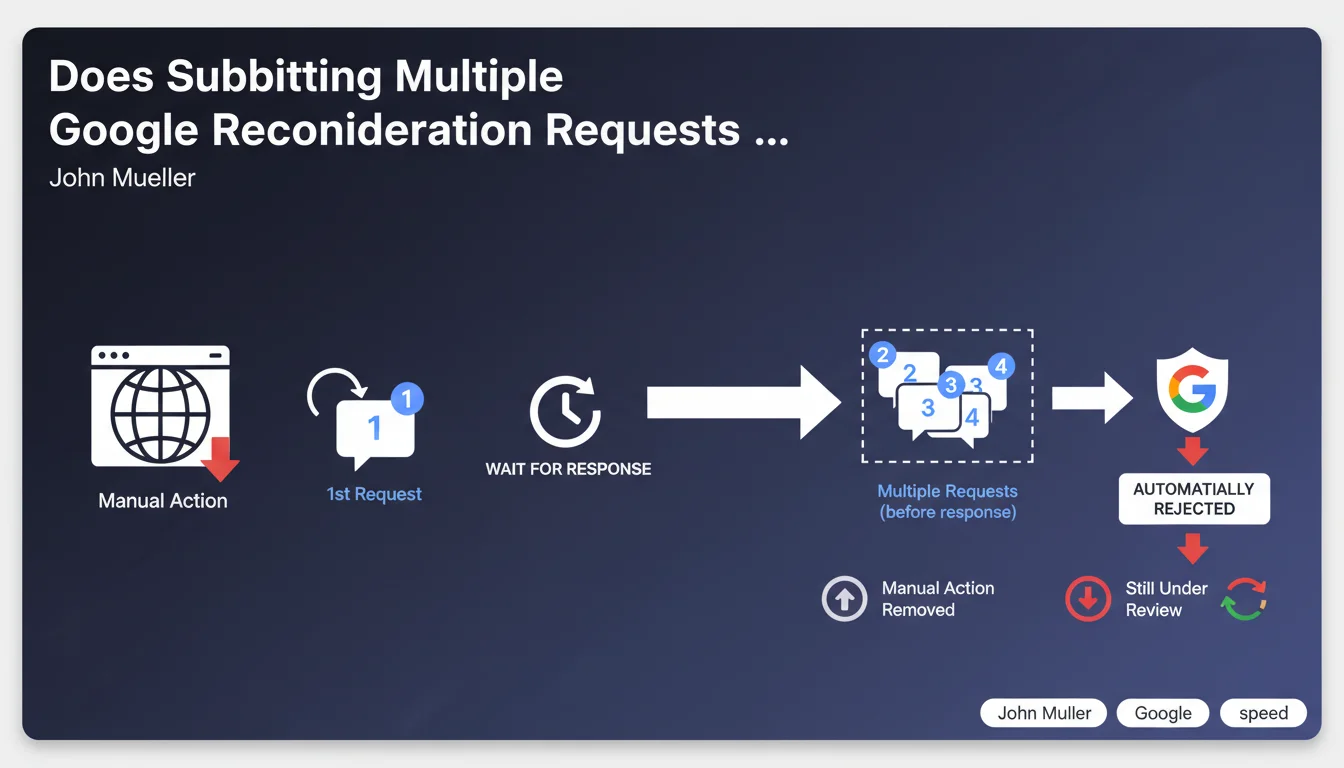
Google has confirmed that the system only processes one request at a time. If you submit multiple requests before receiving the response to the first one, only the first request is retained and reviewed. All subsequent requests are automatically rejected without review.
Why does this limitation exist?
This restriction allows Google to optimize its resources and prevent manual review teams from being overwhelmed by redundant requests. It also encourages webmasters to perform complete corrective work before submitting their first request.
The system thus favors quality over quantity, forcing site owners to take the time to properly correct issues rather than trying their luck repeatedly.
What is the typical processing time for a reconsideration request?
The timeframe varies considerably depending on the type of penalty and the volume of requests being processed. It can take anywhere from a few days to several weeks before receiving an official response.
- Only one reconsideration request is processed at a time per site
- Multiple requests are automatically rejected without review
- The system prioritizes the quality of corrections over submission speed
- Patience is essential in the rehabilitation process
- Each request must be accompanied by detailed documentation of the corrections made
SEO Expert opinion
Is this statement consistent with practices observed in the field?
Absolutely. This information corresponds perfectly with what I have observed for years in the handling of manual actions. Impatient webmasters who multiply requests only waste time and potentially delay the review of their case.
In my practice, I have found that sites that succeed in their reconsideration are those that take the time to meticulously document their corrections before submitting a single, comprehensive request. Rushing is counterproductive in this area.
What important nuances should be added to this rule?
It is crucial to understand that this rule only applies to requests submitted before receiving a response. If your first request is rejected with explanations about persistent issues, you can naturally submit a new request after making additional corrections.
The key lies in timing: always wait for the official response before taking action. Some webmasters panic and submit multiple requests out of anxiety, but this only adds confusion to the process.
In what cases could this rule be problematic?
Some technical situations can create confusion. For example, if you submit a request and then immediately discover a major error that you had forgotten, you cannot cancel the first request to submit a corrected one.
In this specific case, the best strategy is to wait for the response (which will probably be negative), correct the identified problem, then submit a new comprehensive and well-documented request. Patience remains your best ally.
Practical impact and recommendations
What should you actually do before submitting a reconsideration request?
Preparation is absolutely crucial. Before submitting your request, you must have performed a complete audit of your site and corrected all issues identified in the manual action notification.
Document each correction with screenshots, lists of modified URLs, and clear explanations. This documentation will be essential to convince Google's review team that you have taken the problem seriously.
Take the time to check twice rather than once. A well-prepared request has infinitely more chances of success than a series of rushed attempts.
What critical mistakes should you absolutely avoid?
The most common mistake is submitting a request too quickly, without checking the entire site. Some webmasters only correct the examples given by Google, without addressing the underlying systemic problem.
Never multiply requests out of impatience. Not only is it useless, but it can create confusion and give a bad impression to the review team. Show that you are professional and methodical.
Also avoid vague or defensive requests. Acknowledge the problem, explain what you have done to resolve it, and provide concrete evidence of your corrections.
How can you optimize your chances of success with a reconsideration request?
- Perform an exhaustive site audit before any request
- Correct 100% of identified issues, not just the examples given
- Meticulously document each correction with supporting evidence
- Write a clear, concise and professional request without being defensive
- Submit a single comprehensive request and wait patiently for the response
- Never submit new requests while the first one is being processed
- If rejected, analyze the reasons in detail before correcting and resubmitting
- Keep a complete history of all communications and actions
💬 Comments (0)
Be the first to comment.