
Official statement
What you need to understand
Why does Google consider IP address sharing normal?
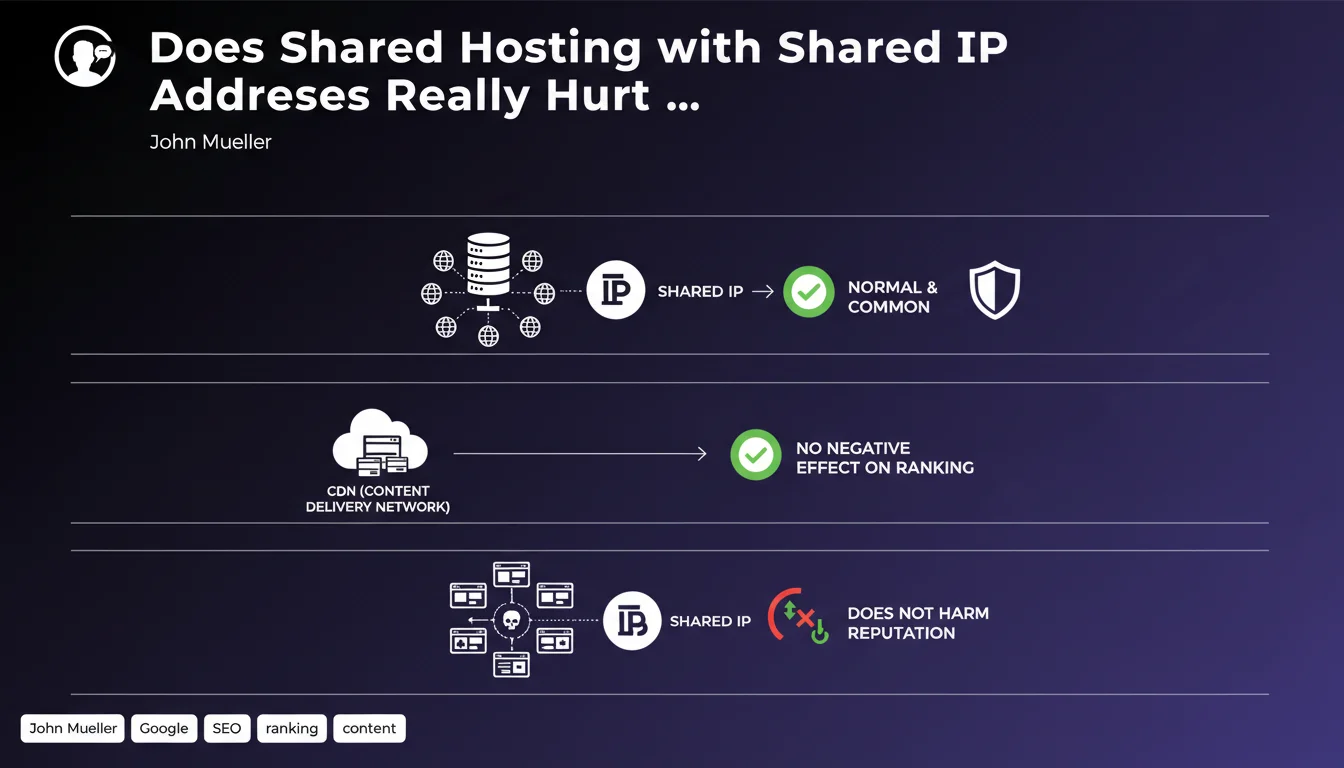
Google has clearly stated that sharing an IP address with other websites on a shared server has no negative impact on SEO. This position is explained by a simple technical reality: the number of available IPv4 addresses is limited, making their sharing unavoidable.
CDNs (content delivery networks) also extensively use IP sharing, a practice that Google considers perfectly legitimate. The search engine has developed its algorithms taking into account this reality of the modern web.
What happens if my site shares an IP with spammy sites?
Contrary to a widespread fear, sharing an IP address with poor quality sites or sites considered spam does not penalize your own site. Google evaluates each site individually, independently of its IP neighborhood.
This granular approach allows the search engine to distinguish the content and practices of each domain, without amalgamation based on shared technical infrastructure.
- IP sharing is a standard practice and recognized as normal by Google
- CDNs extensively use shared IP addresses without negative SEO impact
- A site's reputation does not depend on other sites hosted on the same IP
- Google analyzes each domain individually, not by IP group
- A dedicated server with unique IP provides no particular SEO advantage
Has Google's position on this evolved recently?
No, this statement confirms a consistent position from Google for many years. This is not news but a reminder in response to recurring concerns from webmasters.
The technological evolution of the web, particularly the widespread adoption of CDNs and the exhaustion of IPv4 addresses, makes this approach even more relevant today than before.
SEO Expert opinion
Is this statement consistent with practices observed in the field?
Absolutely. Analysis of thousands of sites on the first page shows a wide diversity of hosting architectures, massively including shared servers. SEO-performing sites use both shared and dedicated hosting equally.
Major web players all use CDNs with shared IPs, which provides the best proof that this practice poses no problem. Cloudflare, Akamai, or Fastly share the IPs of millions of sites without observable negative impact.
What important nuances should be added to this assertion?
While IP sharing does not affect SEO ranking, there are important technical considerations. The quality of the hosting provider remains crucial: server response time, availability, allocated resources directly impact Core Web Vitals and user experience.
A poor quality shared server, overloaded or misconfigured, can indeed harm SEO, not because of the shared IP, but due to degraded performance. It's the quality of the infrastructure that matters, not the type of hosting.
In which specific cases can the type of hosting still matter?
For very high traffic sites or those with specific needs (financial transactions, sensitive data, traffic spikes), a dedicated server or dedicated cloud becomes necessary for performance and security reasons, not SEO.
Large enterprise sites often prefer dedicated infrastructures for control and customization, but this advantage concerns technical management, not natural search engine optimization per se.
Practical impact and recommendations
What should you actually do to optimize your hosting for SEO?
Focus on actual performance rather than the type of hosting. Good shared hosting outperforms a poorly configured dedicated server. The essential thing is to ensure fast loading times and maximum availability.
Prioritize the criteria that actually impact SEO: server response speed (TTFB), stability, responsive technical support, and capacity to handle your traffic. The "dedicated server" label guarantees nothing without appropriate optimization.
What common mistakes should you absolutely avoid?
Don't waste your budget by migrating to a dedicated server solely for a unique IP. This expense will bring no measurable SEO benefit if performance remains identical.
Also avoid rejecting CDNs on the grounds of IP sharing. These services significantly improve performance, a criterion far more important to Google than the exclusivity of an IP address. Speed trumps uniqueness.
How can you verify that your current configuration is optimal?
Use Google's tools to measure what really matters. PageSpeed Insights, Search Console, and Core Web Vitals tell you if your infrastructure is performing correctly.
Regularly monitor your server response time (TTFB) which should ideally remain under 200ms, and the availability rate which should exceed 99.9%. These metrics are infinitely more relevant than the type of IP.
- Regularly measure Core Web Vitals via PageSpeed Insights
- Check server response time (TTFB) in Search Console
- Monitor the availability and stability of your current hosting
- Compare actual performance rather than technical specifications
- Favor a quality host with good support over a basic dedicated server
- Implement a performing CDN without fear of IP sharing
- Monitor performance metrics after any hosting migration
- Invest in technical optimization rather than in a unique IP
💬 Comments (0)
Be the first to comment.