
Official statement
What you need to understand
Where Does This 4 to 12 Month Estimate Actually Come From?
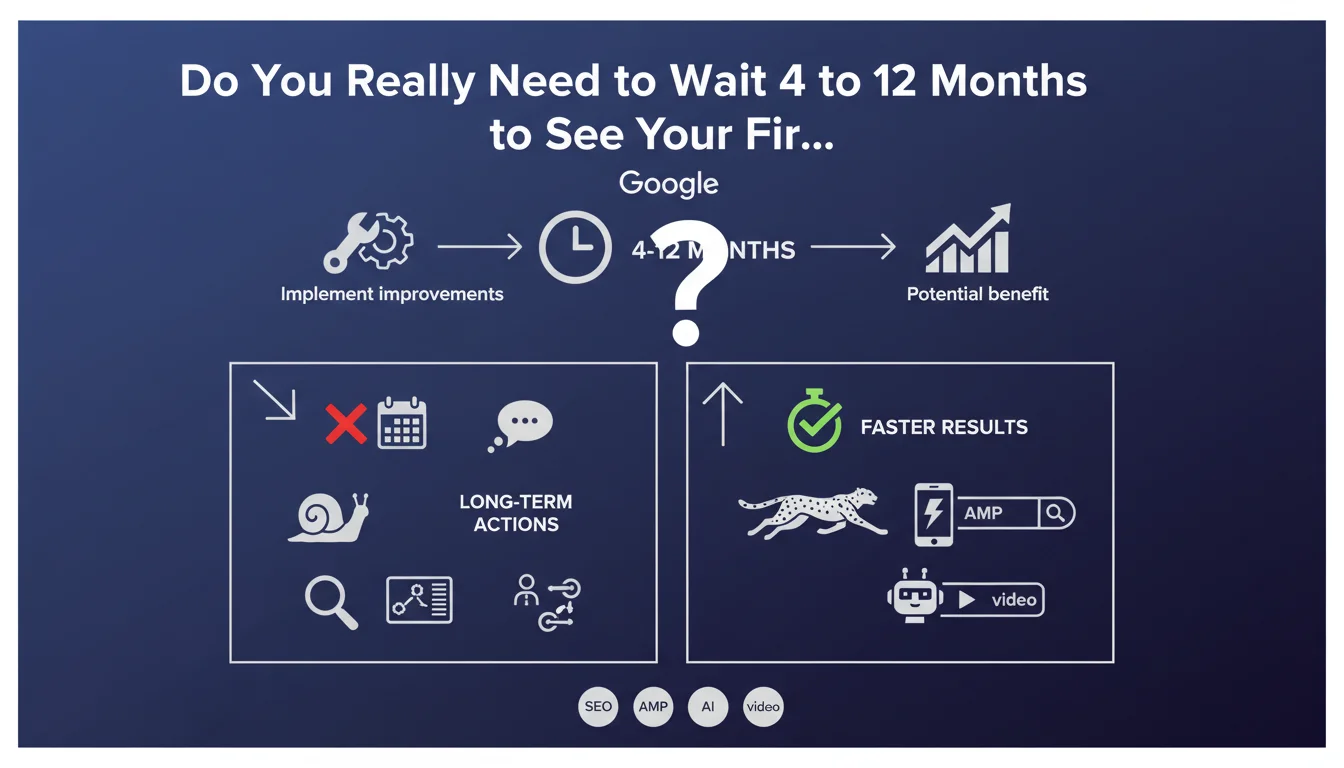
This estimate originates from an official Google video designed to help businesses with hiring SEO service providers. The objective was to provide a realistic timeframe to avoid unrealistic promises from some unscrupulous consultants.
Google was mainly seeking to temper expectations from clients hoping for instant results. This range corresponds to a complete SEO project including audit, technical implementation, content production and link acquisition.
Why Is This Timeframe So Broad?
The variation between 4 and 12 months is explained by the diversity of situations encountered. A recent site in a competitive sector will require more time than an established site with minor corrections to make.
Factors influencing this timeline include domain authority, existing quality, technical team responsiveness and competitive intensity of the sector. Implementation complexity of recommendations also plays a major role.
Does This Duration Apply to All SEO Actions?
No, this generalization is misleading. Some optimizations produce effects much more quickly, sometimes in a few days or weeks.
- Critical technical corrections: resolution of server errors, removal of noindex tags, can have an impact within a few days
- On-page optimizations: improvement of titles/meta descriptions on already ranked pages can yield results in 2-4 weeks
- Content on low-competition queries: indexing and ranking possible within a few weeks
- Long-term strategies: authority building, ranking on highly competitive queries indeed require several months
SEO Expert opinion
Does This Statement Reflect the Reality of Modern SEO Projects?
With 15 years of experience, I observe that this estimate is partially outdated. The SEO ecosystem has considerably evolved since this video, with more responsive algorithms and more powerful tools.
In reality, we regularly observe quick wins within 2 to 6 weeks on targeted optimizations. Well-structured projects often show first positive signals from the first month, even though full maturation does indeed take several months.
What Factors Actually Speed Up or Slow Down Results?
Actual timelines depend primarily on the nature of actions undertaken. A complete technical overhaul will require 6-12 months, while optimization of existing content can bear fruit in 3-6 weeks.
Implementation speed is often the limiting factor. A site capable of rapidly deploying recommendations will see results much faster than an organization with heavy validation processes.
When Does This 4-12 Month Rule Not Apply?
This rule is unsuitable for emergency corrections such as lifting a manual penalty, resolving critical indexing problems or correcting cannibalization on strategic pages.
Similarly, sites with strong established authority generally see their new content rank much more quickly. I've observed articles ranked in the top 10 in less than 48 hours on highly authoritative domains.
Practical impact and recommendations
How Can You Set Realistic Expectations for an SEO Project?
Segment your SEO objectives into phases. Identify quick wins achievable in 4-6 weeks, medium-term optimizations over 2-4 months, and strategic objectives at 6-12 months.
Communicate clearly with your stakeholders about the progressive nature of SEO. Show intermediate indicators (crawl budget, average positions, impressions) before traffic increases significantly.
- Establish a realistic calendar based on specific actions, not on a generic range
- Identify quick wins that will give credibility to the project
- Plan monthly checkpoints to adjust the strategy
- Document each action and its measured impact to build a track record
Which Actions Should You Prioritize to Get Fast Results?
Start with a thorough technical audit to identify critical blockages. Server errors, indexing problems and massive duplicate content can be resolved quickly with immediate impact.
Then optimize existing content already ranked between 6th and 20th position. These pages have already proven their relevance and often just need adjustments to gain several positions.
- Correct blocking technical errors (robots.txt, noindex, redirect chains)
- Optimize pages in position 6-20 with significant click potential
- Improve internal structure to better distribute PageRank
- Create content on long-tail queries with low competition
- Leverage featured snippets on your pages already on the first page
How Can You Effectively Measure the Progress of Your SEO Efforts?
Set up a multi-level dashboard with technical metrics (indexation rate, crawl time), visibility metrics (rankings, impressions) and business metrics (qualified organic traffic, conversions).
Don't focus solely on overall traffic. Track progression by segment: new pages created, optimized pages, targeted query categories. This allows you to precisely identify what's working.
💬 Comments (0)
Be the first to comment.