
Official statement
What you need to understand
What is the "Fast Track" indexing method revealed by Google?
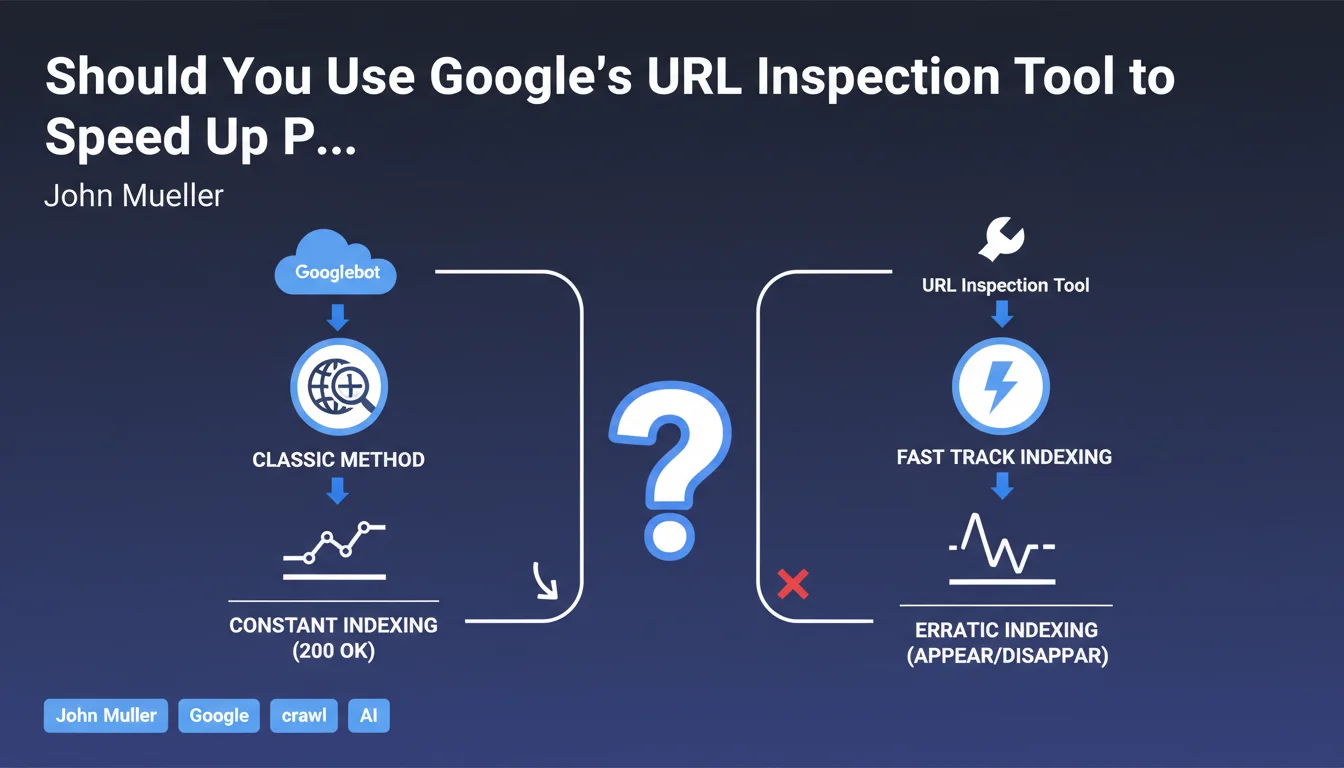
Google has confirmed the existence of two distinct methods for indexing web pages. The first, called "classic", works when Googlebot naturally discovers your pages through internal or external links. This method guarantees stable and lasting indexing as long as the page remains accessible.
The second method, dubbed "Fast Track Indexing", occurs particularly when a webmaster manually submits a URL via Search Console. While this approach accelerates page discovery, it exhibits more erratic indexing behavior until Googlebot takes over naturally.
Why is Fast Track indexing less stable?
Fast Track indexing acts as a temporary priority treatment. Google processes your request quickly, but the page is not yet fully integrated into the classic crawling process. It can therefore appear then disappear from the index unpredictably.
Only when Googlebot naturally discovers the page through links and integrates it into its regular crawl does indexing stabilize permanently. Fast Track is therefore just an initial acceleration solution, not a replacement for organic indexing.
What are the key takeaways about these two indexing modes?
- Classic indexing via links guarantees stable and lasting presence in Google's index
- Fast Track (manual submission) accelerates discovery but creates temporary and unstable indexing
- A page in Fast Track can enter and exit the index until its natural integration
- Transition to classic indexing is necessary for long-term stability
- Both methods can coexist but classic remains preferable for sustainability
SEO Expert opinion
Does this revelation explain behaviors observed in the field?
This statement confirms a recurring observation among SEO professionals: pages manually submitted via Search Console often experience chaotic indexing. They appear quickly, then sometimes disappear for several days before stabilizing.
This phenomenon frustrated many practitioners who suspected penalties or technical issues. In reality, it's simply the normal Fast Track cycle while waiting for classic crawling to take over. This transparency from Google finally allows us to understand these fluctuations.
What nuances should an SEO expert bring to this information?
The speed of Fast Track shouldn't mask its main flaw: lack of stability guarantee. For e-commerce or news sites where constant presence in the index is critical, this method can prove counterproductive if it ultimately delays stable indexing.
Furthermore, Fast Track effectiveness also depends on internal linking quality and site authority. On a site with solid architecture and healthy crawl budget, the difference between both methods will be minimal. On a poorly structured site, Fast Track will only temporarily reveal pages that will struggle to remain indexed.
In which cases can Fast Track prove counterproductive?
For sites with limited crawl budget, forcing indexing of numerous URLs via Fast Track can paradoxically slow down natural crawling. Google might allocate resources to these manual requests at the expense of more efficient organic exploration.
Moreover, on sites with content quality issues, Fast Track quickly exposes these pages to Google, which may then decide not to index them durably. It would sometimes have been preferable to allow time to improve content before it gets evaluated.
Practical impact and recommendations
What should you concretely do to optimize your page indexing?
Always prioritize classic indexing by creating solid internal linking. Each important new page should be linked from at least 2-3 already well-crawled pages. This is the most reliable method to guarantee stable indexing.
Only use Fast Track for emergency situations: launching a flagship product, correcting a critical error, or publishing ultra-timely content. In these specific cases, manual submission via Search Console can save you precious hours.
After a Fast Track submission, carefully monitor indexing for 2-3 weeks. If the page disappears from the index, don't resubmit it immediately. Instead, verify that your internal linking allows Googlebot to rediscover it naturally.
What mistakes should you avoid in your indexing strategy?
Don't turn Search Console into a systematic submission tool. Some webmasters manually submit every new URL, creating dependence on Fast Track. This approach is inefficient and masks structural architecture problems.
Also avoid confusing speed with indexing quality. A page indexed quickly via Fast Track but then disappearing is less effective than a page naturally discovered after 48 hours but stable in the index.
Finally, never neglect your XML sitemap file. While it doesn't guarantee indexing, it helps Googlebot discover your pages naturally, which promotes stable classic indexing.
How can you audit and correct your current approach?
- Analyze in Search Console the ratio of manually submitted pages / naturally discovered pages
- Identify pages with indexing fluctuations and verify if they were submitted via Fast Track
- Audit your internal linking to ensure all important pages are linked from your navigation
- Optimize your crawl budget by blocking unnecessary URLs in robots.txt
- Implement automated indexing monitoring to detect page disappearances
- Document your manual submissions to measure their actual medium-term effectiveness
- Prioritize content quality over indexing speed for strategic pages
💬 Comments (0)
Be the first to comment.