
Official statement
What you need to understand
Why doesn't Google use bounce rate?
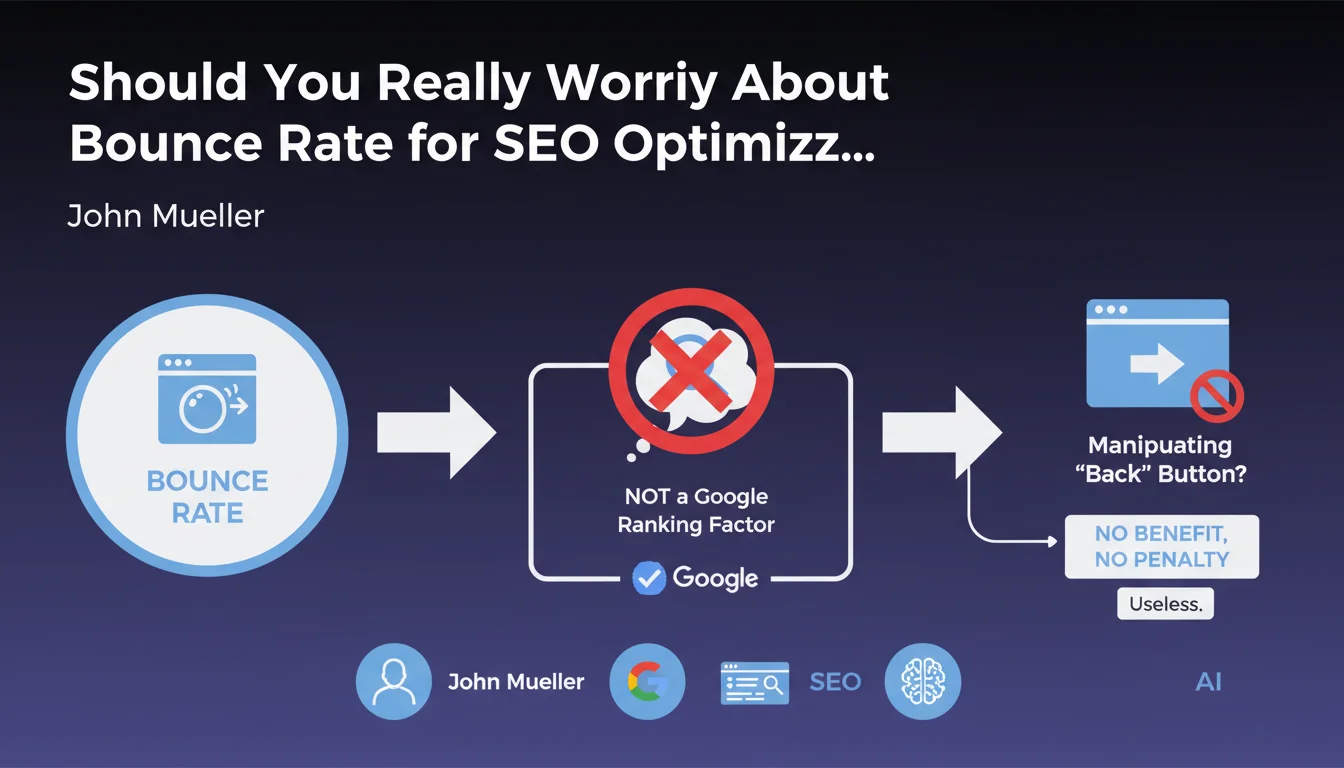
Google does not take bounce rate into account in its ranking algorithms. The reason given by Gary Illyes is simple: it's not a reliable relevance signal.
Indeed, a high bounce rate can have very different meanings. A user may immediately find their answer and leave the site satisfied, or conversely leave disappointed. Google cannot distinguish between these two scenarios using this metric alone.
What's the difference between bounce rate and the engagement signals Google actually uses?
Bounce rate is an Analytics metric, not a native Google signal. Google has its own behavioral signals that are far more sophisticated.
These signals include clicks on search results, time spent before returning to SERPs, and users' navigation patterns. These contextual data points are much more revealing of user satisfaction.
Why does this myth persist in the SEO community?
The confusion stems from an observed correlation between good bounce rates and good rankings. But correlation is not causation.
Well-positioned sites often have low bounce rates because they offer a good user experience. It's this experience that improves ranking, not the bounce rate itself directly.
- Bounce rate is not transmitted to Google by websites
- Google uses its own internal behavioral metrics
- A good bounce rate is a symptom, not a cause of good ranking
- Content relevance remains the determining factor
SEO Expert opinion
Is this statement consistent with field observations?
Absolutely. After 15 years of observation, I can confirm that no direct correlation exists between artificially improving bounce rate and ranking.
I've seen sites with 80% bounce rates ranking very well, particularly informational sites where users find their answer quickly. Conversely, sites with excellent bounce rates can stagnate if the content isn't relevant.
What important nuances should be added to this statement?
While Google doesn't use bounce rate directly, it measures what I call "true engagement signals". Pogosticking (quick return to SERPs) and dwell time are closely monitored.
If a user clicks on your result and immediately returns to search for a better answer, that's a powerful negative signal. This is different from an Analytics bounce where the user is satisfied but doesn't navigate further.
In what cases does bounce rate remain a useful indicator?
Bounce rate remains a valuable business metric for your own analysis. It reveals UX problems, targeting issues, or content quality concerns.
Use it as an internal diagnostic tool, not as an SEO objective. If your bounce rate is abnormal for your industry, it's a symptom to investigate, likely hiding problems that Google detects through other means.
Practical impact and recommendations
What should you actually optimize if it's not bounce rate?
Focus on what Google actually measures: search intent satisfaction. Does your content precisely answer the query that brought the user to your site?
Optimize dwell time by making your content engaging and comprehensive. Structure your pages so users can quickly find their answer without needing to return to SERPs.
Work on your internal linking to encourage natural discovery of related content. Not to artificially reduce bounce rate, but to provide genuine added value.
What common mistakes should you absolutely avoid?
Never try to artificially manipulate bounce rate with forced pop-ups, auto-play videos, or deceptive content. These tactics degrade user experience.
Avoid judging a page's SEO performance solely on its Analytics bounce rate. An informational page that perfectly answers a question can have a legitimately high bounce rate.
How do you actually measure user satisfaction for SEO?
Analyze your Search Console data: CTR, impressions, average position. Look at whether users click on your result and whether they return searching for the same query.
Use heatmap tools and session recording to understand actual behavior on your pages. Measure scroll depth and meaningful interactions.
- Analyze CTR and positions in Search Console rather than bounce rate
- Optimize for search intent, not to artificially reduce bounce rate
- Improve dwell time with quality content and good structure
- Use behavioral tools (heatmaps, recordings) to understand real engagement
- Create natural internal linking that provides value
- Test satisfaction with post-visit user surveys
- Measure conversions and micro-conversions as true success indicators
💬 Comments (0)
Be the first to comment.