
Official statement
What you need to understand
What exactly is an SEO contest and why does Google distrust them?
An SEO contest is a competition where participants attempt to rank a web page for a given keyword phrase in Google's top results. These contests often generate a significant volume of artificial links created solely for the competition.
Google considers these practices contrary to its guidelines because they aim to manipulate search results rather than create value for users. Links obtained in this context are rarely natural or relevant.
What official position does Google take regarding these practices?
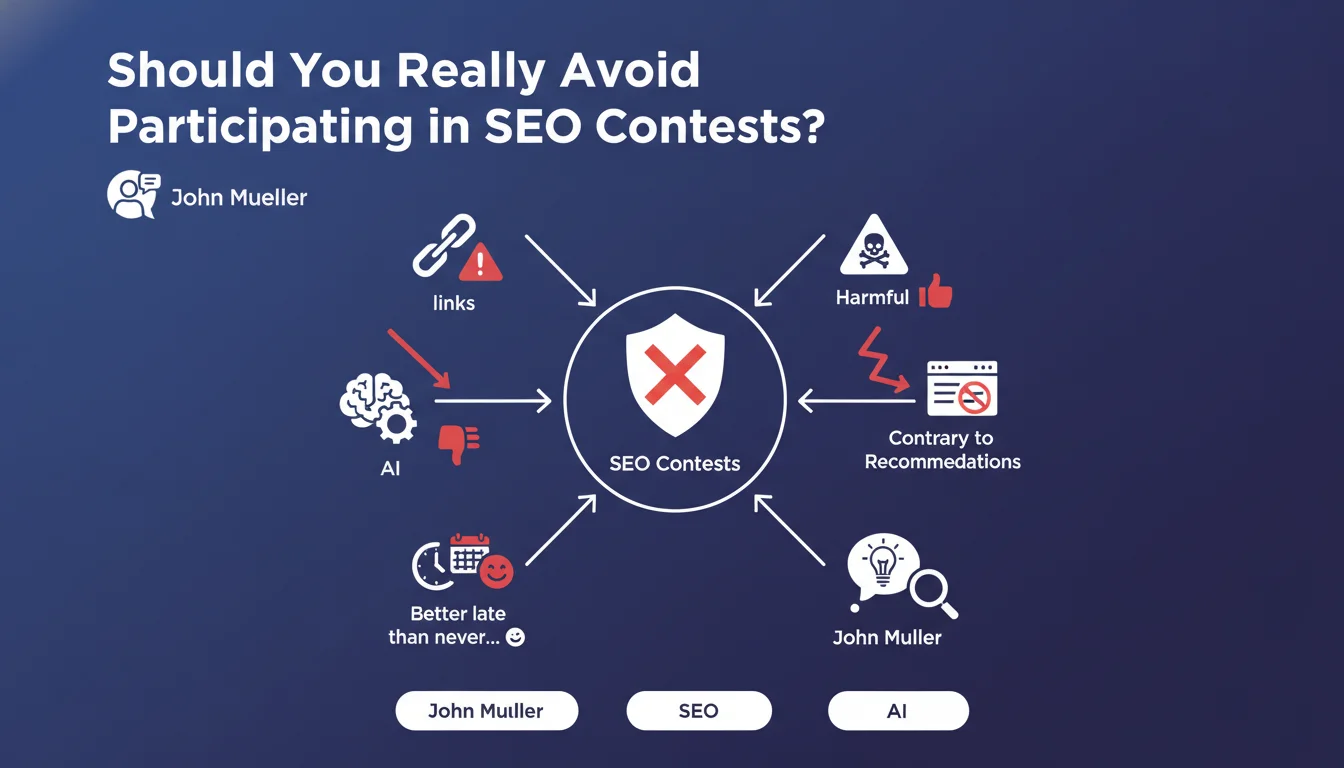
John Mueller has clearly stated that positioning contests can be harmful to your site. Participating in these events can generate a toxic link profile that triggers algorithmic or manual penalties.
Google observes these practices and considers them as attempts to manipulate its algorithm. The search engine wants to discourage these initiatives that serve no legitimate purpose.
What are the concrete risks for participants?
- Creation of an artificial link profile detectable by the Penguin algorithm
- Risk of manual penalty for link manipulation
- Potential devaluation of the overall domain authority
- Subsequent need to massively disavow links
- Possible negative impact on the site's long-term rankings
SEO Expert opinion
Does this statement really reflect Google's actual practice?
John Mueller's position is consistent with Google's official doctrine on artificial links. However, the reality is more nuanced: SEO contests have existed for over 20 years and Google has always struggled to manage them effectively.
In practice, some participants in historical contests have never suffered lasting penalties. Google has indeed made progress in detecting artificial link patterns, but simply participating in a one-time contest does not guarantee automatic sanctions.
What nuances should be added to this warning?
The danger of a contest largely depends on its media visibility and the aggressiveness of the techniques employed. A small, discreet contest among professionals generates fewer risks than a widely publicized event like the "SEO Hero" mentioned in the context.
The real danger lies in the methods used to participate: massive link purchases, comment spam, PBNs... If you participate using only white hat techniques, the risks are considerably reduced.
In what cases does this rule not fully apply?
Contests organized by universities or digital marketing schools for educational purposes generally benefit from greater tolerance. They are less likely to attract negative attention from Google if they remain within an educational framework.
Similarly, private SEO tests among professionals, without a public competitive dimension or massive external link creation, don't really fall into the category targeted by this warning.
Practical impact and recommendations
What should you do if you've participated in an SEO contest?
Immediately conduct a comprehensive audit of your link profile via Google Search Console and third-party tools like Ahrefs or Majestic. Identify all backlinks obtained during and after the contest.
Proceed with cleaning up toxic links: contact webmasters for removal, then use Google's disavow tool for links that cannot be removed. Document all your actions.
What mistakes should you absolutely avoid with SEO contests?
- Never use an actual business domain to participate in a contest
- Avoid massive spam techniques (comments, forums, low-quality directories)
- Don't create a network of artificial sites solely for the contest
- Refuse to participate if the rules encourage black hat practices
- Don't neglect post-contest cleanup even if you didn't win
How can you protect your long-term SEO strategy?
Focus your efforts on natural and sustainable link building strategies: creating quality content, digital press relations, authentic partnerships. These approaches generate more stable results with no risk.
If you want to experiment with advanced SEO techniques, do so in isolated test environments. Maintain strict separation between your experiments and your strategic digital assets.
In summary: SEO contests present real risks of penalties and can permanently compromise your visibility. Always prioritize strategies that comply with Google's guidelines.
Implementing a sustainable and compliant SEO strategy requires in-depth expertise in Google's guidelines and constant monitoring of algorithmic changes. These complex optimizations often require specialized support to avoid costly mistakes and maximize results without taking unnecessary risks.
💬 Comments (0)
Be the first to comment.