
Official statement
What you need to understand
What is Google's official position on outbound links to authority sites?
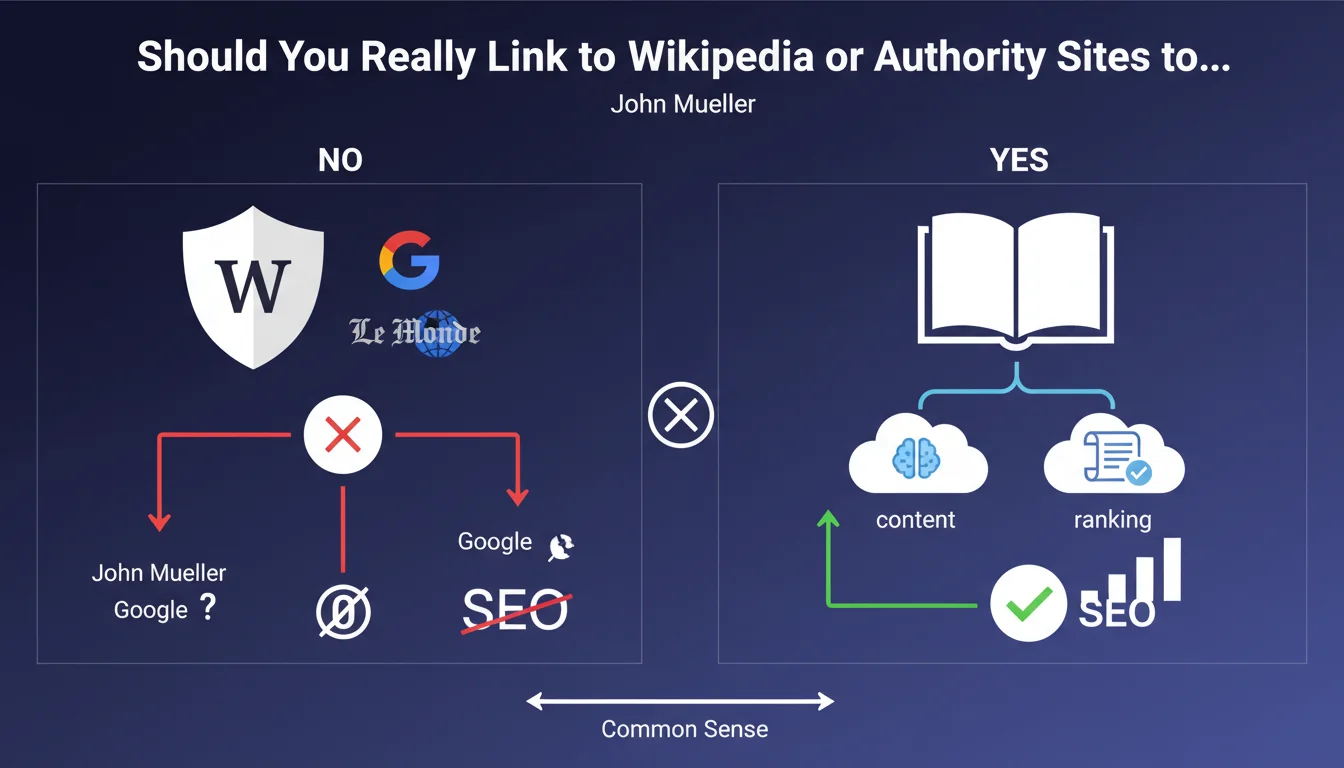
John Mueller clearly stated that creating external links to high authority sites like Wikipedia, Google or Le Monde provides no direct SEO benefit. This statement demystifies a widespread practice in the SEO community that consisted of "borrowing" authority from these web giants.
The mere presence of an outbound link to a reputable site doesn't transmit any positive signal to your page. Google doesn't consider this a ranking factor in itself.
What actually matters when it comes to external outbound links?
What matters is the contextual relevance and the quality of the content you're pointing to. An external link to a resource that genuinely deepens the topic covered on your page can indeed improve your rankings.
Google's algorithm evaluates the overall thematic coherence of your content. By linking to complementary quality resources, you demonstrate that your page is part of an expert content ecosystem on the subject.
Why does this approach make sense from a user experience perspective?
Relevant external links improve user experience by offering useful complementary sources. Google values pages that fully satisfy search intent, including by directing users toward relevant additional resources.
- The domain authority of the target site is not a ranking criterion for your outbound links
- The contextual relevance of the linked content is the determining factor
- Quality external links contribute to the thematic coherence of your page
- The objective is to enrich user experience, not manipulate algorithms
SEO Expert opinion
Is this statement consistent with real-world observations?
My 15 years of experience completely confirm this position. I've conducted numerous A/B tests where adding links to Wikipedia or other authority sites generated no measurable improvement in rankings. The observed variations remained within the statistical margin of error.
On the other hand, I've observed significant improvements when outbound links pointed to specialized resources, scientific studies or technical guides directly related to the topic covered. The key factor is the informational added value, not the notoriety of the target site.
What nuances should be added to this recommendation?
There are situations where linking to Wikipedia or other authority sites remains relevant, not for SEO but for editorial credibility. If you're citing a definition, historical date or verifiable fact, sourcing with Wikipedia reinforces reader trust.
Moreover, in certain sensitive sectors like health or finance (YMYL), Google analyzes the rigor of your sources. Linking to scientific publications or official institutions can indirectly influence your E-E-A-T, even if not through the link itself but through the overall quality assessment.
In what cases might this rule evolve?
Google is constantly refining its algorithms for analyzing semantic context. In the future, the search engine could better identify content hubs that play a role as quality gateways to expert resources.
However, the current direction clearly favors user intent and search satisfaction. As long as this philosophy prevails, relevance will take precedence over the raw authority of linked sites.
Practical impact and recommendations
What should you actually do with external links on your site?
Conduct an audit of your existing outbound links. Identify those placed solely to "borrow authority" from popular sites without providing real contextual value. These links can be removed without fear of penalty.
For each new piece of content, ask yourself: does this external link truly help my reader deepen their understanding of the topic? If yes, integrate it naturally. If it's just to "do SEO," refrain.
Prioritize links to specialized resources: case studies, academic research, technical guides, statistical analyses. These sources provide tangible documentary added value.
What mistakes should you avoid in your outbound link strategy?
Don't adopt a strategy of systematic outbound links to authorities just to "check the box." Google detects artificial patterns and this improves neither your SEO nor your content.
Also avoid the opposite extreme: not including external links for fear of "losing link juice." A well-documented page with relevant sources sends a signal of editorial quality. Outgoing PageRank is no longer a major issue in 2024.
Don't neglect the appropriate link attribute. For links to reliable resources you recommend, use a standard link. Reserve nofollow for advertising links or unvalidated content.
How can you optimize your external link strategy to maximize SEO impact?
Integrate your outbound links within rich semantic context. The anchor text and surrounding sentences should clarify why this external resource enriches your point. This contextualization helps Google understand the thematic coherence.
Analyze the outbound links of your well-ranked competitors. Identify the specialized resources they reference and assess whether they provide value you could also leverage to enrich your content.
- Audit your current external links and remove those without contextual value
- For each outbound link, verify that it addresses a real user need
- Prioritize specialized resources rather than generalist giants
- Integrate links within explicit and rich semantic context
- Use appropriate link attributes (standard, nofollow, sponsored)
- Don't be afraid to link out to quality content
- Document sources for important facts, statistics and citations
- Analyze external link patterns of high-performing competitor pages
💬 Comments (0)
Be the first to comment.