
Official statement
What you need to understand
What exactly happens when you submit a removal request in Search Console?
When an SEO practitioner requests the removal of a URL through the Search Console removal tool, Google applies this action to all variants of that address. This means that the HTTP, HTTPS, www and non-www versions will be simultaneously removed from the index.
This mechanism can be surprising because many SEOs think that each URL variant is treated individually. In reality, Google considers that a removal request concerns the identity of the resource rather than its specific technical form.
- A single removal request impacts 4 potential variants of URL (HTTP/HTTPS + www/non-www)
- Google processes deindexing at the level of the logical resource and not the technical URL
- This functionality aims to simplify management for webmasters while avoiding duplicate content
- The removal remains temporary (approximately 6 months) unless accompanied by technical actions
Why did Google design this mechanism this way?
This approach responds to a logic of index consistency. Google knows that the different variants of the same URL generally point to the same content, thanks to redirects or canonicals. Removing only one version would create inconsistencies in search results.
Moreover, this protects webmasters against partial errors. If you really want to remove a page, it makes sense that all its technical variations disappear simultaneously. This prevents a forgotten variant from remaining accessible and creating confusion.
How does this differ from other deindexing methods?
The Search Console URL removal tool is a temporary emergency solution. It acts quickly (a few hours) but its effect only lasts about 6 months. This is different from a robots.txt which blocks crawling, or a noindex tag which requests permanent deindexing.
For lasting deindexing, you need to combine several techniques: noindex, physical removal of the page, or 410 code. The Search Console tool should be seen as a quick fix while awaiting the implementation of permanent solutions.
SEO Expert opinion
Is this statement consistent with practices observed in the field?
After 15 years of SEO practice, I confirm that this behavior is perfectly consistent with field observations. Tests indeed show that a removal request affects all variants simultaneously, even if your Search Console is only configured for one version.
However, there is an important nuance: this rule mainly applies when Google has already identified the relationships between your different variants via 301 redirects or canonicals. If your HTTP/HTTPS versions are poorly configured without clear redirects, the behavior may be less predictable.
What risks does this functionality pose for SEOs in a hurry?
I've seen several cases where teams removed the HTTP version of a page thinking only that variant would be impacted, when their main HTTPS version (well-ranked) also disappeared. The reaction and restoration time can cost several days of SEO visibility.
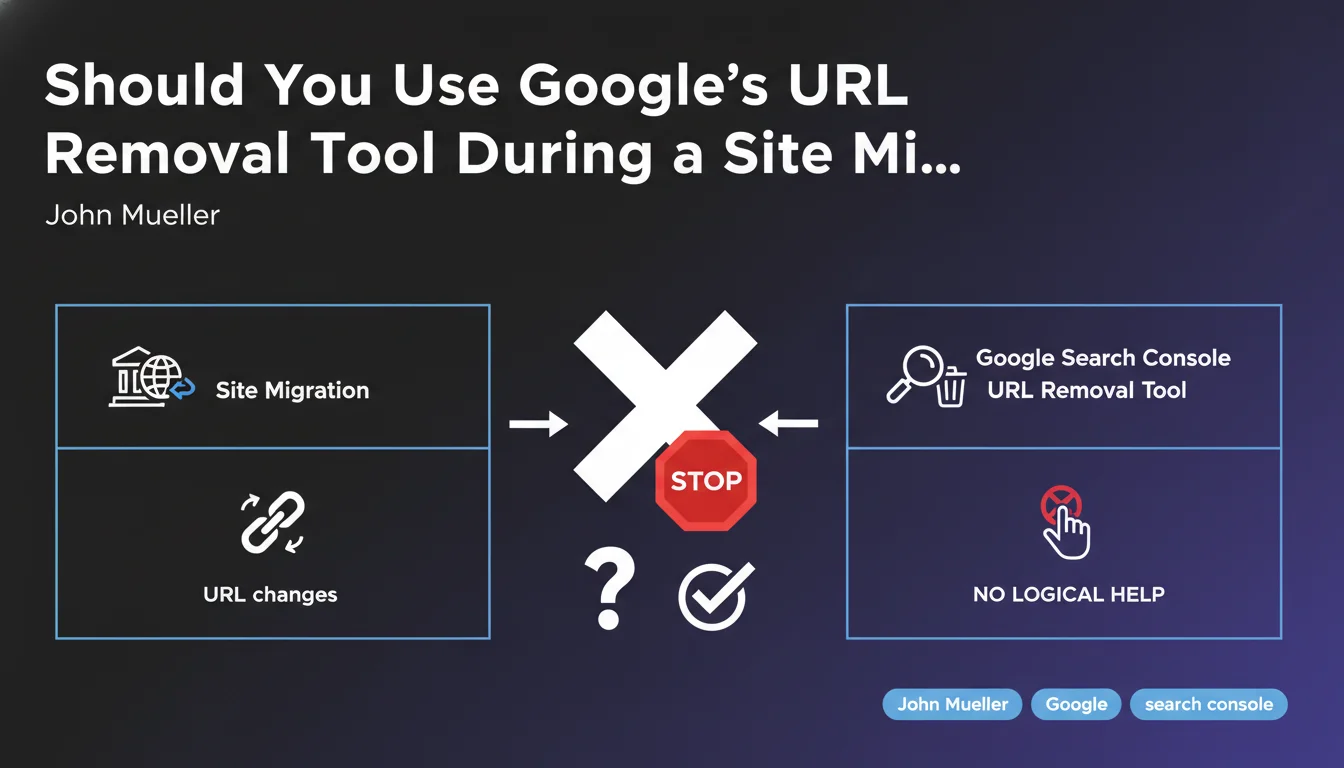
Another trap concerns site migrations. If you remove old URLs before the new ones are well established, you create a void in the index that can impact your entire domain.
In which contexts does this rule require heightened vigilance?
Sites with a complex architecture or multiple subdomains must be particularly careful. If you manage www.example.com and blog.example.com, a removal on one normally doesn't affect the other, but confusion is frequent.
Sites undergoing HTTPS migration represent another sensitive case. During the transition period when HTTP and HTTPS coexist, a poorly calibrated removal can deindex your old and new site simultaneously, creating a temporary black hole in your visibility.
Practical impact and recommendations
What should you check before requesting a URL removal?
Before any removal request, take the time to verify the strategic importance of the page in question. Consult Google Analytics and Search Console to evaluate its organic traffic and rankings. A page may seem useless in appearance but generate qualified conversions.
Also make sure you fully understand your site structure. List all existing URL variants (HTTP, HTTPS, www, non-www) and verify your redirects. If they're not properly configured, Google's behavior might surprise you.
- Audit the organic traffic of the URL over at least the last 6 months
- Check the backlinks pointing to this page and its variants
- Test all URL variants in a browser to understand their behavior
- Document the reason for removal and inform all stakeholders
- Prepare a restoration plan in case the removal was an error
What alternatives should you consider before using the removal tool?
The URL removal tool is an emergency solution, not standard practice. For non-urgent situations, favor more controlled methods like adding a noindex tag in the page code, which allows gradual and reversible deindexing.
If you want to permanently remove a page, implement a 410 (Gone) code rather than 404. This explicitly indicates to Google that the resource no longer exists and won't return. Combined with a 301 redirect to a relevant alternative page, this is the cleanest solution.
For temporarily unavailable content, consider a 503 code that asks Google to check back later. This preserves your rankings while temporarily removing the page from the index.
How can you implement a secure process for managing removals?
Establish an internal validation workflow before any URL removal. At minimum two people should approve the request, verifying the potential impact on traffic and conversions. Document each removal in a tracking spreadsheet with the date, reason, and before/after metrics.
Also create a post-removal monitoring system. Configure alerts in Google Analytics to detect any abnormal traffic drops. Regularly verify that removed pages aren't generating massive 404 errors that could impact your crawl budget.
- Implement a dual validation system for any removal request
- Create a reference document listing the potential impacts of each type of removal
- Configure automatic alerts on key traffic metrics
- Train the entire team on deindexing best practices
- Maintain a comprehensive logbook of all removal actions
URL removal via Search Console is a powerful tool but one that requires in-depth mastery of its mechanisms. The simultaneous impact on all variants of a URL can create delicate situations, particularly for complex sites with several active technical versions.
Implementing rigorous processes, combined with a fine understanding of your site architecture, is essential to avoid costly errors. These technical optimizations often require specialized expertise and constant monitoring of Google's evolutions. For businesses managing sites with high strategic stakes, support from a specialized SEO agency can prove valuable to secure these sensitive operations and benefit from expert insight on your entire visibility strategy.
💬 Comments (0)
Be the first to comment.