
Official statement
What you need to understand
Why does Google claim there's no universal SEO recipe?
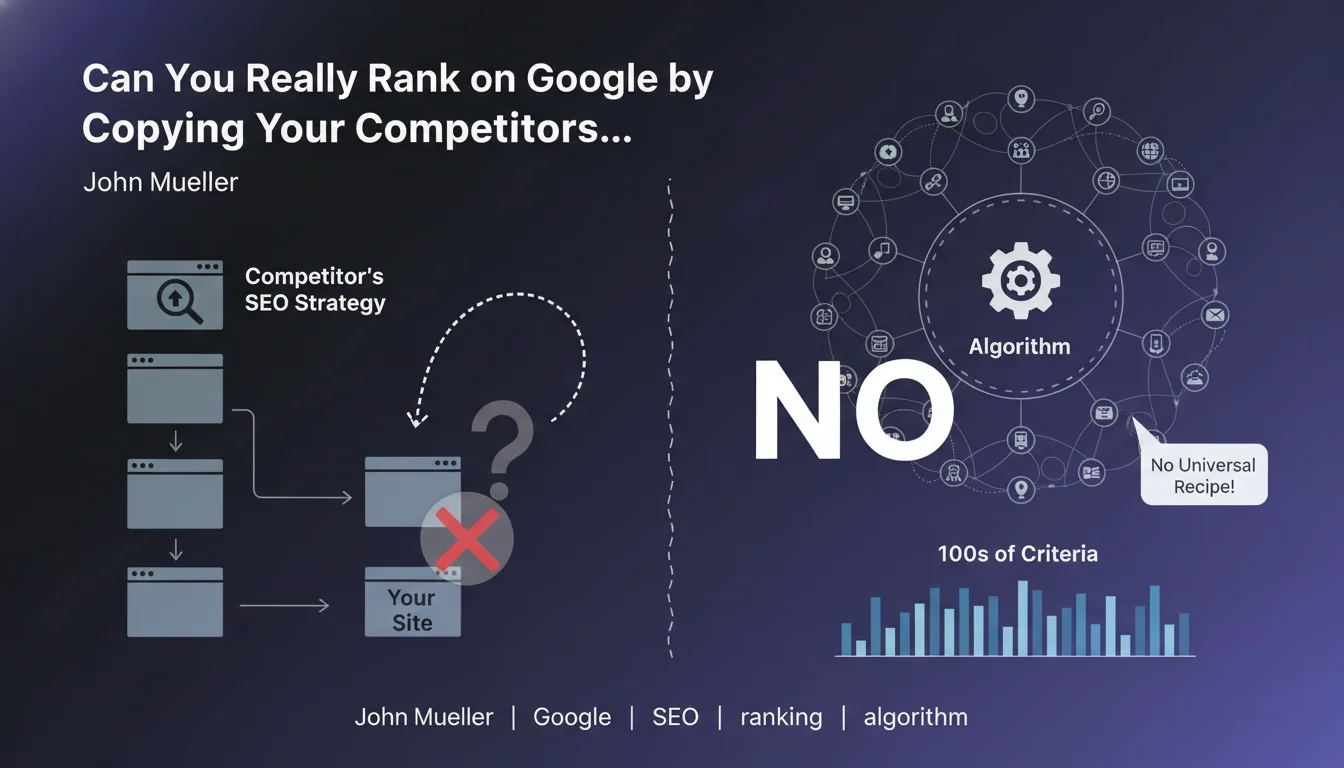
Google uses several hundred criteria to evaluate and rank web pages in its search results. Each site is unique in its history, authority, content, and context.
This algorithmic complexity means that a strategy that works perfectly for one site can prove completely ineffective for another. The specific context of each site plays a determining role in the results obtained.
What does this actually mean for competitive analysis?
Competitive analysis remains important, but pure and simple copying of observed strategies is doomed to fail. The signals that Google perceives for your site differ from those of your competitors.
A competitor may rank thanks to their seniority, link profile, brand awareness, or other factors that you cannot replicate instantly. Copying only the visible elements ignores all the invisible signals.
What factors make each SEO strategy unique?
- Domain history: age, past penalties, content evolution
- Backlink profile: quality, diversity, anchors, timing of acquisitions
- Brand signals: direct searches, mentions, industry authority
- User behavior: click-through rate, engagement, retention
- Technical structure: architecture, performance, historical crawlability
- Semantic context: topical authority built over time
SEO Expert opinion
Does this statement align with real-world observations?
Absolutely. After 15 years of experience, I've witnessed countless times that replicating competitor strategies produces highly variable results. Contextual factors weigh enormously in the equation.
The most revealing cases involve new sites copying established leaders. Even with identical content and similar structure, the missing authority and trust signals prevent equivalent ranking for months, even years.
What important nuances should we add to this statement?
You shouldn't completely reject competitive analysis. Observing what well-ranked sites do reveals Google's expectations for a given query: content type, depth, format, editorial angle.
The critical nuance: use the competition as a source of inspiration and understanding, not as a model to copy. Identify the patterns common to the top 10, but adapt them to your own context and differentiate yourself.
When does competitive analysis remain relevant?
It's essential for understanding search intent and expected formats. If all competitors offer detailed comparisons, that's probably what Google considers relevant for that query.
Technical analysis of competitors also reveals opportunities: neglected keywords, unanswered questions, absent innovative formats. Use these insights to create a differentiated and superior strategy, not to imitate.
Practical impact and recommendations
What approach should you take to competitive analysis?
Focus on an intelligent analysis methodology rather than copying. Identify what unites well-ranked sites, but also look for what differentiates them and what's missing from the current landscape.
Build your strategy starting from your own strengths: your unique expertise, your specific audience, your available resources. Differentiation becomes a major competitive advantage.
How do you build an SEO strategy truly adapted to your site?
Start with a thorough audit of your current situation: domain authority, link profile, technical strengths and weaknesses, current positioning. Your starting point determines your optimal trajectory.
Then define a strategy based on your business objectives and operational reality. A startup doesn't have the same leverage as an established player, and that's normal.
- Analyze common patterns among well-ranked competitors (intents, formats, depth)
- Identify your differentiators: unique expertise, editorial angle, specific audience
- Audit your starting point: authority, technical aspects, existing content, link profile
- Prioritize actions according to your resources and specific context
- Create original content that brings demonstrable added value
- Build your topical authority progressively and consistently
- Measure your own metrics rather than directly comparing to competitors
- Test and iterate: what works for you is unique to your context
What critical mistakes must you absolutely avoid?
Don't fall into the trap of systematic copying: overly similar content, identical structure, same keyword strategy. Google detects and penalizes lack of originality.
Also avoid the opposite mistake: completely ignoring the competition. Analysis remains valuable for understanding expectations, provided you use it as a basis for reflection rather than as a model to reproduce.
💬 Comments (0)
Be the first to comment.