
Official statement
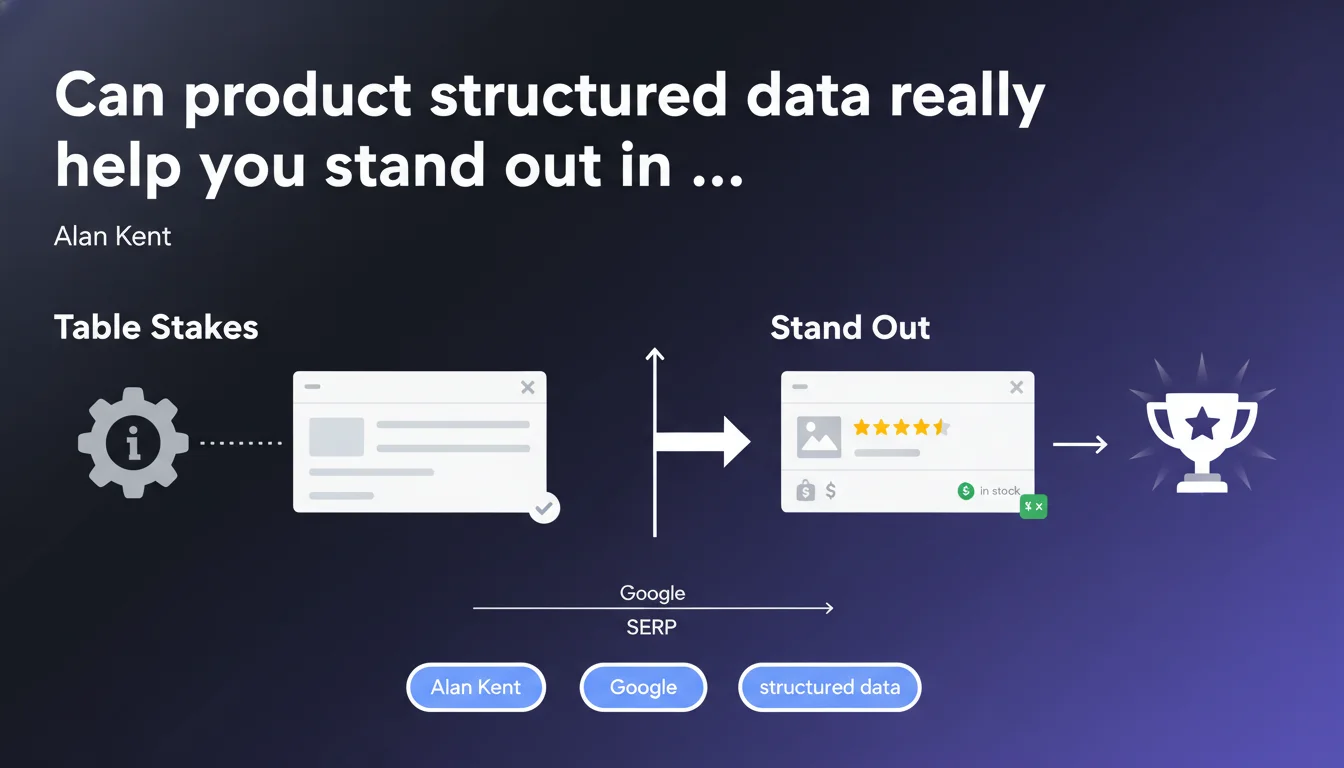
Google claims that adding product structured data improves page visibility in search results. The message is straightforward: mark your product pages with Schema.org Product to enable rich snippets. The real question is whether that's enough when your competitors are doing exactly the same thing.
What you need to understand
What does "standing out" in Google results actually mean in practice?
Google is talking here about increased visibility through rich snippets — those enhanced displays that show price, availability, ratings, and product images directly in the SERPs. The goal: catch the user's eye before they click.
In practical terms, this translates to a potentially higher click-through rate. But "standing out" doesn't mean "ranking better" — Google never says that structured data is a direct ranking factor. It's a tool for attractiveness, not positioning.
What exactly does Google expect in product structured data?
The expected format is Schema.org Product, with at minimum: name, image, description. To enable product rich snippets, you need to add: price, priceCurrency, availability. Aggregate ratings (AggregateRating) are a plus — if you have them legitimately.
Google hates fake reviews. If you mark up reviews without verifiable collection, you risk a manual action or outright removal of your rich snippets. Transparency is non-negotiable.
Do all e-commerce sites have access to product rich snippets?
No. Google reserves the right not to display enhancements even if the markup is correct. Several factors play a role: site quality, query relevance, keyword competition, domain history. Some sites observe rich snippets on certain queries and not others — with no clear explanation.
Small new sites may wait weeks before Google "validates" their snippets. And certain industries (health, finance) see fewer rich snippets displayed out of Google's editorial caution.
- Product structured data activates rich snippets, not direct ranking
- Minimum format: name, image, description, price, availability
- Aggregate ratings require legitimate collection or risk penalties
- Rich snippet display is never guaranteed, even with perfect markup
- Primary impact: CTR improvement, not organic positioning
SEO Expert opinion
Is this claim consistent with real-world observations?
Yes and no. Yes, sites that markup correctly have better chances of seeing their pages enriched. No, because "standing out" becomes less and less true as everyone adopts the same tags. When 80% of results on an e-commerce SERP display prices and ratings, the competitive advantage erodes.
Let's be honest: facing a typical transactional query like "buy women's running shoes," if the top 10 results all have rich snippets, you're not standing out — you're just at parity. The initial advantage early adopters had is gone.
What nuances should we add to this claim?
Google doesn't specify the magnitude of impact. "Standing out" could mean a +5% CTR boost or +30% — [To verify] depending on context. Third-party studies show highly variable results: some e-commerce sites see a CTR jump, others see almost nothing. It all depends on the SERP, snippet quality, and competition.
Another point: structured data doesn't compensate for weak content. If your product page is thin, poorly written, with blurry images, the rich snippet might attract a click… but your bounce rate will skyrocket. The net effect on conversions could be zero or even negative.
And be careful — Google can remove your rich snippets overnight if your markup drifts or you try to manipulate it (fake reviews, misleading prices, abusive markup of data not present on the visible page). Penalties are discreet but real.
In what cases does this rule not fully apply?
Giant marketplaces (Amazon, eBay) often crush the rich snippets of small sites on highly competitive queries. Even with perfect markup, you don't "stand out" against a giant with 10M verified reviews and colossal domain authority.
Niche products with low search volume may never trigger rich snippets — Google prioritizes high-traffic queries to enable these displays. If you sell rare spare parts, don't expect visual miracles in the SERPs.
Practical impact and recommendations
What should you do concretely to benefit from this advantage?
First, audit your current markup. Use Google's Rich Results Test tool, not just a generic Schema validator. Verify that each product page properly exposes name, image, description, price, priceCurrency, availability. If you have reviews, make sure they're legitimate and your AggregateRating markup is correct.
Next, implement properly. JSON-LD is recommended — easier to maintain than HTML microdata. Place the script at the bottom of the page or in the <head>, it doesn't matter, Google will read it. The key: consistency between markup and visible content.
What mistakes must you absolutely avoid?
Don't mark up prices or reviews if the information doesn't clearly appear on the page. Google cross-references structured data with HTML content — any inconsistency gets flagged. Don't duplicate Product tags on the same page (e.g., product lists); each Product should correspond to a unique URL.
Avoid auto-generated or purchased reviews. Google has filters that detect suspicious patterns (same dates, same phrasing, too many 5-stars at once). If your reviews smell fake, you'll lose your snippets — and possibly more.
How can you verify that the markup works and generates results?
Use Search Console: go to "Enhancements," then "Products." Google will show you how many pages are eligible, how many have errors, how many have warnings. Fix everything that's red or orange before complaining it's not working.
Then monitor your CTR in Search Console — compare before/after implementation. If you see no change after 4-6 weeks, either your snippets aren't displaying (verify in actual search) or the competition has the same markup and you're at parity.
- Implement Schema.org Product in JSON-LD on all product pages
- Include at minimum: name, image, description, price, priceCurrency, availability
- Add AggregateRating only if reviews are verifiable and legitimate
- Test each page with Google's Rich Results Test tool
- Monitor the "Products" section in Search Console to catch errors
- Compare CTR before/after implementation to measure real impact
- Never mark up data that's absent or not visible on the page
- Maintain consistency between markup and displayed HTML content
❓ Frequently Asked Questions
Les données structurées produit améliorent-elles directement le positionnement dans Google ?
Combien de temps faut-il pour que les rich snippets produit apparaissent après implémentation ?
Peut-on baliser des avis produit même si on a peu d'avis clients ?
Que se passe-t-il si mon balisage produit contient des erreurs ?
Les rich snippets produit fonctionnent-ils aussi sur Google Shopping ?
🎥 From the same video 2
Other SEO insights extracted from this same Google Search Central video · published on 31/10/2022
🎥 Watch the full video on YouTube →
💬 Comments (0)
Be the first to comment.