
Official statement
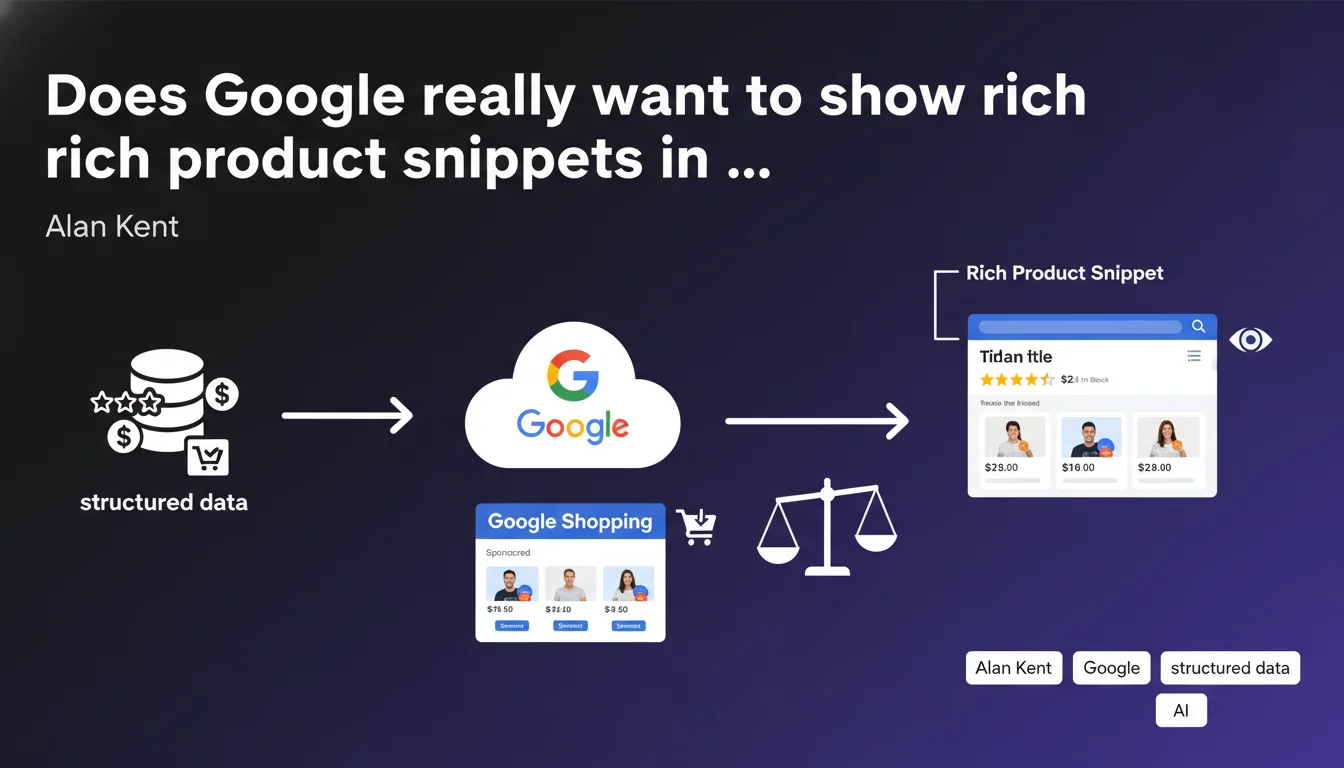
Google confirms that product structured data (price, availability, ratings) enables the display of enriched information directly in search results. The stakes: maximize visibility and click-through rate by occupying more space in SERPs with rich snippets. Without proper implementation, you're losing an acquisition lever while competitors who do implement it gain an edge.
What you need to understand
What is Google really trying to get from structured data?
Google wants to display richer search results without users needing to click. Prices, availability, ratings — everything that helps with purchase decisions before even landing on a site. For Google, it's a better user experience. For you, it's an opportunity to capture attention in an increasingly competitive results environment.
Alan Kent's statement is crystal clear: providing this information via Schema.org Product tags allows Google to exploit it directly in SERPs. No structured data = no rich snippets. No rich snippets = less visibility, fewer clicks.
Which product information does Google actually value?
Google emphasizes several key attributes: ratings (customer reviews), price, availability (stock status), but also brand, image, and reviews. These elements visually enrich the search result and directly influence the click decision.
Concretely, a result with stars, price, and "In stock" notation captures far more attention than a standard blue link. It's visual SEO — and it works.
- Ratings: yellow stars catch the eye and build confidence in quality
- Price: allows users to compare without clicking
- Availability: prevents wasted clicks if the product is out of stock
- Images: enriches the result in "shopping" mode in certain contexts
- Google never guarantees display, but without structured data, you have zero chance
How does this approach differ from other types of rich snippets?
Unlike FAQ or HowTo snippets, product structured data has a direct impact on commercial conversion. They don't just take up space or answer a question — they influence purchase decisions before the click even happens.
It's also an area where Google has far more control: it can choose to redirect traffic to Google Shopping rather than your organic product pages. Let's be honest — the search engine is playing both sides: helping you enrich your results while reserving the right to capture the user within its own shopping ecosystem.
SEO Expert opinion
Is this recommendation consistent with what we observe in the field?
Yes, absolutely. E-commerce sites that properly implement Product structured data regularly observe an increase in organic CTR on product pages. Stars, displayed price, "In stock" mentions — it all works in favor of clicks.
But — and this is where it gets tricky — Google never guarantees display. You can have perfect markup validated by the Rich Results Test and see nothing appear in SERPs. Why? Because Google applies quality filters, relevance checks, and sometimes opaque rules depending on sectors. [To verify]: some actors suspect Google favors large sites or those investing in Google Shopping — nothing officially confirmed, but field observations point that way.
What are the gray areas in this statement?
Alan Kent doesn't specify when or under what conditions Google displays this information. He says "can display" — not "will display." This distinction is crucial. In practice, some sectors see their product rich snippets display consistently, others never, even with flawless markup.
Another point: Google says nothing about the internal competition between organic results and Google Shopping. If your product page appears with a price in organic search, Google Shopping can cannibalize that click. And if you don't pay for Shopping, you risk losing visibility to those who do. It's a delicate balance — and Google doesn't really help you understand it.
Should you really prioritize this optimization?
Yes, but with eyes wide open. Product structured data is a low-cost technical lever for potentially high visibility gains. If you're in e-commerce, it's a must-have — failing to implement it means risking that your competitors will capture clicks you could have had.
But don't expect miracles. Display depends on many factors: site authority, review quality, data consistency, and sometimes criteria you don't control. Implement the markup, test, measure impact on CTR — and adjust based on real results, not theoretical promises.
Practical impact and recommendations
What exactly should you do to implement this structured data?
Start by identifying all your product pages and check if they already have Product Schema.org markup. If not, you need to add it — either via your CMS (Shopify, WooCommerce, PrestaShop often have plugins) or by injecting it directly into the code.
Essential attributes to include: name, image, description, brand, offers (with price, priceCurrency, availability), and if possible aggregateRating. The more complete and consistent information you provide, the better your chances of Google exploiting it.
- Verify that each product page has valid Schema.org Product markup
- Include at minimum: name, image, price, availability, brand
- Add customer ratings (aggregateRating) if you collect them
- Test markup using Google's Rich Results Test in Search Console
- Check consistency between structured data and visible page content
- Monitor actual display in SERPs — don't rely solely on the validator
What mistakes should you absolutely avoid?
First mistake: marking up products that no longer exist or displaying incorrect prices. Google hates inconsistencies. If your markup says "In stock" but the product is out of stock, or if the price shown in SERPs doesn't match the actual page price, you risk a manual penalty or outright removal of rich snippets.
Second mistake: using fake reviews or manipulating ratings to achieve artificial 5-star ratings. Google has detection systems — and if you're caught, your entire site can lose rich snippets or face a manual action.
Third mistake: not monitoring anything. You can have perfect markup today and lose rich snippets tomorrow due to a CMS update, misconfigured plugin, or algorithm change. Regularly monitor display in SERPs and "Enhancements" reports in Google Search Console.
How can you verify that everything is working correctly?
Use the Rich Results Test to validate your markup technically. Then, run real Google searches — search for your products by name, brand, category. Check if rich snippets appear and compare with competitors.
In Google Search Console, check the "Rich results for products" report. It shows how many pages are eligible, how many have errors, and alerts you to issues. It's your dashboard for tracking markup evolution.
❓ Frequently Asked Questions
Les données structurées produit garantissent-elles l'affichage en rich snippet ?
Quels attributs Schema.org sont indispensables pour une fiche produit ?
Peut-on perdre ses rich snippets produit après les avoir obtenus ?
Les données structurées produit influencent-elles le classement organique ?
Faut-il choisir entre Google Shopping et les rich snippets organiques ?
🎥 From the same video 2
Other SEO insights extracted from this same Google Search Central video · published on 31/10/2022
🎥 Watch the full video on YouTube →
💬 Comments (0)
Be the first to comment.