
Official statement
Other statements from this video 4 ▾
- 0:33 Faut-il encore utiliser le balisage rel=author pour attribuer un contenu à son rédacteur ?
- 1:03 Le balisage rel=author peut-il vraiment améliorer votre classement dans Google ?
- 7:28 Le balisage rel=me peut-il vraiment renforcer l'autorité de vos contenus ?
- 9:33 Les photos d'auteurs influencent-elles vraiment le taux de clic en SEO ?
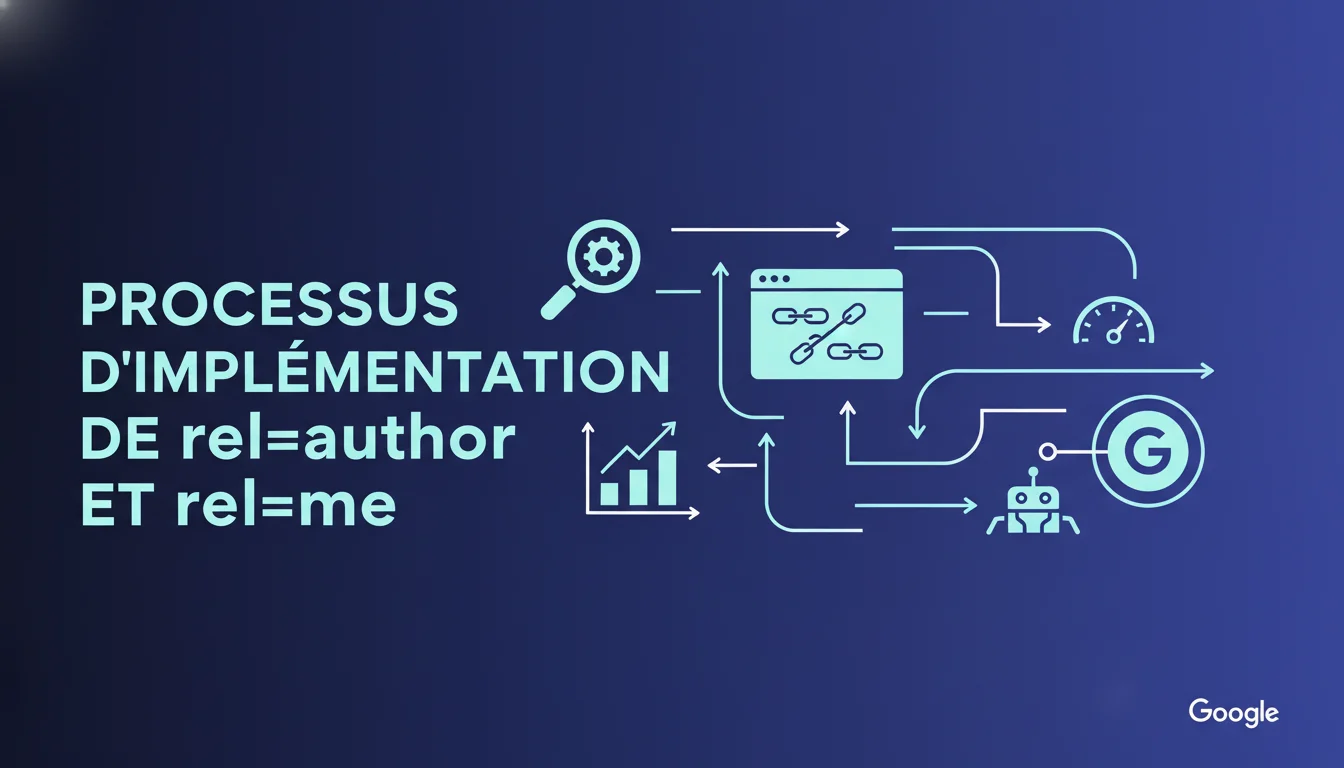
Google requires a double link to validate authorship: each article must point to the author's Google profile, which must also link back to the site to confirm authorization. On multi-author platforms, rel=author links the article to the author's bio, and then rel=me connects this bio to the Google profile. Without this complete validation loop, authorship attribution fails and authority signals do not transfer.
What you need to understand
Why does Google enforce a double validation of authorship?
The system is based on a mutual verification principle that prevents identity theft. A site cannot simply claim that a recognized author wrote an article: the author must confirm from their Google profile that they are indeed contributing to that field.
This architecture creates a bidirectional trust chain. Without the return link from the Google profile to the site, the engine cannot establish that the author truly allows the association. This mechanism protects both authors from reputation theft and Google from markup abuses.
What is the difference between rel=author and rel=me in a multi-author context?
The rel=author establishes the direct authorship of content. It points from the article to the page representing the author. On a personal blog with a single contributor, this link can lead directly to the Google profile.
The rel=me comes into play when the site's architecture imposes an intermediary layer. On a collaborative platform, each author has a local bio page. The rel=author links the article to this bio, and then the rel=me connects the bio to the external Google profile. This stratification manages dozens or hundreds of authors without confusion.
Does this implementation affect ranking signals?
Historically, Google has used authorship to transfer authority signals from the author's profile to their publications. A recognized author in a field can potentially enhance the credibility of the articles they sign.
The quality of the technical implementation determines whether these signals propagate. A broken link in the chain — Google profile without a return link, rel=author pointing to a 404, or poorly formatted rel=me — negates any benefit. The engine does not take risks with incomplete markups.
- Mandatory double validation: article → Google profile AND Google profile → site
- Rel=author to link content and author identity (local bio or external profile)
- Rel=me to connect local bio and Google profile on multi-author sites
- Chain break = total loss of authorship benefits
- Impact on authority: transfer of reputation from the author to their content
SEO Expert opinion
Does this mechanism still work in practice?
Let's be honest: authorship as Google originally designed it is largely abandoned. The engine has removed author photos from the SERPs and gradually deprioritized these signals. Most field audits show that the absence of rel=author/rel=me does not prevent content from ranking.
That said, Google has never confirmed that it has completely removed the use of these attributes in the backend. Large-scale tests are lacking to make a definitive decision. [To be verified] to what extent the engine still uses this data to assess an author's expertise in an E-E-A-T context.
Which sites actually benefit from this implementation?
YMYL platforms (health, finance, legal) where clear author identification impacts trust remain the main candidates. A medical article signed by a verifiable practitioner gains credibility, and Google might still leverage these signals in its quality assessment algorithms.
On generalist blogs or corporate sites where authors have no legacy Google+ presence or Knowledge Graph profile, the effort of implementation likely outweighs the gain. Focus your resources on more direct E-E-A-T signals: detailed bios, verifiable LinkedIn links, external mentions.
Do implementation errors pose a risk?
A broken authorship markup does not directly penalize, but it exposes technical negligence that may raise concerns during automated or manual audits. Google reads maintenance signals: obsolete or poorly formed rel attributes suggest a poorly maintained site.
The real danger lies in manipulation attempts. Artificially associating weak content with a recognized author profile through fraudulent bidirectional links can trigger spam filters. If the Google profile disavows the return link or if the quality gap is too large, you expose yourself to manual devaluation.
Practical impact and recommendations
Should you still implement rel=author and rel=me on a modern site?
The answer depends on your industry and the structure of your editorial team. If you operate in a YMYL domain with authors having active Google profiles or Knowledge Graph presence, the implementation remains defensible as a complementary E-E-A-T signal.
For a standard blog or corporate site without highly visible external authors, invest instead in rich author bios hosted locally with Schema.org Person, LinkedIn links, referenced external publications. These elements have a more measurable ROI than obsolete rel attributes.
How can you verify that the authorship chain is complete?
Crawl your URLs with Screaming Frog or Sitebulb by enabling rel attribute extraction. Identify all rel=author links and manually verify that each target Google profile indeed contains a return link to your domain in the “Contributor to” section.
Also test the validity of rel=me links from the bio pages. A simple inspect with Chrome DevTools is sufficient: look for the attribute in the HTML, follow the link, confirm it leads to an active Google profile. If you get 404s or deleted profiles, clean them up immediately.
What alternatives offer a better return on investment?
The Schema.org Article type with author property (Person or Organization object) transmits structured data directly usable by Google for rich snippets. Unlike rel attributes, JSON-LD allows you to specify name, short bio, photo, and social links in an unambiguous format.
Combine this markup with optimized author pages: long bio (200-300 words), list of published articles, links to social networks and verifiable external publications. These pages can rank for queries like “articles by [author name]” and reinforce the site's overall authority.
- Audit existing rel=author links: valid destination, active profile, return link present
- Check rel=me consistency: local bio → Google profile with bidirectional confirmation
- Implement Schema.org Article with author of type Person for each content
- Create or enrich author pages with detailed bios, publication portfolio, verifiable social links
- Clean up orphaned rel attributes or those pointing to deleted profiles
- Regular testing with Google Rich Results Test to validate Schema.org markup
❓ Frequently Asked Questions
Le rel=author a-t-il encore un impact réel sur le classement Google ?
Puis-je utiliser rel=author sans profil Google actif ?
Quelle différence entre rel=author et Schema.org author ?
Faut-il un rel=author sur chaque article ou seulement sur la page auteur ?
Un authorship mal implémenté peut-il pénaliser mon site ?
🎥 From the same video 4
Other SEO insights extracted from this same Google Search Central video · duration 9 min · published on 09/08/2011
🎥 Watch the full video on YouTube →
💬 Comments (0)
Be the first to comment.