
Official statement
Other statements from this video 11 ▾
- □ Is Google's SEO documentation really accessible to non-experts?
- □ Can You Really Measure the ROI of Core Web Vitals?
- □ Why is your SEO traffic stalling even after six months of continuous effort?
- □ Why is your 500-recommendation SEO audit useless without prioritization?
- □ Should you really track every SEO metric, even when results are going downhill?
- □ Why does Google really demand such frequent communication with your SEO provider?
- □ Why should a serious SEO provider ask questions about your business before signing a contract?
- □ Why are cookie-cutter SEO formulas doomed to fail?
- □ Why does SEO fail without the involvement of other teams?
- □ Should you really advise clients NOT to do SEO in the short term?
- □ Why won't a good SEO consultant ever promise you Google's top 3?
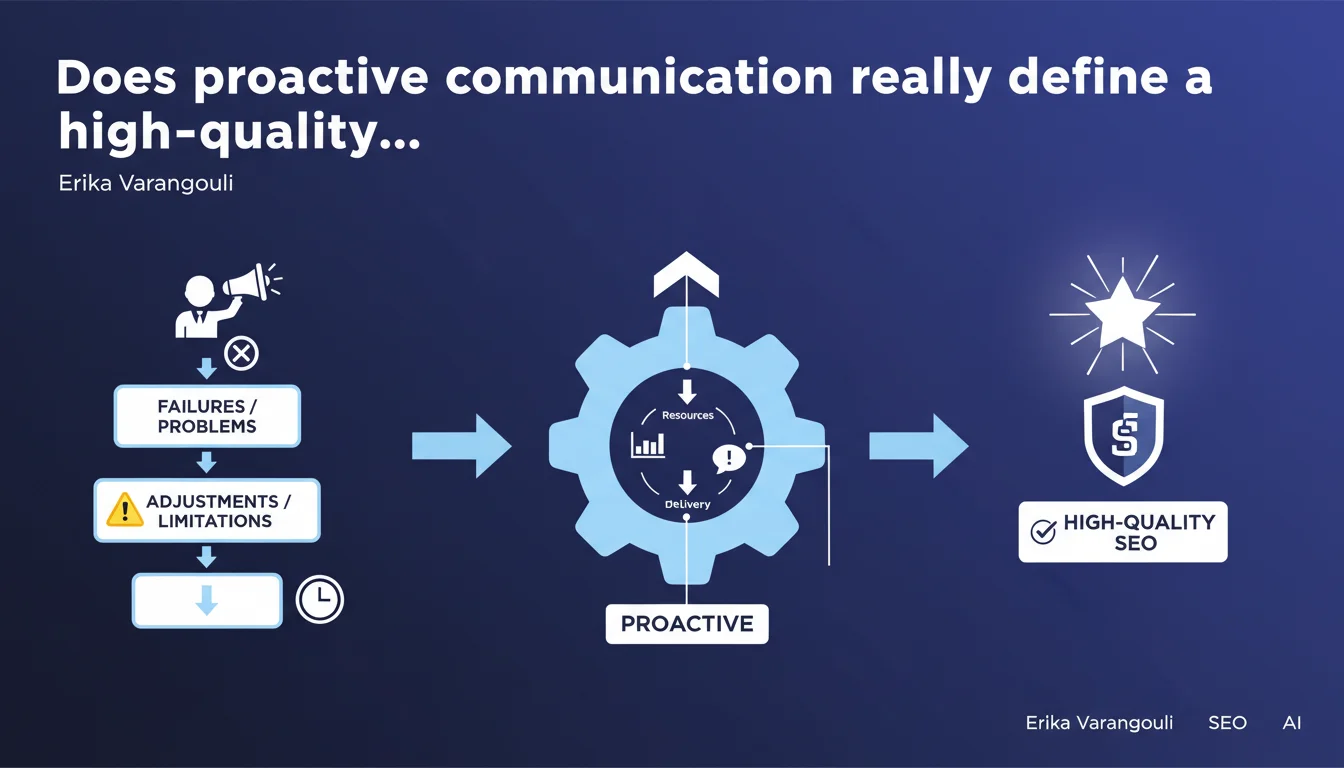
Google believes a good SEO must actively communicate about failures, necessary adjustments, and constraints encountered. Transparency about resource limitations and delivery challenges becomes a marker of professionalism, not a weakness to hide.
What you need to understand
Why is Google making a statement about SEO professionals' soft skills?
This position reflects a desire to professionalize the SEO industry. Google has observed questionable practices for years: unrealistic promises, sugar-coated reports, radio silence when things go wrong.
By valuing proactive communication, Google aims to raise standards. The underlying message? An SEO who anticipates, alerts, and adjusts is worth more than a magician who oversells and then disappears.
What does it concretely mean to be "proactive" according to this definition?
Proactivity extends beyond sending monthly reports. It means alerting before problems explode: "This migration risks breaking indexation if we don't have access to the CDN," "Crawl budget is saturated, we won't be able to index the 50,000 new pages planned."
Communicating failures is part of the package — saying "this content strategy didn't work, here's why and what we're testing now" rather than dressing up the numbers in a PowerPoint report.
Does this approach apply only to agencies or also to in-house SEOs?
Both. An in-house SEO must inform their management when dev resources are insufficient or when the editorial calendar is falling behind. An external consultant must frankly say when the initial brief is unrealistic.
The difference lies in context: in an agency, this transparency also serves to manage client expectations. In-house, it enables prioritization and securing necessary resources.
- Proactivity = communication before the problem becomes critical
- Transparency about failures and necessary adjustments
- Alert when resources (dev, content, budget) limit delivery
- Applicable to consultants, agencies, and in-house SEOs
- Objective: manage expectations and adjust strategy in real time
SEO Expert opinion
Does this statement reflect the reality of SEO work?
Yes, but with a significant caveat. In practice, proactive communication is indeed what distinguishes a senior SEO from an executor. Knowing how to say "no" or "not under these conditions" is a rare and valuable skill.
The problem? The commercial environment doesn't always reward this honesty. Clients compare quotes, management wants quick results. The SEO who says "this will take 12 months and we risk intermediate failures" loses to one who promises "page 1 in 3 months guaranteed." [To verify]: how many contracts are actually signed on the basis of this transparency rather than flattering promises?
What are the risks of poorly calibrated transparency?
Let's be honest: there's a delicate balance between transparency and anxiety-inducing over-communication. Alerting on every micro-technical issue can drown out real concerns and tire your contact.
Intelligent proactivity means prioritizing — flagging what structurally blocks the strategy, not every implementation detail. A client receiving 15 alerts per week will eventually read none of them.
Does this approach work in all client contexts?
No. Some clients interpret frankness as incompetence. "If you tell me it's complicated, you don't know how to do it." This attitude exists, especially among decision-makers unfamiliar with SEO.
In these cases, education becomes as important as proactivity. Explaining why a limitation exists, quantifying its impact, proposing an alternative — otherwise transparency backfires on the professional.
Practical impact and recommendations
How to structure effective proactive SEO communication?
Establish clear communication rituals: weekly check-ins on blockers, monthly reports with an "alerts and adjustments" section, immediate escalation if a critical element threatens the timeline.
Systematically document constraints encountered — a shared Notion, a dedicated Slack channel, whatever tool works. The key: information flows before problems impact results.
What mistakes should you avoid in managing expectations?
Never oversell during the sales phase what you can't deliver during execution. If the client brief includes 10,000 pages to optimize but you know their tech team processes only 50 tickets per month, say it during the audit.
Also avoid the "everything is fine" syndrome in reports while knowing the planned migration will cause problems. Transparency costs less than a crisis of confidence six months later.
How do you concretely announce a failure or delay?
Context, findings, consequence, correction. "We tested this internal linking approach (context), metrics haven't moved after 6 weeks (findings), crawl impact is zero (consequence), we're pivoting to a thematic silo structure (correction)."
Never bury a failure in technical jargon to hide it. Decision-makers aren't fooled — and if you lose their trust, no SEO skill will recover it.
- Establish regular communication points (weekly, monthly) with an "alerts" section
- Document blockers in real time — technical, editorial, or organizational
- Quantify the impact of constraints on objectives (timelines, expected results)
- Systematically propose an alternative or Plan B for each blocker
- Avoid commercial overselling — calibrate promises to real resources
- Announce failures with context, analysis, and adjustment plan
- Train stakeholders on SEO constraints to facilitate understanding
❓ Frequently Asked Questions
La proactivité dans la communication est-elle plus importante que les compétences techniques en SEO ?
Comment annoncer un échec SEO sans perdre la confiance du client ou de la direction ?
À quelle fréquence faut-il communiquer de manière proactive sur un projet SEO ?
Que faire si le client refuse d'entendre les alertes proactives sur les limites de ressources ?
La transparence sur les échecs peut-elle nuire à la réputation d'une agence SEO ?
🎥 From the same video 11
Other SEO insights extracted from this same Google Search Central video · published on 19/09/2024
🎥 Watch the full video on YouTube →
💬 Comments (0)
Be the first to comment.