
Official statement
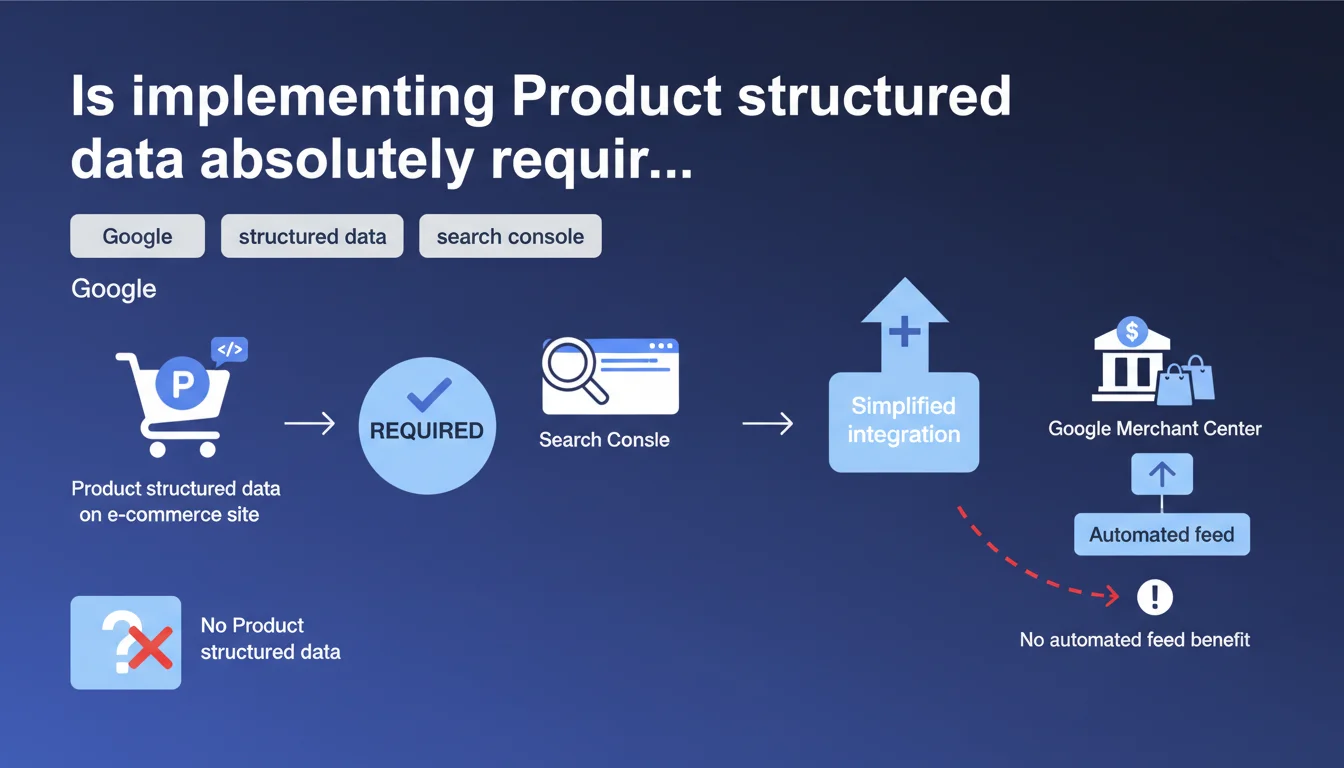
Google now mandates Product structured data as a mandatory requirement to use the automated feed in Merchant Center via Search Console. Without this implementation, you cannot benefit from the simplified integration — which forces e-commerce retailers to adopt semantic markup for their product sheets.
What you need to understand
What is the automated feed in Merchant Center and why does Google make it conditional on structured data?
The automated feed allows Merchant Center to automatically retrieve product information from your e-commerce site without you having to manually create and maintain an XML or CSV file. Google crawls your pages, extracts Product structured data, and feeds your Merchant Center catalog in real time.
By making this functionality conditional on the presence of Product structured data, Google simplifies its own extraction work while standardizing the e-commerce web. No more guessing where the price or availability is located — everything is tagged according to the Schema.org standard.
How does the integration via Search Console actually work?
Search Console plays the role of automatic gateway between your site and Merchant Center. Once your structured data is validated in the Rich Results Test tool and detected by Search Console, you can activate the automated feed directly from the Merchant Center interface.
This approach avoids time-consuming back-and-forth with manual feeds — but it requires rigorous technical implementation upfront. No valid Product markup? No access to the automated feed.
What are the essential elements to remember about this prerequisite?
- Technical requirement: Product structured data is no longer optional for e-commerce retailers who want to benefit from the automated feed.
- Expected format: Schema.org Product type, with at minimum name, image, price, availability and url.
- Validation required: Google verifies compliance via Search Console — markup errors block integration.
- Limited scope: this requirement only applies to the automated feed via Search Console, not other catalog submission methods (XML files, Content API).
- Indirect SEO impact: beyond Merchant Center, this structured data also feeds rich results in organic search.
SEO Expert opinion
Does this statement reflect a strategic shift by Google or just a technical prerequisite?
Let's be honest: Google has been heavily pushing structured data for several years, and this requirement fits into a web standardization logic. By making Product mandatory for the automated feed, Google forces e-commerce retailers to adopt markup they should have already implemented for other reasons (rich results, Google Shopping, etc.).
What's interesting — and where it gets sticky — is that Google doesn't communicate clearly on the quality thresholds expected. How many products must be marked up? What error rate is tolerated before the automated feed is disabled? [To verify] based on field feedback, as official documentation remains vague on these criteria.
Is Product structured data alone enough to guarantee visibility in Merchant Center?
No, and this is an essential distinction. Product markup is a technical prerequisite, not a guarantee of commercial performance. Even with perfect structured data, your products can be rejected for non-compliance with Merchant Center policies (inconsistent pricing, poor image quality, misleading descriptions).
Additionally, some report that the automated feed can be less responsive than manual XML file submission — especially for stock or price updates. If you manage a volatile catalog with flash promotions, the lag between Google's crawl and Merchant Center updates can be problematic.
In which cases does this rule not apply or can it be bypassed?
If you're already using an XML feed or Content API to feed Merchant Center, this requirement doesn't directly affect you. Structured data remains recommended for rich results, but it doesn't condition your catalog submission.
On the other hand — and this is a rarely mentioned point — some CMS or hosted e-commerce platforms (Shopify, WooCommerce, PrestaShop) automatically generate Product structured data. The problem is that these auto-generated implementations are sometimes incomplete or incorrect. Always verify manually rather than blindly trusting the plugin.
Practical impact and recommendations
What exactly must you do to comply with this prerequisite?
First step: audit your product pages and verify whether they already contain Product structured data. Use Google's Rich Results Test tool or an SEO crawler capable of detecting Schema.org markup.
If markup is missing or incomplete, implement it following the minimum properties expected: name, image, price, priceCurrency, availability, url. For optimal rich results, also add description, brand, sku, gtin (barcode), and aggregateRating if you collect customer reviews.
What errors should you avoid when implementing Product structured data?
The most common error? Inconsistency between visible content and structured markup. If your displayed price differs from the one declared in JSON-LD, Google can reject the page or penalize the automated feed.
Another pitfall: the availability markup. Don't declare "InStock" if the product is out of stock — Google compares with the page's visual signal and quickly detects divergences. Update this property dynamically based on your actual inventory.
Finally, avoid duplicate structured data (JSON-LD + microdata on the same page). Prefer JSON-LD in the <head> tag for better maintainability.
How do you verify that your site is compliant and the automated feed is working?
- Test your product pages with Google's Rich Results Test tool and fix all reported errors.
- Check the "Products" report in Search Console to identify pages with valid or problematic structured data.
- Connect Search Console to Merchant Center and enable the automated feed in the data feed settings.
- Monitor Merchant Center diagnostic reports to spot rejected products or crawl issues.
- Compare the number of marked-up products detected by Google with your actual catalog — a significant gap reveals exploration or markup problems.
- Verify the automated feed update frequency and test responsiveness after changing a price or stock level.
❓ Frequently Asked Questions
Puis-je utiliser Merchant Center sans données structurées Product ?
Les données structurées Product améliorent-elles le SEO au-delà de Merchant Center ?
Faut-il baliser tous les produits ou seulement une sélection ?
Que se passe-t-il si mes données structurées contiennent des erreurs ?
Le flux automatisé remplace-t-il définitivement l'envoi manuel de fichiers ?
🎥 From the same video 2
Other SEO insights extracted from this same Google Search Central video · published on 07/12/2022
🎥 Watch the full video on YouTube →
💬 Comments (0)
Be the first to comment.