
Official statement
What you need to understand
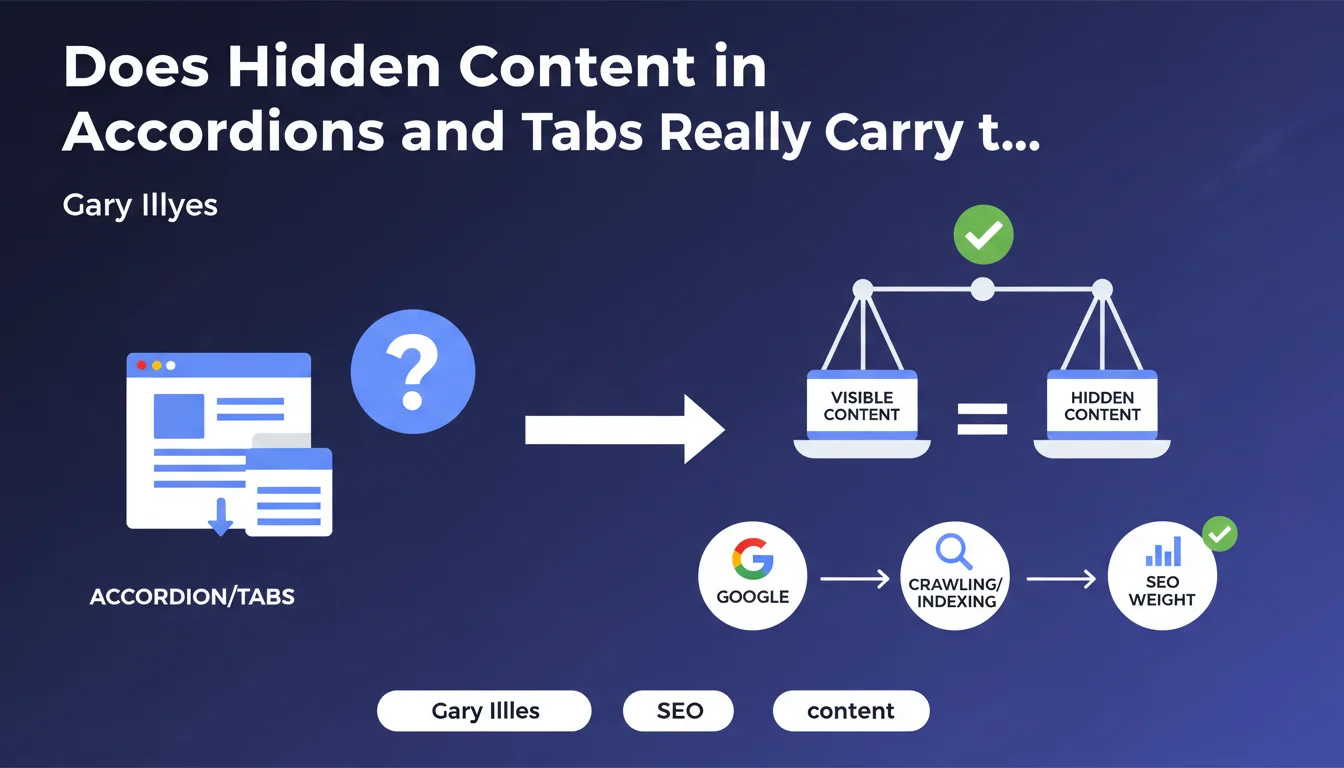
Google officially confirms that content hidden by default but accessible via user interaction (clicking on an accordion, changing tabs, dropdown menu) is fully indexed and valued in the same way as directly visible content.
This clarification is important because it dispels old SEO fears dating back to when Google penalized "text hiding" considered as a manipulation technique. Today, with the rise of responsive design and mobile interfaces, these interaction patterns have become the norm for improving user experience.
Concretely, this means you can organize your content ergonomically without fearing SEO devaluation. Accordion FAQs, tabbed sections, dropdown menus are all considered full-fledged content.
- Content in accordions has the same weight as immediately visible content
- Tabs and navigation tabs allow you to organize information without SEO penalty
- User experience takes priority: if hiding content improves UX, do it without fear
- JavaScript used for these interactions doesn't prevent content indexing
- Semantic HTML tags (details, summary) are fully recognized
SEO Expert opinion
This Google position is consistent with field observations over several years. Sites extensively using accordions to structure their long content (particularly e-commerce sites with detailed product descriptions) don't suffer any visible penalty.
However, an important nuance deserves to be highlighted: if content is technically present in the DOM but made invisible by CSS (display:none, visibility:hidden) without any planned interaction mechanism, Google might consider it differently. The key lies in legitimate UX intent.
Furthermore, in a context of voice search and featured snippets, content structured in questions-and-answers via accordions even presents an advantage, as it perfectly matches the formats favored by Google for rich snippets.
Practical impact and recommendations
- Freely use accordions to structure your long content, FAQs, detailed product descriptions without fear of penalty
- Prioritize semantic HTML5 tags like <details> and <summary> which are natively understood by Google
- Optimize mobile experience by intelligently hiding secondary sections in accordions to avoid endless scrolling
- Structure your FAQs with schema.org FAQPage even if they're in accordions, to maximize chances of getting rich snippets
- Avoid hidden content without UX reason: all hiding must serve user experience, not just SEO
- Test rendering with the inspection tool in Search Console to verify your accordion content is properly accessible to Googlebot
- Don't duplicate the same content in both visible and hidden: choose one or the other according to your ergonomic needs
- Organize your content by priority: even if everything has weight, visual hierarchy remains a relevance signal
💬 Comments (0)
Be the first to comment.