
Official statement
What you need to understand
What exactly does Google say about content plagiarism?
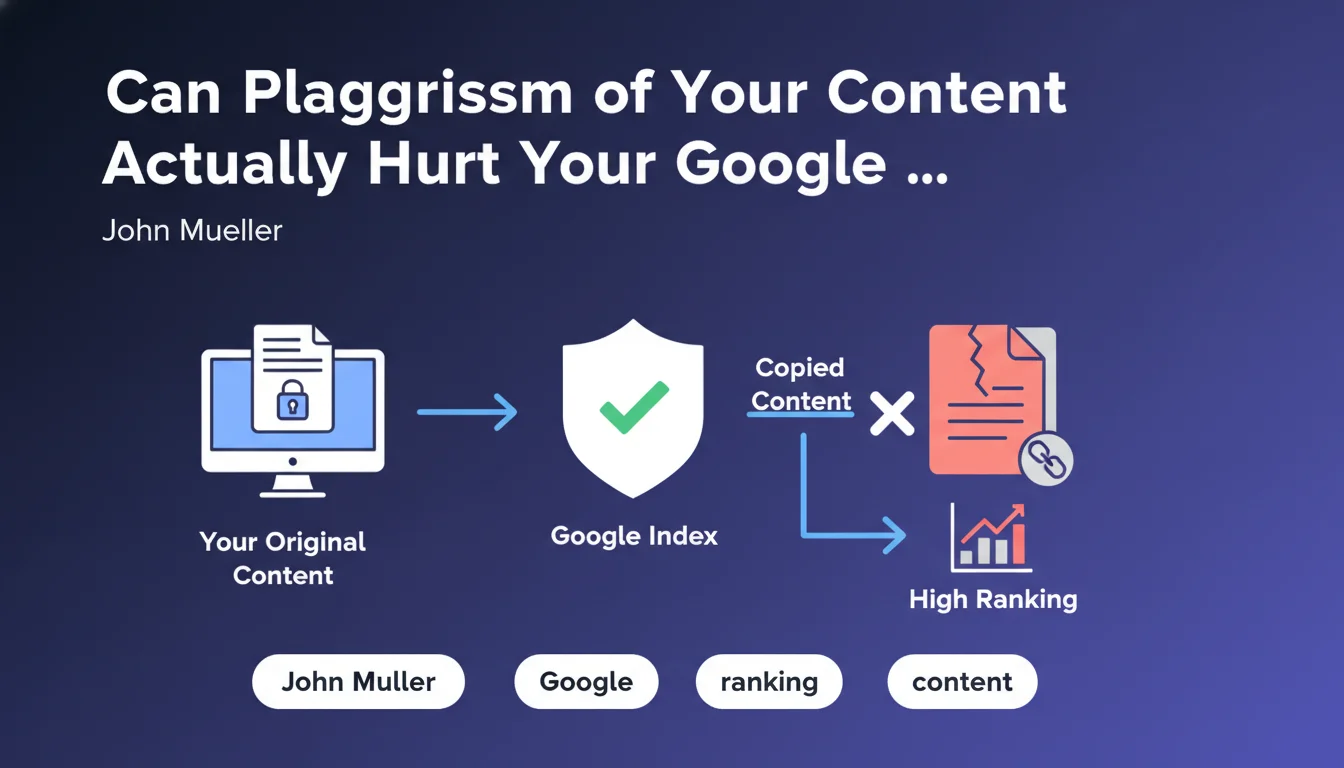
Google officially states that the fact that another site copies your content will not negatively affect your ranking in search results. This position aims to reassure original content creators.
The search engine considers that the original site should not be penalized by the malicious actions of a third party who would reproduce its content. In theory, Google has mechanisms to identify the original source.
How does duplicate content detection actually work?
Google uses an automatic canonicalization system to determine which version of duplicate content should be considered the reference. The search engine analyzes multiple signals to identify the original.
These signals include indexing date, domain authority, crawl frequency, and links pointing to each version. The site identified as canonical will be the one displayed in the results.
What are the real risks of external duplicate content?
The problem arises when Google makes a mistake in its analysis and attributes content authorship to the plagiarist rather than the original creator. This scenario, although rare, can have dramatic consequences.
- Loss of visibility if the plagiarist becomes the canonical version
- Traffic dilution across multiple versions of the same content
- Confusion for Google when attributing topical authority
- Increased risk for new sites with low domain authority
- Negative impact if the plagiarist has a stronger link profile
SEO Expert opinion
Does this statement actually align with what we observe in real-world practice?
In the majority of cases, Google does indeed manage to correctly identify the original content, especially for established sites with good authority. The official statement reflects the algorithm's standard behavior.
However, my 15 years of experience reveal situations where the system gets it wrong, particularly when a plagiarist has a highly authoritative domain or a better link profile. New sites are especially vulnerable to this phenomenon.
What crucial nuances need to be added to this statement?
Google's statement is true under ideal conditions, but several factors can compromise the recognition of the original. Publication and indexing timing plays a crucial role.
If the plagiarist gets the copied content indexed before Google crawls your version, you risk being considered the copier. Similarly, a site with a higher crawl budget will be indexed more quickly.
In which cases does this rule not completely apply?
Content aggregators and syndication sites pose a particular challenge. Even with permission, they can sometimes supplant the original if their authority is significantly higher.
E-commerce sites using standardized supplier descriptions are also in a gray area. Google may choose the most authoritative site as canonical rather than the one that published first.
Practical impact and recommendations
What should you actually do to protect your original content?
The first step is to actively monitor the use of your content on the web. Tools like Copyscape or Google Alerts can detect suspicious copies.
Make sure your content is crawled and indexed quickly after publication. Submit new URLs via Google Search Console and optimize your crawl budget for priority pages.
Systematically strengthen your domain authority and link profile. A site with strong authority will naturally be favored by Google in the canonicalization process.
How can you detect if you're suffering from canonicalization reversal?
Regularly search for exact phrases from your content in quotes on Google. If other sites appear before you, it's a warning signal.
Check in Google Search Console if certain pages display the message "Duplicate, page not selected as canonical". This indicates that Google has chosen another version as the reference.
- Set up Google Alerts to detect copies of your key content
- Use the URL Inspection tool in Search Console to verify canonicalization
- Immediately submit new content for rapid indexing
- Implement self-referencing canonical tags on all your pages
- Add unique identification elements (original quotes, proprietary examples)
- Document publication date with Article/NewsArticle structured data
- Continuously strengthen your backlink profile
What actions should you take if a plagiarist outranks you on Google?
Start by documenting the plagiarism with timestamped screenshots and evidence of your precedence (archives, publication histories). This documentation will be useful for any subsequent action.
Contact the plagiarist with a formal removal request or request to add a canonical link to your version. In about 30% of cases, this direct approach is sufficient to resolve the problem.
If that fails, use Google's DMCA form to report the copyright violation. Google may then deindex the copied content, but this procedure takes time and requires solid evidence.
💬 Comments (0)
Be the first to comment.