
Official statement
What you need to understand
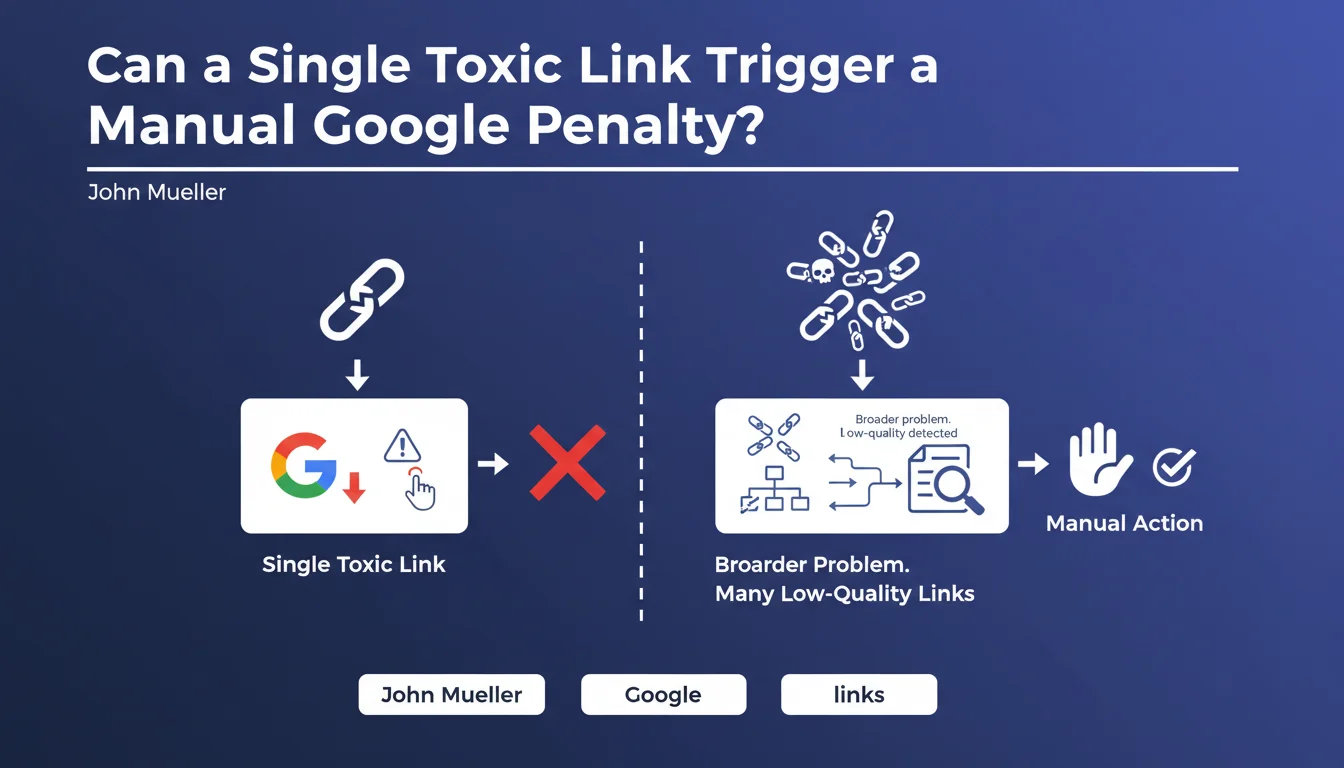
This statement from John Mueller provides an important clarification on how manual actions work at Google. Contrary to a common misconception, an isolated toxic link is not enough to trigger human intervention from the Search Quality Team.
For a manual action to be applied, Google must identify a systemic and repeated problem. The search engine needs to detect a significant volume of low-quality links pointing to a site, revealing a deliberate manipulation strategy rather than a one-off accident.
This distinction is crucial because it differentiates two types of penalties:
- Manual actions: decided by humans after review, require a massive pattern of toxic links
- Algorithmic filters (Penguin): automated, can react to smaller volumes of suspicious links
- Real impact: a quality site with an overall good link profile will withstand a few isolated problematic backlinks
- Global context: Google always evaluates the link profile as a whole, not link by link
This approach shows that Google favors a holistic vision of site quality rather than a punitive hunt for the slightest imperfections.
SEO Expert opinion
This Google position is totally consistent with what I've observed for years in the field. The manual actions I encounter with my clients systematically concern sites that have practiced massive link buying, large-scale comment spam, or participated in extensive PBN networks.
However, an important nuance must be made regarding algorithmic filters. While Penguin is now integrated in real-time into the main algorithm and works more through devaluation than brutal penalty, a site can still see certain pages lose visibility if their link profile is questionable. It's not a penalty in the strict sense, but the effect remains perceptible on traffic.
My main recommendation therefore remains the proactive building of a healthy link profile rather than obsessive monitoring of every suspicious backlink. The energy spent disavowing isolated links is often disproportionate to the actual risk incurred.
Practical impact and recommendations
- Don't panic over an isolated toxic link: a sporadic dubious backlink generally doesn't warrant immediate disavowal
- Audit your link profile globally: analyze trends and patterns rather than each link individually
- Prioritize building positive links: create remarkable content that naturally attracts quality backlinks
- Only intervene on systemic problems: if you detect a massive spam pattern or dozens of links from suspicious networks, then use the disavow file
- Monitor Search Console: manual actions are always notified, you can't miss them
- Document your link building campaigns: keep track of your actions to quickly identify potential providers who may have generated problematic links
- Diversify your backlink sources: a natural profile includes links of different types, qualities and sources
- Invest in premium content: resources that spontaneously generate natural editorial links are your best protection
Strategic management of a backlink profile requires sharp technical expertise and constant monitoring of algorithmic evolutions. Between semantic analysis of anchors, evaluation of the relative toxicity of referring domains, and optimization of the dofollow/nofollow ratio, there are many parameters to master.
For businesses that want to sustainably secure their organic visibility without mobilizing considerable internal resources, support from a specialized SEO agency provides a methodical approach, professional backlink analysis tools, and a link building strategy tailored to your sector and business objectives.
💬 Comments (0)
Be the first to comment.