
Official statement
What you need to understand
What does the absence of a "toxic flag" at Google actually mean?
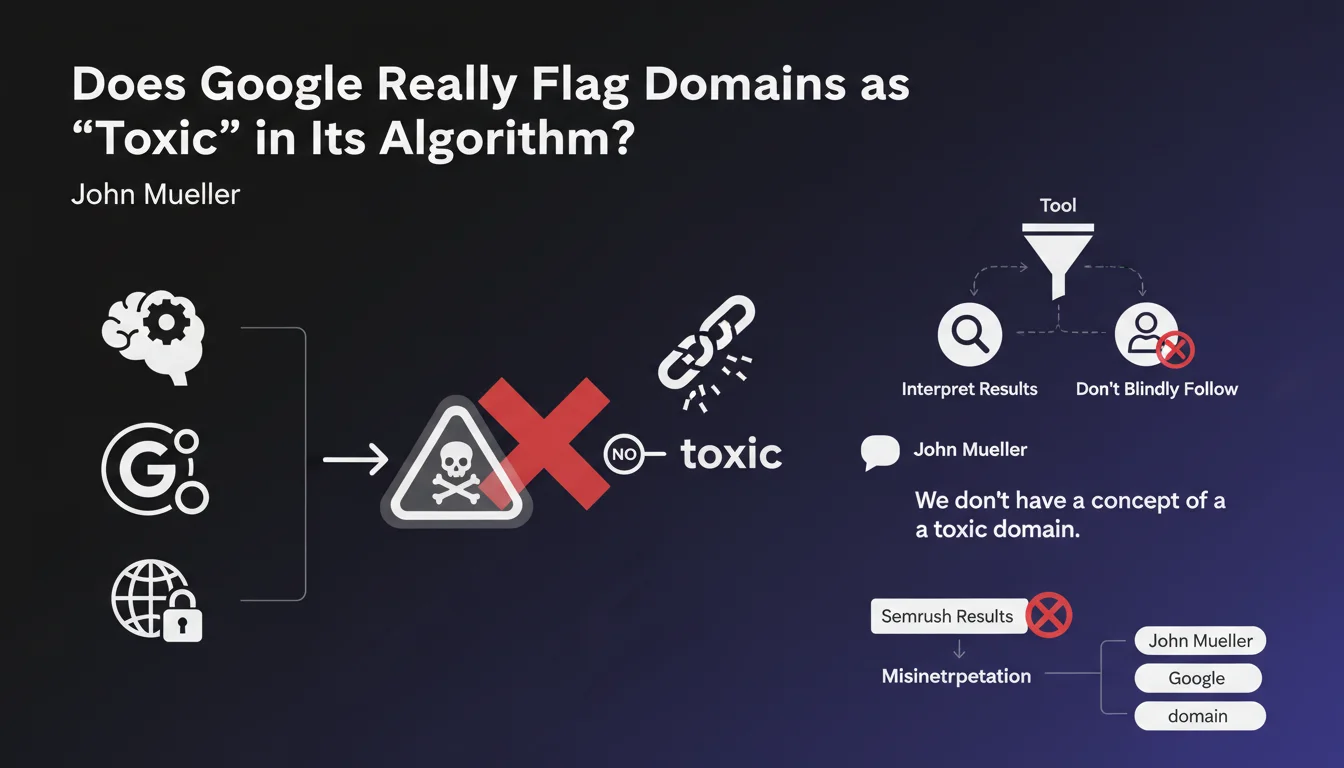
John Mueller clearly states that Google doesn't mark any domain as toxic in its system. This declaration challenges a widely held belief in the SEO industry.
Contrary to what some third-party tools suggest, there is no blacklist of domains at Google. The search engine instead evaluates each link individually, based on its context and quality.
Why do SEO tools talk about "toxicity" then?
Tools like Semrush, Ahrefs, or Moz have created their own proprietary metrics to assess backlink quality. These toxicity scores are algorithmic interpretations, not official Google data.
These tools use signals like spam score, domain age, or suspicious link patterns. While useful, these metrics don't necessarily reflect Google's actual perspective.
How does Google handle poor-quality links?
Google has significantly improved its ability to automatically ignore artificial or low-quality links. The engine no longer systematically penalizes for questionable backlinks.
The algorithm has become sophisticated enough to disregard problematic links without negative impact on your rankings. Only extreme cases of massive manipulation can still trigger manual actions.
- No domain is flagged as toxic in Google's algorithm
- Toxicity scores are third-party tool creations, not official metrics
- Google now ignores the majority of bad links rather than penalizing
- Manual penalties for backlinks remain rare and concern massive manipulations
- Interpreting SEO tool data requires expertise and discernment
SEO Expert opinion
Is this statement consistent with real-world observations?
Absolutely. Since Penguin's evolution in 2016 into a real-time system integrated into the algorithm, we've indeed observed a much more nuanced approach. Massive penalties for backlinks have virtually disappeared.
Documented cases of recovery after link profile cleanup have become rare. This confirms that Google devalues rather than penalizes. The energy spent on link disavowal is often disproportionate to actual gains.
What important nuances should be added to this statement?
While Google doesn't have a "toxic domain" flag, it certainly has quality signals per domain. A site with a massive spam history simply won't have any PageRank transmission value.
The distinction is subtle but crucial: a link from a bad domain won't penalize you, but it won't bring you anything whatsoever either. The real risk concerns massive artificial link networks that can still trigger manual actions.
When should you still monitor your link profile?
When purchasing an expired domain or acquiring a company, the domain's history deserves examination. If the domain was used for spam, even without an active penalty, its ability to rank may be permanently compromised.
Massive negative SEO attacks remain possible, though rare. If you suddenly receive thousands of links from adult or obvious spam sites, monitoring is necessary. Google should ignore them, but reporting via the disavow file remains a reasonable precaution.
Practical impact and recommendations
What should you actually do with "toxicity" reports?
Stop systematically panicking at a high toxicity score in your tools. First analyze whether these links come from voluntary action on your part or are natural/negative.
Focus only on artificial links you've created as part of questionable link building strategies. For negative links received passively, action is generally unnecessary.
- Don't blindly follow automatic recommendations from disavow tools
- Manually analyze referring domains before any cleanup action
- Prioritize acquiring good links over obsessive cleanup
- Use the disavow file only for massive artificial links you created
- Document your link profile in case of future manual action
What common mistakes should you absolutely avoid?
The main mistake is massively disavowing domains simply because a tool flags them. Some SEOs have disavowed hundreds of legitimate domains, thus losing valuable traffic sources.
Also avoid wasting time on time-consuming backlink audits when your resources would be better invested in creating quality content and natural link acquisition.
Don't confuse correlation and causation: a traffic drop coinciding with bad backlinks doesn't necessarily mean they're the cause. Core updates or technical issues are often the real culprits.
How do you build a healthy and sustainable link building strategy?
Focus on acquiring natural editorial links from thematically relevant sites. Quality and contextualization now far outweigh quantity.
Diversify your link sources and favor domains with real audience and editorial authority. A single link from a recognized media outlet is worth more than a hundred links from obscure directories.
In summary: Google has no concept of a toxic domain and automatically ignores most bad links. Your energy should focus on acquiring quality links rather than obsessive profile cleanup.
Strategic management of a healthy backlink profile requires expertise and discernment to correctly interpret signals. These optimizations requiring fine analysis and an overall vision of your SEO ecosystem, support from a specialized SEO agency can prove valuable for developing a truly high-performing and sustainable link building strategy, tailored to your sector and specific objectives.
💬 Comments (0)
Be the first to comment.