
Official statement
What you need to understand
What had Google initially planned with this badge?
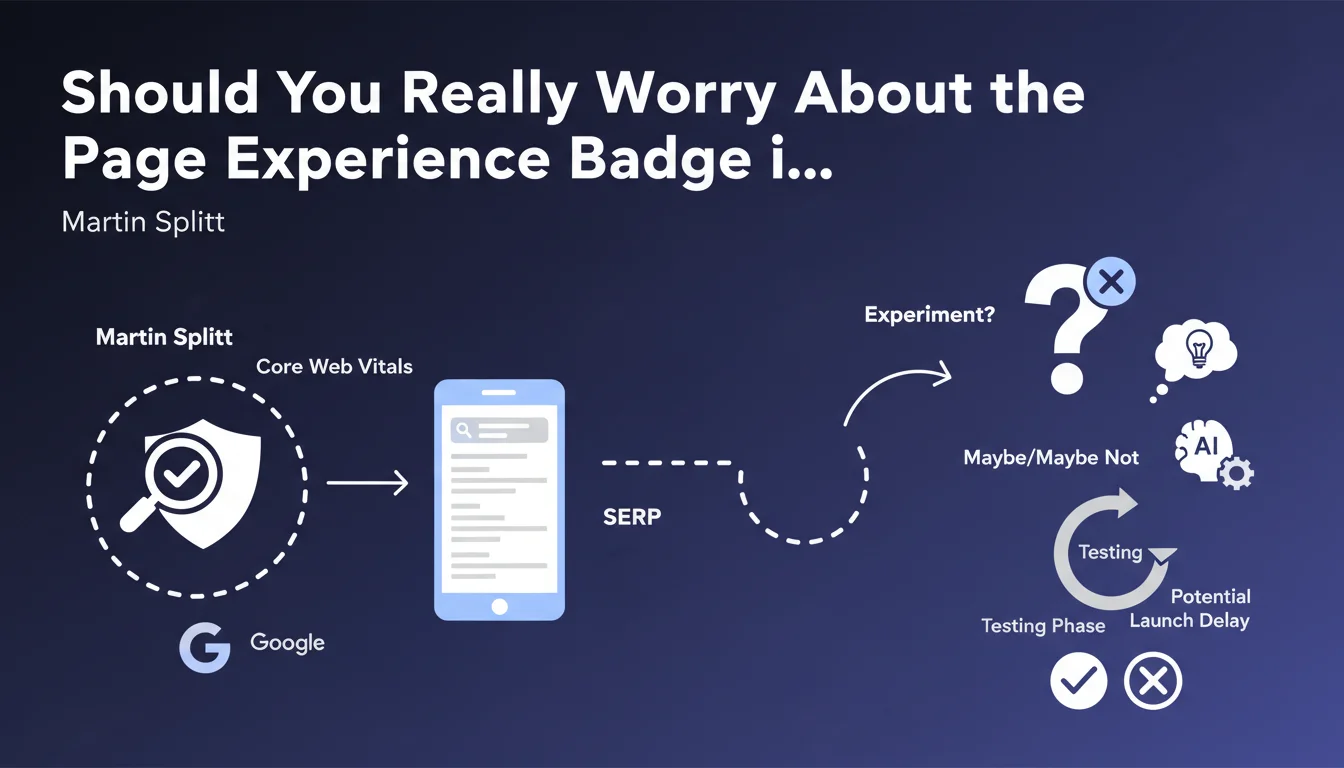
Google had announced its intention to display a visual indicator in search results to identify pages offering a good user experience. This badge was meant to accompany the rollout of the Page Experience update and Core Web Vitals, initially scheduled for May 2021.
The goal was to visually signal to users which sites met the criteria for performance, interactivity, and visual stability. This initiative was part of Google's commitment to promote sites offering smooth and pleasant navigation.
Why did Martin Splitt call this feature into question?
Martin Splitt clarified on Twitter that this visual badge was ultimately just an experiment. Google had not yet made a final decision regarding its deployment in the SERPs.
This statement surprised many SEO professionals who considered this indicator a done deal. It serves as a reminder that Google constantly tests new features without guaranteeing final implementation.
What are the implications of this uncertainty for SEO?
Even if the badge might not materialize, Core Web Vitals and Page Experience remain confirmed ranking factors. The absence of a visual indicator doesn't diminish the importance of optimizing these technical aspects.
- The badge was an experiment, not a guaranteed feature
- Google has abandoned similar visual indicators in the past (mobile-friendly badge)
- Core Web Vitals remain an official ranking factor
- User experience remains a priority regardless of visual signage
- This situation illustrates Google's iterative strategy for SERP innovation
SEO Expert opinion
Is this about-face consistent with Google's historical behavior?
Absolutely. Google has a long history of abandoned experiments concerning visual indicators in the SERPs. The "mobile-friendly" badge is the perfect example: displayed for some time, it then disappeared once mobile optimization became the norm.
This approach reveals a deliberate strategy: Google uses these temporary indicators as adoption levers. Once the majority of sites comply with the recommendations, the indicator loses its differentiating utility and can be removed.
What important nuances should be brought to this statement?
The potential abandonment of the badge absolutely does not mean that Page Experience is less important. On the contrary, it may indicate that Google considers it so fundamental that it doesn't require special signaling.
Two aspects must be clearly distinguished: visual communication (the badge) and the ranking factor (Page Experience). The former is incidental, the latter is structural and confirmed. Neglecting optimization on the grounds that the badge doesn't exist would be a major strategic error.
In what strategic context should this announcement be interpreted?
This statement occurs during a transition phase where Google is testing different approaches to encourage webmasters to improve performance. The Mountain View giant is probably observing adoption rates before deciding whether visual reinforcement is necessary.
For SEO professionals, this confirms that the focus should be on technical fundamentals rather than cosmetic elements. Optimization should be motivated by genuine improvement of user experience, not by the pursuit of a badge.
Practical impact and recommendations
What should you concretely do in the face of this uncertainty?
Your strategy should not change one iota following this announcement. Core Web Vitals remain an official ranking factor, and user experience directly impacts your conversion rates and engagement.
Continue optimizing Largest Contentful Paint (LCP), First Input Delay (FID), and Cumulative Layout Shift (CLS). These metrics reflect real user experience issues, regardless of any signage in search results.
Focus on tangible benefits: reduced bounce rate, improved time on site, increased conversions. These business metrics justify the investment in performance well beyond simple SEO.
What strategic mistakes should you absolutely avoid?
Don't postpone your optimizations while waiting to see whether the badge will be deployed or not. This wait-and-see approach would waste precious time and a potential competitive advantage.
Don't optimize solely to satisfy an algorithm or obtain a badge. Work on a real and measurable improvement of user experience, which will benefit your visitors regardless of SERP evolution.
Avoid focusing exclusively on Core Web Vitals thresholds while neglecting other crucial aspects like content quality, semantic relevance, or information architecture.
How can you verify and maintain your site's performance?
- Regularly audit your Core Web Vitals via Google Search Console and PageSpeed Insights
- Install continuous monitoring tools like Lighthouse CI or RUM (Real User Monitoring) solutions
- Optimize image loading with modern formats (WebP, AVIF) and lazy loading
- Implement a high-performance CDN to reduce server response times
- Minimize and defer non-critical JavaScript to improve FID
- Stabilize your layout by defining explicit dimensions for images and iframes
- Test regularly on various connections and devices to identify regressions
- Document your optimizations and measure their impact on business metrics
💬 Comments (0)
Be the first to comment.