
Official statement
What you need to understand
What is the fundamental difference between a 404 and a 410 status code?
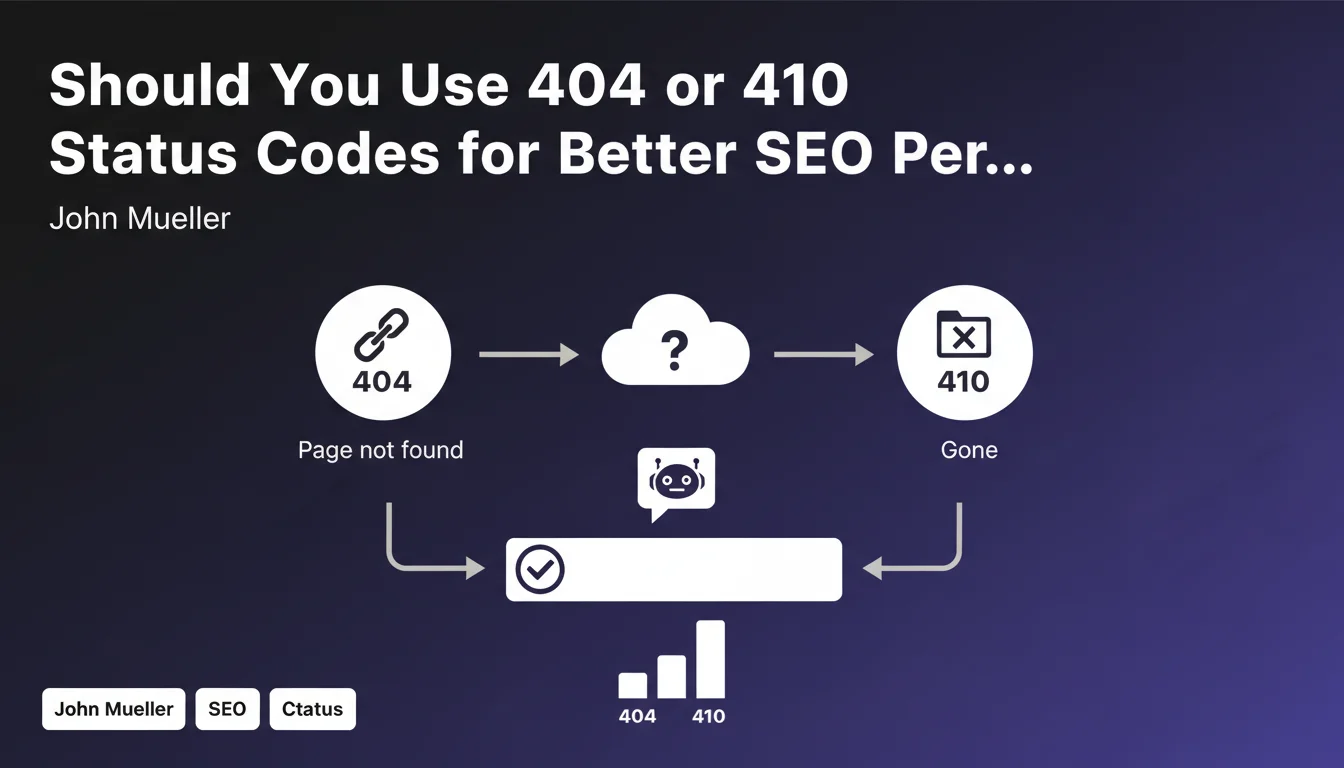
The HTTP 404 status code means "Not Found" and indicates that a page doesn't currently exist, but could potentially reappear. It's the most common error code.
The HTTP 410 status code means "Gone" and communicates more definitive information: the resource has been permanently deleted and will never return. This technical nuance is rarely exploited by webmasters.
Why does Google Search Console treat these two codes the same way?
Currently, Search Console doesn't differentiate between these two codes in its error reports. Google groups these errors under the generic "404" label.
John Mueller from Google acknowledges that a distinction could be added, but questions the real practical utility of this feature for webmasters. Cases where this differentiation would provide genuine added value are considered marginal.
What are the key takeaways from this statement?
- Google technically differentiates between 404 and 410 during crawling, even if Search Console doesn't reflect it
- Both codes tell Google to progressively deindex the affected URLs
- The 410 code can slightly accelerate deindexing, but the impact remains marginal
- A Search Console evolution could distinguish these codes, but it's not a priority for Google
- The multiplication of message types in Search Console is not considered relevant by Google
SEO Expert opinion
Is Google's position consistent with practices observed in the field?
Yes, this statement perfectly reflects what SEO experts have observed for years. In practice, the difference in treatment between 404 and 410 by Google is minimal and doesn't justify particular efforts in most cases.
Tests show that URLs with 410 are indeed deindexed slightly faster, but we're talking about a difference of a few days to a few weeks at most. For a site with normal error management, this gap has no measurable impact on performance.
In which specific cases does the 410 code present a real advantage?
The 410 code becomes relevant in very specific situations. For example, during massive deletion of obsolete or duplicate content, particularly after an SEO audit revealing thousands of low-quality pages.
It's also useful for e-commerce sites that permanently remove products (end of life, product recall, discontinuation). In these cases, the 410 clearly communicates the intention of permanent deletion and can accelerate index cleanup.
What are the limitations of Google's minimalist approach?
While Google's pragmatic position is understandable, it can frustrate advanced technical SEOs who want granular control over crawling and indexing. Better distinction in Search Console would allow identification of finer error patterns.
For example, differentiating voluntary 410s (intentional deletions) from accidental 404s (configuration errors) would facilitate technical problem diagnosis. But Google clearly prefers simplicity to data comprehensiveness.
Practical impact and recommendations
What should you actually do with 404 and 410 status codes?
For daily management of your site, continue using the 404 code as the default code for pages not found. It's the web standard and works perfectly.
Reserve the 410 code only for massive and permanent deletions of content, when you want to accelerate the deindexing process. For example: closing an entire site section, deleting thousands of obsolete product pages.
Don't waste time analyzing in Search Console whether an error is a 404 or 410. Instead, focus on identifying and fixing important errors: broken internal links, missing redirects on pages with traffic or backlinks.
What errors should you absolutely avoid in status code management?
The most common mistake is returning a 200 (OK) status code on a custom error page. This practice creates "soft 404s" that pollute Google's index with useless pages.
Another trap: using the 410 code by default for all deleted pages without thinking. You could slow down reindexing if you reactivate certain seasonal or temporary content.
Finally, don't neglect 301 redirects. When a page is deleted but a relevant alternative exists, a redirect is always preferable to an error code, whether 404 or 410.
How can you audit and optimize error management on your site?
- Configure your server correctly to return real 404 codes (no soft 404s)
- Create a custom 404 page with navigation and suggestions to retain visitors
- Regularly monitor the "Coverage" report in Search Console
- Identify error pages that still receive backlinks or traffic
- Implement 301 redirects to relevant content when possible
- Use the 410 code only for massive and permanent deletions
- Document your error management strategy to maintain consistency over time
- Audit your internal links to avoid pointing to error pages
The distinction between 404 and 410 status codes has little practical impact for most sites. The 404 remains the recommended default code, while the 410 is reserved for specific cases of permanent deletion.
The essential element lies in clean error management: avoiding soft 404s, creating useful error pages, fixing broken links, and redirecting intelligently when relevant.
These technical optimizations, though conceptually simple, require detailed analysis of your architecture and rigorous implementation. For complex sites or during major redesigns, support from a specialized SEO agency helps avoid costly mistakes and implement an error management strategy tailored to your specific challenges.
💬 Comments (0)
Be the first to comment.