
Official statement
What you need to understand
What's the Difference Between Authority and Popularity According to Google?
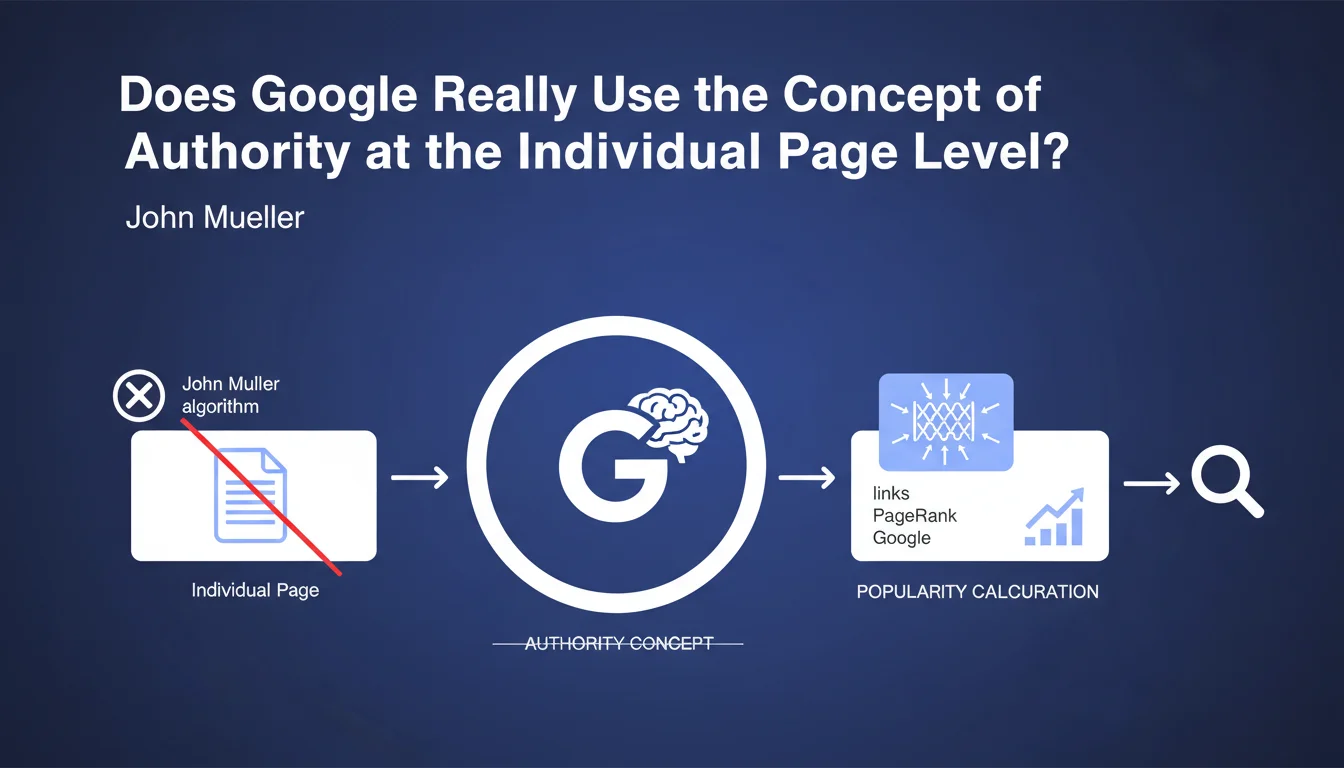
John Mueller clarified on Twitter a frequent confusion in the SEO world: Google's relevance algorithm does not measure authority at the individual page level. This distinction is fundamental to understanding how the search engine works.
The popularity of a page is indeed measured, through the inbound links it receives. This concept translates into the famous PageRank, which evaluates the quality and quantity of backlinks pointing to a specific URL.
At What Level Does Google Actually Measure Authority?
Contrary to what many think, authority according to Google applies at the level of the website as a whole, not to each page individually. It's a global notion that reflects the credibility and expertise of an entire domain.
It's crucial not to confuse this notion with third-party metrics like Moz's Domain Authority, which are external approximations having no direct connection with Google's internal calculations.
Why Is This Distinction Important for SEO?
This clarification directly impacts how you should plan your search engine optimization strategy. A page can very well be popular (thanks to its backlinks) without the site having high overall authority, and vice versa.
- Authority is a domain-level concept, not at the individual page level
- A page's popularity is measured via PageRank based on inbound links
- Third-party metrics like Domain Authority don't reflect Google's internal calculations
- Google has never detailed precisely how a site's authority is calculated
- A page can rank thanks to its own popularity even on a site with moderate authority
SEO Expert opinion
Is This Statement Consistent with What SEOs Observe in the Field?
As an expert, I find that this statement from John Mueller aligns perfectly with ranking patterns observed for years. Many pages from moderately recognized sites manage to position themselves on the first page thanks to a targeted and qualitative link building strategy.
However, a domain's overall authority remains a powerful indirect factor. A site recognized in its field benefits from a "halo effect" that facilitates quick indexing and initial positioning of its new pages, even without immediate backlinks.
What Nuances Should Absolutely Be Added to This Statement?
The reality is more complex than a simple authority/popularity dichotomy. Google uses expertise and trust signals (E-E-A-T) that are evaluated at different levels: author, page, site section, and global domain.
For sensitive topics (YMYL - Your Money Your Life), the domain's authority in its field weighs enormously. A medical page on a recognized medical authority site will have much more ease ranking than a similar page on a general blog, even if well-linked.
In Which Cases Does This Rule Seem to Apply Less?
Competitive informational queries show that certain historic and recognized domains massively occupy the SERPs, even with recent and poorly linked pages. This suggests that a global thematic authority factor does indeed play a role.
Similarly, during Core Updates algorithm updates, we regularly observe massive fluctuations affecting entire sites, not just isolated pages. This confirms that Google does indeed evaluate quality and reliability at the domain level.
Practical impact and recommendations
How Should You Concretely Adapt Your SEO Strategy After This Clarification?
This authority/popularity distinction should lead you to adopt a two-level approach. On one side, work on the popularity of your strategic pages through targeted backlinks. On the other, methodically build your domain's overall authority.
For your priority pages, focus on acquiring quality links from thematically relevant sites. It's the page's PageRank that will make the immediate difference in competitive SERPs.
For the domain's overall authority, focus on producing expert content demonstrating your thematic competence, brand mentions, linkless citations, and recognition by reference players in your sector.
What Major Mistakes Should You Absolutely Avoid?
Don't fall into the trap of focusing only on third-party metrics like Moz's Domain Authority or Ahrefs' Domain Rating. These indicators are useful for relatively comparing sites, but don't reflect Google's internal calculations.
Also avoid neglecting page-level popularity thinking your domain's authority will suffice. Even an authority site needs backlinks to its individual pages to rank on competitive queries.
Beware of massive domain-level link strategies without a per-page strategy. The intelligent distribution of your link building budget between strategic pages and overall authority is crucial.
What Should You Regularly Check and Measure on Your Site?
- Analyze the backlink distribution among your pages: identify those lacking popularity despite their potential
- Monitor your domain's E-E-A-T signals: expert mentions, citations, industry recognition
- Measure the performance of new pages: an authority site sees its fresh content index and rank more quickly
- Evaluate your site's thematic consistency: authority is built on clear and recognized expertise
- Compare your link profile with direct competitors at both page and domain level
- Identify your link-orphaned pages that could perform with a targeted link building strategy
- Verify that your content demonstrates expertise and credibility with sources, identified authors, and proof of competence
💬 Comments (0)
Be the first to comment.