
Official statement
What you need to understand
Why Does Keyword Positioning Still Matter in 2024?
Contrary to some misconceptions, keyword placement in long-form content hasn't become obsolete with Google's semantic algorithms. In text spanning several thousand words, the search engine relies on strategic zones to quickly identify the main topic.
Google uses hierarchical signals to understand a page's structure and theme. Hot zones allow the engine to analyze content efficiently without treating every word with equal importance.
Which Priority Zones Has Google Actually Identified?
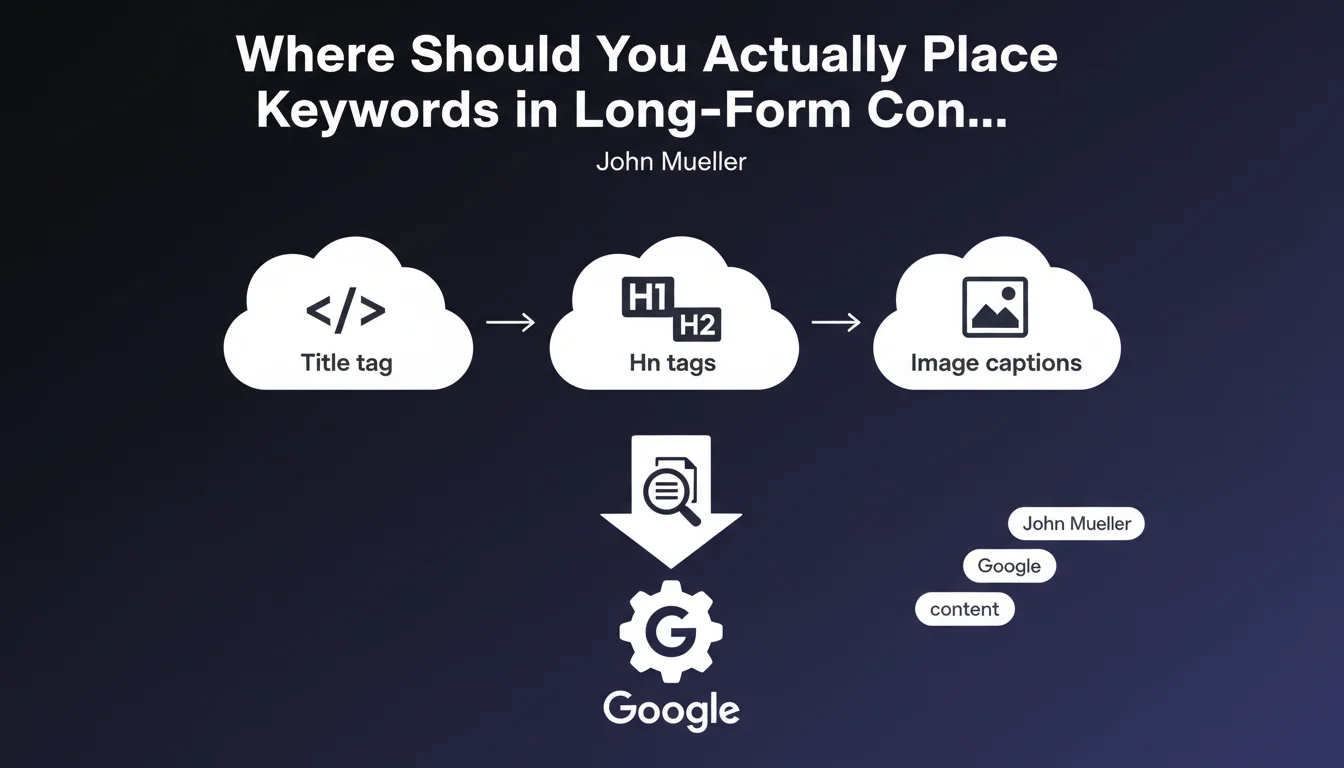
John Mueller clearly identified three privileged placements: the Title tag, Hn tags (hierarchical headings), and image captions. These zones function as semantic markers for the search engine.
The mention of image captions is particularly interesting because it confirms that Google pays specific attention to alt attributes and figcaption tags, often neglected by content writers.
- The Title remains the strongest signal for indicating the main topic
- Hn tags hierarchically structure the concepts addressed
- Image captions constitute semantic zones exploited by Google
- In long-form content, these zones enable rapid understanding of the subject
- Placing keywords only at the end of text dilutes their perceived importance
How Does Google Interpret Poorly Structured Content?
A 20,000-word text without clear structure represents an analytical challenge for Google. If your primary keywords only appear in the conclusion, the engine might misinterpret your priority theme.
The algorithms use hot zones as semantic anchor points. Well-structured content facilitates indexing and improves positioning accuracy for targeted queries.
SEO Expert opinion
Does This Recommendation Align with Real-World Observations?
After 15 years of SEO experience, I can confirm that this statement perfectly reflects empirical observations. A/B tests on long-form content consistently show that optimizing the Title and Hn tags significantly improves rankings.
The mention of image captions is particularly relevant. Our audits reveal that sites properly optimizing their alt attributes and figcaption tags benefit from better contextual understanding by Google, especially for multimedia queries.
What Nuances Should We Add to This Statement?
Be careful not to fall into over-optimization of these zones. Mechanically repeating your keywords in every Hn tag or image caption will create a counterproductive effect, perceived as keyword stuffing.
Contextual quality trumps quantity. A well-integrated keyword in a relevant H2 is worth more than five forced repetitions in artificial headings.
When Does This Rule Need Adjustments?
For highly technical or scientific content, precise terminology sometimes must appear gradually after contextual explanations. In these cases, prioritize a clear introduction in the Title and H1, even if detailed development comes later.
Narrative content (case studies, storytelling) may also require a different approach where the primary keyword emerges naturally from the narrative, while still remaining present in structural tags.
Practical impact and recommendations
How Can You Concretely Optimize These Hot Zones?
Start with an audit of your existing long-form content. Identify pieces exceeding 3,000 words and verify whether your primary keywords appear in the Title, at least two Hn tags, and in relevant image captions.
For each new long-form piece, create your Hn structure before writing. This approach guarantees natural distribution of your key concepts in strategic zones.
Regarding images, don't limit yourself to the alt attribute. Use the <figcaption> tag to create visible captions that enrich the semantic context for Google and improve user experience.
What Mistakes Should You Absolutely Avoid?
Never overload your hot zones with exact variations of the same keyword. Google favors semantic diversity and penalizes overly obvious manipulative practices.
Avoid Hn tags optimized solely for search engines. Your headings must remain understandable and attractive to human readers, who represent your final audience.
Remember that image captions must provide genuine informational value. A generic caption stuffed with keywords without useful context will be counterproductive.
- Audit your long-form content to verify keyword presence in hot zones
- Create your Hn structure before writing to ensure semantic coherence
- Optimize your Title tags by including the primary keyword near the beginning
- Use natural semantic variations in your different Hn tags
- Add descriptive captions to your images with figcaption tags
- Systematically fill alt attributes with contextual descriptions
- Verify that your primary keywords appear in the first 200 words
- Review your hot zones to eliminate any blatant over-optimization
- Test the readability of your Hn tags: they should function as a standalone summary
How Can You Measure the Effectiveness of These Optimizations?
Track the evolution of your positions on targeted keywords after optimizing hot zones. Use Google Search Console to identify whether your pages are climbing for primary queries.
Also analyze Featured Snippets: well-structured content with optimized Hn tags has better chances of being extracted for these privileged positions.
💬 Comments (0)
Be the first to comment.