
Official statement
What you need to understand
What Is the PRG Pattern and How Does It Work Technically?
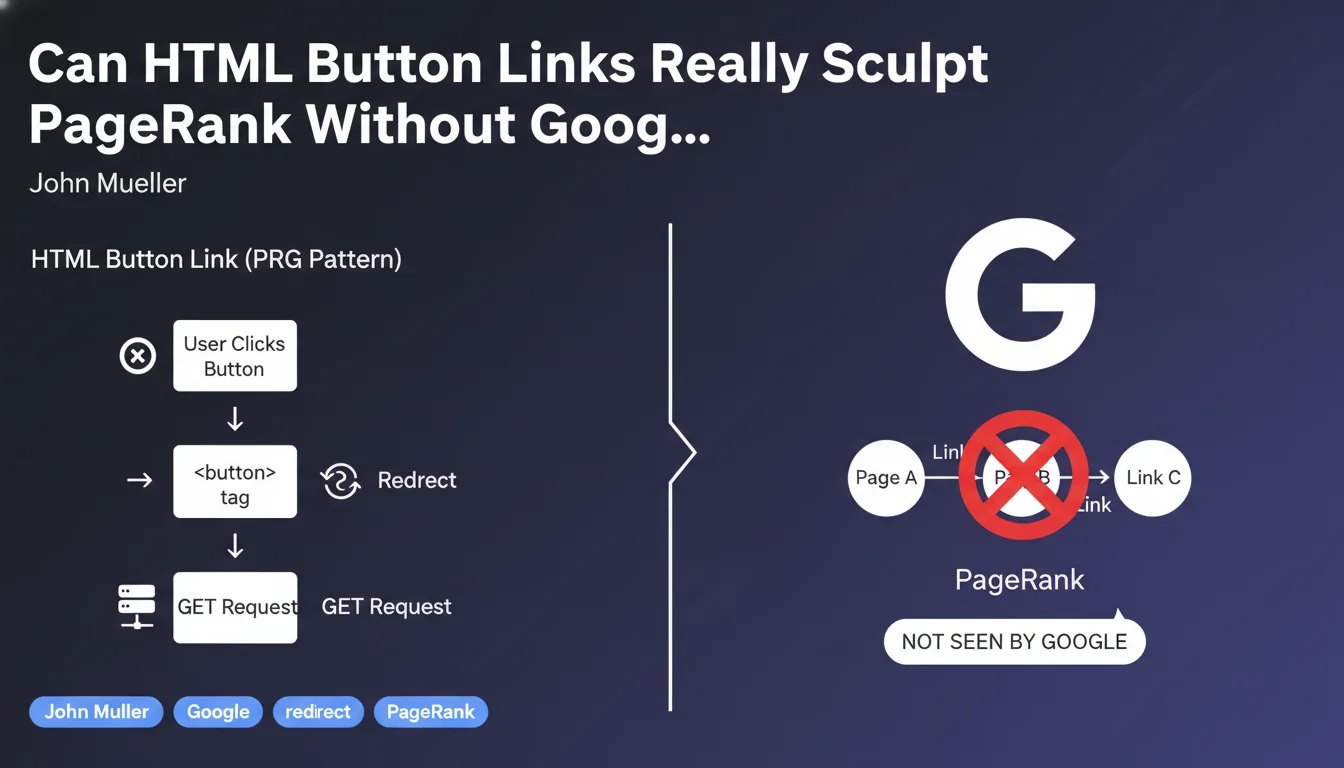
The PRG Pattern (Post/Redirect/Get) is a technique using HTML buttons to create links that are not directly visible in the source code as classic <a href> tags. When a user clicks on a button, a POST request is sent to the server, which then performs a GET redirect to the target page.
This technical approach generates links undetectable by Google's crawlers since they generally don't follow POST forms. The objective is to create functional navigation for users while remaining invisible to indexing bots.
Why Is This Technique Used for PageRank Sculpting?
PageRank Sculpting consists of controlling the distribution of link juice across a website. By hiding certain links from bots, SEOs attempt to concentrate PageRank on strategic pages rather than diluting it across the entire internal linking structure.
This practice aims to optimize link architecture to favor the ranking of priority pages. HTML buttons offer an alternative to nofollow links, which have lost their effectiveness for this strategy since Google modified their treatment.
What Is Google's Official Position on These Hidden Links?
John Mueller explicitly confirmed that Google does not see and does not take into account these links implemented via HTML buttons with the PRG pattern. This statement validates the technical effectiveness of this method for hiding links from crawlers.
However, this confirmation comes with uncertainty about the sustainability of this approach. Google could eventually decide to detect and treat these links differently, especially if their usage becomes massive and problematic.
- Links via HTML POST buttons are currently not crawled by Google
- This technique allows hiding internal linking structure links from bots
- The objective is to control PageRank distribution across the site
- Google could modify its algorithm if this practice becomes abusive
- It is a form of link obfuscation that is tolerated but potentially fragile
SEO Expert opinion
Is This PageRank Sculpting Technique Really Advisable in 2024?
Although technically effective today, this approach presents significant strategic risks. The history of nofollow sculpting shows that Google doesn't hesitate to change the rules of the game when a technique is diverted from its initial purpose. In 2009, Matt Cutts already announced that nofollow no longer allowed PageRank concentration.
Moreover, this strategy relies on a mechanistic vision of SEO that no longer corresponds to Google's current priorities. The algorithm now values user experience, content relevance, and natural site structure rather than technical PageRank manipulations.
What Are the Concrete Risks of This Obfuscation Approach?
The first risk is the planned obsolescence of the technique. If Google decides tomorrow to crawl POST forms or penalize deliberate link obfuscation, all the implementation work will be lost and could even harm the site. The invested resources would have been more useful on sustainable optimizations.
The second risk concerns user experience. HTML buttons are generally less performant in terms of accessibility, keyboard navigation, and compatibility with assistive technologies. Sacrificing UX for a hypothetical SEO gain is rarely a good long-term strategy.
Are There More Sustainable Alternatives to PageRank Sculpting by Obfuscation?
The best alternative remains a well-designed information architecture. A logical silo structure, clear hierarchy, and coherent internal linking naturally distribute PageRank toward important pages without requiring artificial manipulation. This approach is aligned with Google's expectations.
Contextual links within content, intelligent page depth management, and crawl budget optimization via robots.txt and XML sitemap are more robust techniques. They offer sufficient control without creating technical debt or risking future penalties.
Practical impact and recommendations
Should Existing HTML Button Links Already Implemented on a Site Be Removed?
If these buttons were implemented for legitimate UX reasons (form validation, specific user actions), there is no reason to modify them. The absence of crawling is then an acceptable side effect, not the primary objective.
On the other hand, if these buttons were created solely to sculpt PageRank, it is wise to reevaluate this strategy. The risk/benefit ratio becomes unfavorable in the medium term. It's better to invest in an internal linking redesign based on solid architectural principles.
How Can Internal Linking Be Optimized Without Resorting to Obfuscation?
Focus on a semantic silo structure where pages are organized by themes and levels of specificity. Important pages naturally receive more internal links thanks to their position in the hierarchy, without artificial manipulation.
Use optimized and contextual anchors in your content to strengthen thematic relevance. A well-placed link in a relevant paragraph has more value than a multitude of footer links hidden by technical artifices.
Regularly audit your page depth to ensure your strategic content is accessible within 2-3 clicks maximum from the homepage. This approach simultaneously improves SEO and user experience.
What Should Be Checked Specifically on a Site?
- Identify all HTML buttons that create links via Post/Redirect/Get on your site
- Verify if these buttons were implemented for legitimate UX reasons or for sculpting
- Analyze internal PageRank distribution with tools like Screaming Frog or OnCrawl
- Map your link architecture to identify under-optimized strategic pages
- Evaluate the average depth of your important pages (objective: 2-3 clicks from home)
- Examine the quality and relevance of your internal link anchors
- Verify that your internal linking follows a coherent thematic logic
- Ensure that important links use standard, crawlable
<a href>tags
💬 Comments (0)
Be the first to comment.