
Official statement
What you need to understand
This official statement clarifies a technical point that is often a source of confusion: the independence between a page's indexing directives and those of its content embedded in an iframe.
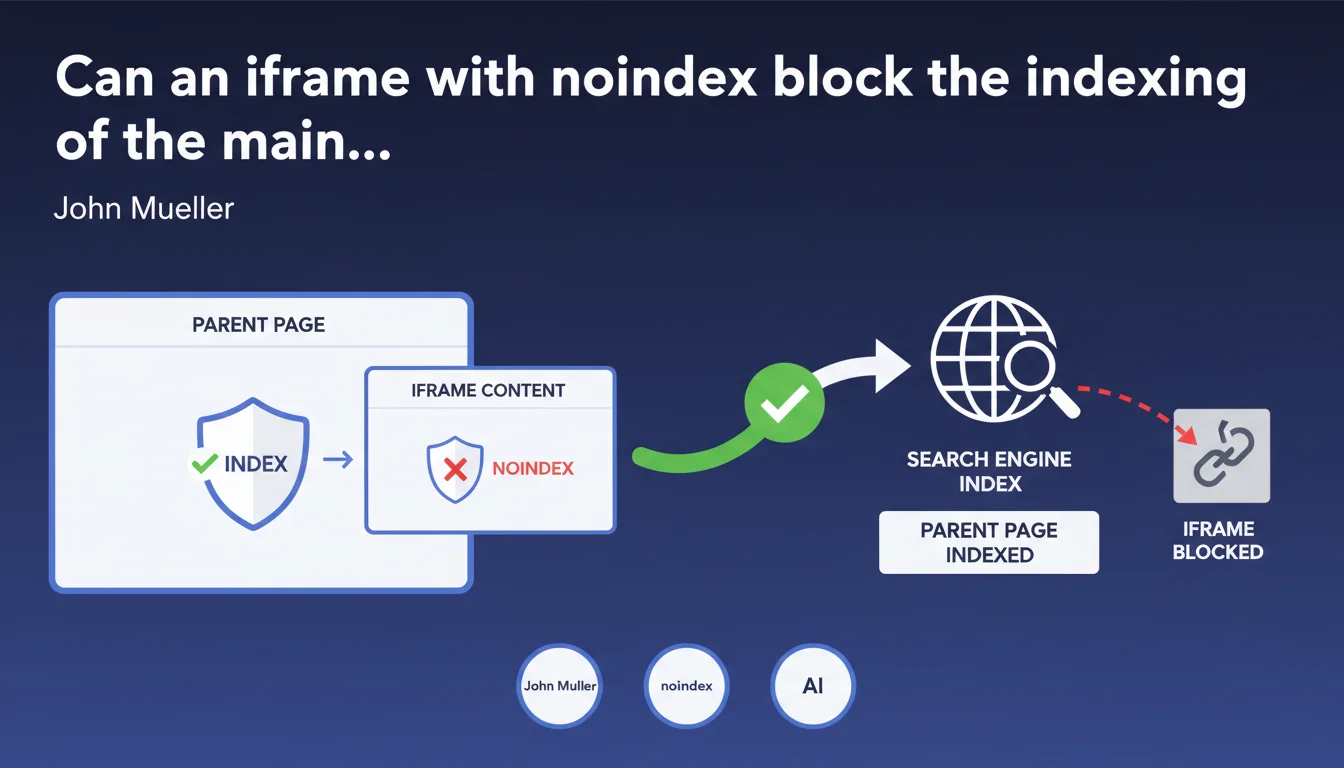
Concretely, if you have a page A with a meta robots "index" tag that displays via an iframe a page B containing a meta robots "noindex" tag, Google will index page A normally. The noindex of page B does not propagate upward and does not affect the indexing of the parent page.
This situation can occur in several practical contexts:
- Integration of third-party widgets or external content via iframe
- Display of private or temporary content in embedded frames
- Use of SaaS solutions integrated by iframe on your site
- Forms or tools hosted on separate domains
It is important to understand that Google treats iframes as distinct entities, each with its own indexing directives. This logical separation protects the parent page from restrictive directives applied to the embedded content.
SEO Expert opinion
This statement is perfectly consistent with the technical architecture of search engines. Iframes do indeed create separate rendering contexts, and it would be counterproductive for the directives of an embedded page to contaminate the parent page.
However, several nuances deserve to be made. If the iframe content represents a significant portion of the visible content of the page, Google might consider the parent page as having little value of its own. Moreover, the content of the iframe generally does not contribute to the indexable content of the parent page, which can limit your keyword strategy.
In cases where the iframe comes from a third-party domain that is potentially penalized or of low quality, the impact on your page remains minimal since Google treats these elements separately. Nevertheless, user experience remains an indirect ranking factor that should not be overlooked.
Practical impact and recommendations
- Check your pages using iframes: make sure that the main and indexable content is indeed in the parent page, not in the iframe
- Don't try to semantically enrich a page via iframe: this content will not be considered as part of your page for indexing purposes
- Use iframes with confidence for third-party widgets, forms or auxiliary content without fearing a negative impact on indexing
- Document your implementations: keep an inventory of the iframes used and their origin to facilitate future audits
- Prioritize native content: for any strategic SEO content, integrate it directly into your HTML rather than via iframe
- Test indexing: use Search Console to verify that your pages with iframes are properly indexed as expected
These technical optimizations often require an in-depth analysis of your site's architecture and how different contents are integrated. Compliance can prove complex, especially on e-commerce sites or platforms using numerous third-party services. Support from a specialized SEO agency will allow you to obtain a precise audit of your current implementations and an optimization strategy adapted to your specific technical context, while avoiding common errors that could compromise your visibility.
💬 Comments (0)
Be the first to comment.