
Official statement
What you need to understand
What is Google's official stance on affiliate links?
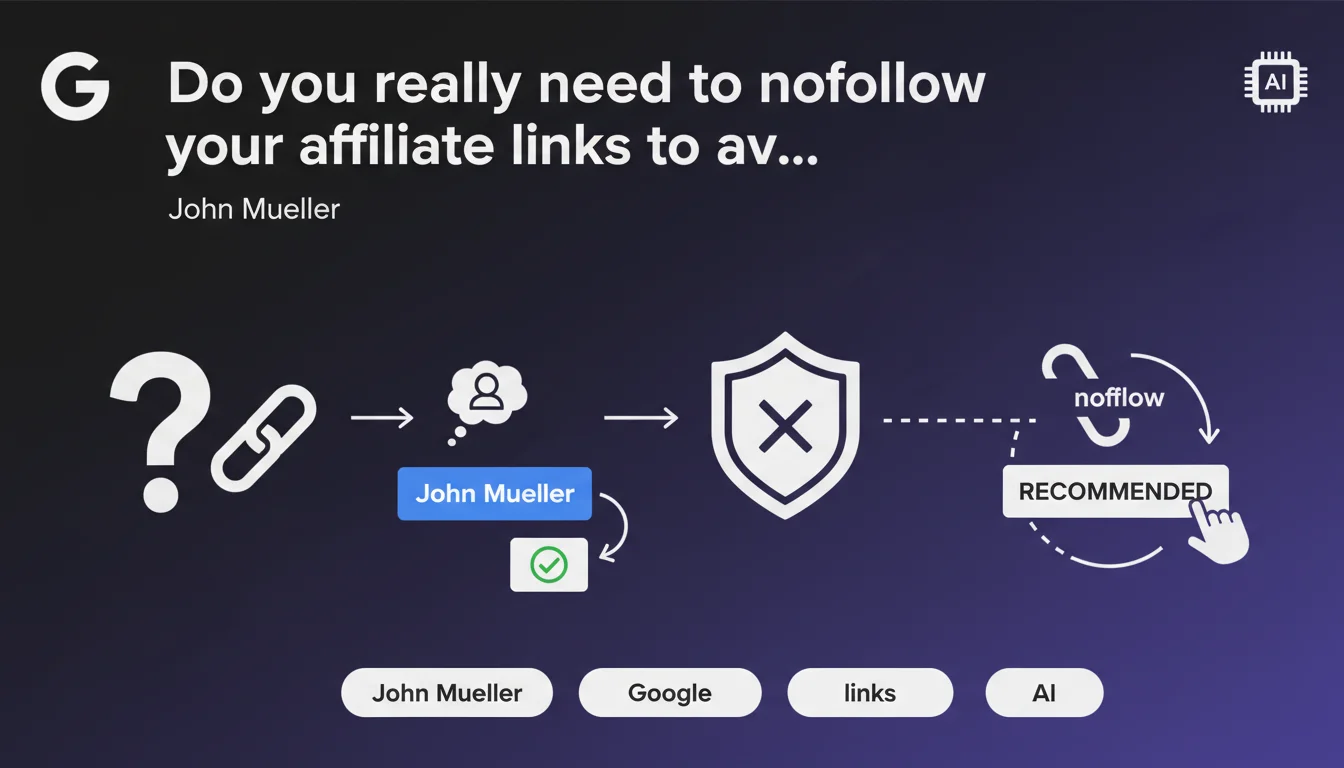
Google has clarified its position regarding affiliate links and the use of nofollow or sponsored attributes. During an exchange with webmasters, it was confirmed that the absence of these attributes on affiliate links does not trigger manual action against a site.
However, Google continues to strongly recommend using rel="sponsored" or rel="nofollow" attributes to identify these commercial links. This recommendation is part of the transparency and web quality logic that the search engine advocates.
Why is this distinction between recommendation and penalty so important?
The distinction is crucial for SEO professionals. A recommendation not followed does not automatically mean an algorithmic or manual sanction. Google can tolerate certain practices while discouraging them.
This clarification helps understand that if you notice a drop in organic traffic on an affiliate site, the absence of nofollow is probably not the main cause. You need to investigate other factors such as content quality, user experience, or algorithmic updates.
What are the key takeaways from this statement?
- The absence of nofollow or sponsored attributes on affiliate links does not trigger manual penalties
- Google still strongly recommends using these attributes to identify commercial links
- A traffic drop on an affiliate site has other causes than the absence of nofollow
- Transparency remains a guiding principle of Google's guidelines
- There is a difference between recommended best practices and penalty factors
SEO Expert opinion
Is this statement consistent with practices observed in the field?
With 15 years of SEO experience, I can confirm that this position is consistent with field observations. Many affiliate sites perform very well without systematic nofollow attributes on all their commercial links, without suffering manual penalties.
However, the absence of manual penalty does not mean there is no algorithmic impact. Google can very well devalue the PageRank transmitted by these links or adjust the trust granted to the site more subtly, without triggering a manual action visible in Search Console.
What important nuances should be added to this rule?
The first nuance concerns the overall context of the site. A site with 100% unmarked affiliate links and poor content will probably be treated differently from a quality editorial site with a few discreet affiliate links.
The second nuance relates to the evolution of guidelines. Google introduced the rel="sponsored" attribute specifically for these cases, indicating a clear direction. Not following these recommendations for years could become problematic if Google tightens its policy.
In what cases might this tolerance no longer apply?
Google's tolerance applies to good-faith sites that create quality content. A site whose sole objective is to manipulate rankings via massive affiliate links will probably be sanctioned for other reasons (thin content, spam, etc.).
Moreover, certain sensitive sectors such as health or finance (YMYL) could be subject to stricter monitoring. In these areas, any negative signal, including the absence of attributes on commercial links, could contribute to an unfavorable overall assessment.
Practical impact and recommendations
What should you actually do with your affiliate links?
Despite the absence of manual penalty, the best practice remains to clearly identify your affiliate links with rel="sponsored". This is a defensive approach that protects you from future guideline evolutions and improves your site's transparency.
For existing sites with numerous affiliate links, prioritize marking the most visible links: main pages, high-traffic articles, links in editorial content. Links in sidebars or footers are less critical but should also be handled progressively.
What interpretation mistakes should you absolutely avoid?
The main mistake would be to conclude that link attributes have no importance. This statement specifically concerns manual penalties, not the overall algorithmic impact nor other types of links (purchased, exchanged, etc.).
Another mistake: systematically attributing any traffic drop to minor technical factors. If your affiliate site loses traffic, first examine content quality, competition, search intent, and recent algorithmic updates.
How can you properly audit and optimize your affiliate links?
- Identify all affiliate links present on the site via a comprehensive technical crawl
- Check for the presence of rel="sponsored" or rel="nofollow" attribute on each commercial link
- Implement an automated process to correctly mark new affiliate links
- Assess the editorial content/commercial links ratio on each page to maintain a healthy balance
- Document your transparency policy regarding affiliation in your legal notices
- Regularly monitor Search Console to detect any manual actions
- Analyze the organic performance of pages containing affiliate links versus pure editorial pages
- Test the impact of adding sponsored attributes on control page groups
In summary: Although Google does not manually penalize the absence of attributes on affiliate links, marking these links with rel="sponsored" remains a recommended practice that protects your site long-term. Focus on overall editorial quality rather than this single technical factor.
Optimizing affiliate links is part of a comprehensive SEO strategy that includes content quality, site architecture, and user experience. For complex sites with numerous commercial links, these technical and editorial optimizations can represent a considerable challenge. Engaging a specialized SEO agency provides personalized support, in-depth audits, and recommendations tailored to your specific context, thus ensuring effective compliance while preserving your organic performance.
💬 Comments (0)
Be the first to comment.