
Official statement
What you need to understand
What is Google's official position on special characters?
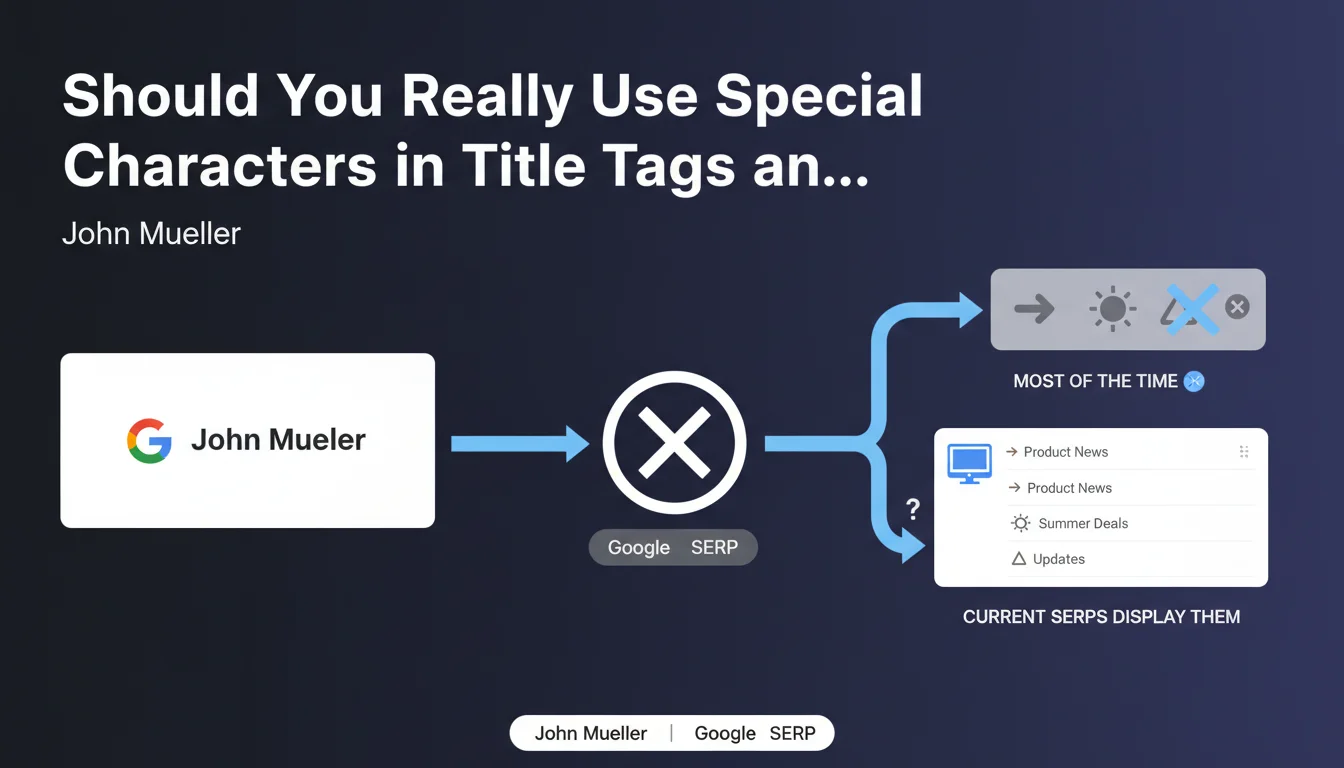
Google has clearly indicated that special characters have no impact on the ranking algorithm. Emojis, arrows, checkmarks and other typographic symbols (✓, ▷, ➡, ★) are not a ranking factor.
This clarification is important because many SEOs have long believed that these elements could provide a competitive advantage in search results. Google definitively debunks this belief.
Why are these characters used in SEO then?
The main objective of using special characters is not to improve positioning, but to increase the click-through rate (CTR) in results pages. It is a visual attractiveness strategy.
In theory, a title with eye-catching symbols should stand out visually from other results and attract more attention from users. However, Google filters the majority of these characters during display.
What does Google's filtering of these characters mean?
Google has automatic filtering mechanisms that remove or replace most special characters when displaying them in SERPs. This means that the symbol you carefully placed will probably never appear.
This filtering aims to maintain visual consistency and avoid abuse. Only a few specific and contextually relevant characters can sometimes pass through this filter.
- No impact on ranking: special characters are not a positioning factor
- CTR objective only: their only theoretical usefulness is to attract visual attention
- Systematic filtering: Google removes the majority of these characters when displaying
- Limited visual effect: few characters actually pass through Google's filter
SEO Expert opinion
Is this statement consistent with field observations?
Absolutely. Tests conducted by the SEO community confirm that the display of special characters is random and unpredictable. What works today may be filtered tomorrow.
Moreover, analysis of correlations between the presence of special characters and positions in SERPs has never shown statistically significant causality. Well-positioned sites are so for other fundamental reasons.
What nuances should be added to this rule?
There are a few contextual exceptions. For example, currency symbols (€, $, £) on e-commerce pages are generally preserved because they provide useful information to the user.
Similarly, certain standard typographic characters such as quotation marks, dashes or parentheses are part of normal punctuation and are not considered problematic "special characters".
What is the real issue behind this problem?
This question reveals a problematic trend in SEO: the search for shortcuts and quick tricks rather than foundational work. Special characters are symptomatic of a superficial approach.
The energy invested in testing different emojis would be much more profitable if it were devoted to improving content quality, semantic structure or user experience.
Practical impact and recommendations
What should you actually do with Title and Description tags?
Focus on writing clear, descriptive and persuasive titles without visual gimmicks. Use power words, numbers and concrete promises to improve CTR.
Prioritize an approach focused on real added value for the user: what will they discover by clicking? Why does your result deserve their attention more than another?
What mistakes should you absolutely avoid?
Don't waste time systematically testing different emojis or symbols. This approach generates a low return on investment and can even discredit your brand.
Also avoid copying the practices of competitors who heavily use these characters. Just because they do it doesn't mean it's effective, and you risk replicating their mistakes rather than their successes.
How can you effectively optimize your metadata for CTR?
Invest in A/B testing of your Titles and Descriptions by varying the wording, structure and sales arguments. This will have a measurably greater impact.
Analyze search intents and adapt your metadata to respond precisely to them. A title perfectly aligned with user expectations will naturally generate better CTR.
- Remove all non-essential special characters from your Title and Description tags
- Keep only functional symbols (currencies, standard separators)
- Rewrite your metadata by prioritizing clarity and value proposition
- Integrate action words and concrete benefits into your titles
- Test different formulations via Google Search Console to identify the most effective ones
- Analyze the CTR of your pages and optimize as a priority those with the highest potential
- Train your editorial teams in best practices for writing metadata
💬 Comments (0)
Be the first to comment.