
Official statement
Other statements from this video 4 ▾
- □ Why is Google removing the crawl rate tool from Search Console?
- □ Are you missing the critical Search Console features that could transform your SEO strategy?
- □ Why is Google now publishing dedicated resources on local SEO for businesses?
- □ Is Google finally releasing clear documentation on LLMs and their SEO impact?
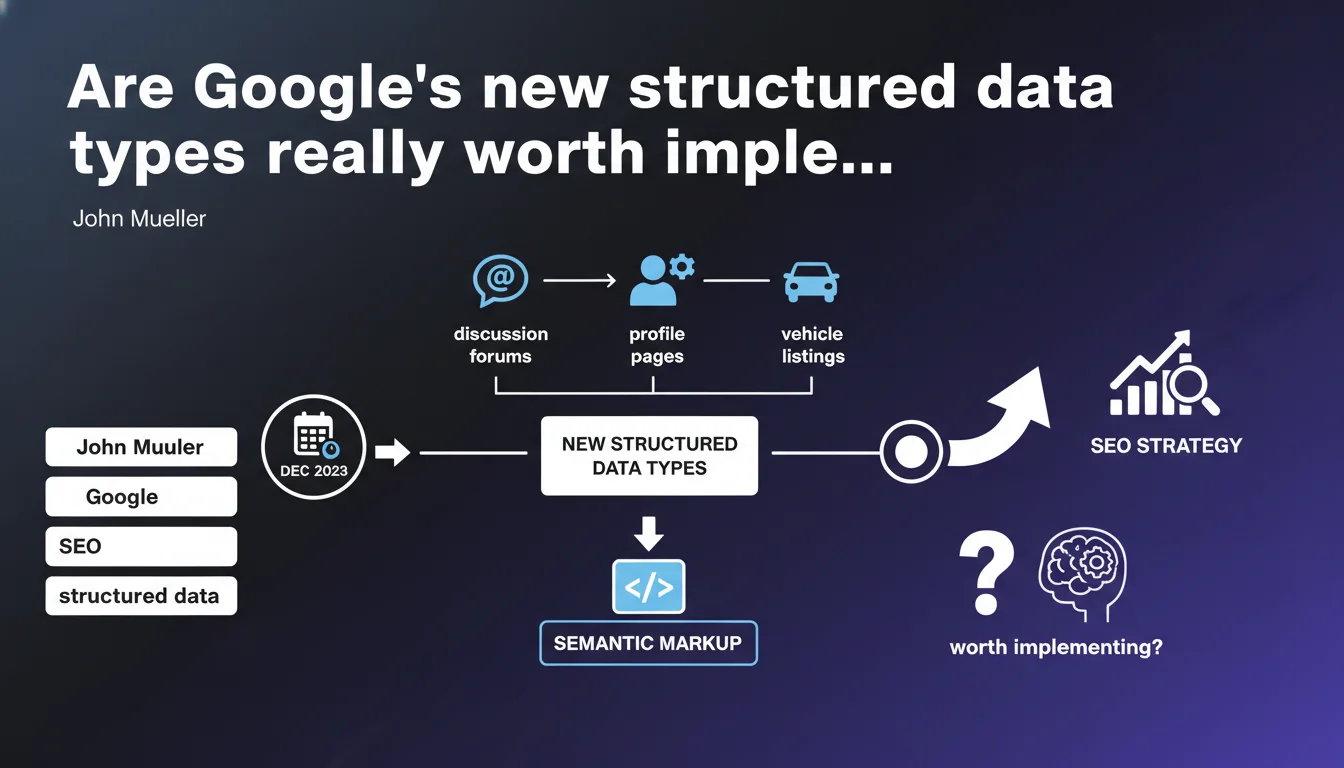
Google has deployed three new structured data types: discussion forums, profile pages, and vehicle listings. The stated objective? Enriching semantic markup across relevant websites. But in concrete terms, what real impact will implementing these schemas have on visibility and traffic for the sites that adopt them?
What you need to understand
Google continues to expand the types of structured data available to webmasters, progressively broadening the scope of content it can interpret with precision. These three new options target specific verticals and page typologies that have until now lacked standardized markup.
Why is Google launching these new schemas now?
The logic is consistent with Mountain View's strategy: better understand content to display it more effectively in enriched results. Forums, user profiles, and vehicle listings represent massive volumes of web pages that have partially escaped structured interpretation.
By standardizing these formats, Google facilitates the extraction of key information — message author, vehicle specifications, profile role — and can theoretically deliver more relevant results or enriched snippets in the SERP.
Which sites are directly affected by these updates?
Discussion forums: any site offering conversation threads (Reddit-like platforms, but also community sections of thematic websites). Profile pages: social networks, professional platforms, directories, anywhere a user has a public profile card. Vehicle listings: auto marketplaces, dealership websites, classified ad platforms.
If your site falls into one of these categories, you now have official vocabulary to mark up your content. The question remains whether Google will make visible use of it.
What specific elements should you mark up in these new schemas?
- Forums: subject title, author, number of replies, publication date, content of the first message
- Profiles: name, photo, biography, URL, social identifiers, skills or roles
- Vehicles: brand, model, year, mileage, price, fuel type, availability
- In all cases: consistency with visible content on the page — Google penalizes misleading markup
SEO Expert opinion
Is this announcement consistent with real-world practices?
Let's be honest: Google regularly announces new structured data types, but not all result in visible enriched displays in SERPs. Some schemas only serve to improve internal understanding with no visible benefit to the webmaster.
Forums and profiles in particular currently lack documented use cases showing measurable impact on visibility. Vehicle listings, on the other hand, fit into an already proven logic of enriched results for other e-commerce verticals (products, recipes, job postings).
[To verify]: there is no official communication about eligibility criteria for enriched results with these new schemas, nor about traffic volumes observed post-implementation. We're flying blind.
Should you implement these schemas immediately or wait?
It depends on your risk tolerance and your ability to deploy markup without guaranteed ROI. If you manage an active forum or auto marketplace, implementation can be justified — but only if it's clean, tested, and maintained.
The trap? Rolling out incomplete or faulty markup in a rush. Google may ignore your structured data if it's poorly formatted, inconsistent with visible DOM, or considered spam. In that case, not only will you gain no benefit, but you risk cluttering your code for nothing.
What concrete data is missing from this announcement?
Pretty much everything. No information on enriched result display rates for these new schemas. No CTR metrics observed on pilot sites. No concrete examples of enriched SERPs for forums or profiles.
Google communicates about the technical availability of the schema, not its real utility for webmasters. This is a constant in announcements of this type — and it's frustrating for anyone trying to prioritize their SEO projects based on tangible data.
Practical impact and recommendations
What should you do concretely if your site is affected?
First, assess relevance: does your site clearly fall into one of the three categories? If so, consult the official Schema.org documentation to understand the required and recommended properties of each type.
Next, implement properly: JSON-LD remains Google's preferred format. Test each marked-up page using the Rich Results Test tool and Search Console. Verify that structured data accurately reflects visible content — any inconsistency can be ignored or penalized.
What errors should you avoid during implementation?
- Don't mark up invisible or misleading content — Google penalizes manipulations
- Don't duplicate schemas on the same page without valid reason
- Don't overlook required properties (each type has mandatory fields)
- Don't deploy to production without first testing on a sample of pages
- Don't neglect maintenance: if your content evolves, your structured data must follow
How do you measure the real impact of these new schemas?
Set up tracking in Search Console: the "Enhancements" tab will tell you if your pages are eligible for enriched results and if errors are detected. Also monitor performance reports to spot any potential CTR gains on marked-up pages.
Be patient: the effects of structured data are not immediate. Google may take several weeks to crawl, index, and interpret your new schemas. And let's repeat — no guarantee of enriched display.
Implementing these new structured data types can represent a substantial technical project, especially for sites with thousands of affected pages (active forums, large auto catalogs, community platforms). From mapping definitions to testing, deployment, and maintenance, it all requires solid technical SEO expertise.
If you lack internal resources or wish to avoid costly mistakes, it may be wise to have yourself supported by a specialized SEO agency that masters these semantic markup challenges and can audit, implement, and track results for you.
❓ Frequently Asked Questions
Les nouveaux types de données structurées garantissent-ils des résultats enrichis dans Google ?
Faut-il privilégier JSON-LD, Microdata ou RDFa pour ces nouveaux schémas ?
Puis-je baliser un forum avec plusieurs types de données structurées simultanément ?
Combien de temps faut-il pour voir un impact SEO après implémentation ?
Que se passe-t-il si mes données structurées contiennent des erreurs ?
🎥 From the same video 4
Other SEO insights extracted from this same Google Search Central video · published on 15/12/2023
🎥 Watch the full video on YouTube →
💬 Comments (0)
Be the first to comment.