
Official statement
Other statements from this video 19 ▾
- 2:38 Should you really multiply sitemaps when you have a lot of URLs?
- 2:38 Is it really necessary to split your sitemap into multiple files to index a large site?
- 5:15 Why does replacing HTML with JavaScript canvas hurt SEO?
- 5:18 Should you ditch HTML5 canvas to ensure your content gets indexed?
- 10:56 Should you ditch the noscript attribute for SEO?
- 12:26 Should you really ditch noscript for rendering your content?
- 15:13 What happens when your HTML metadata contradicts the JavaScript ones?
- 16:19 Do complex JavaScript menus really block the indexing of your navigation?
- 18:47 Does Googlebot really follow all the JavaScript links on your site?
- 19:28 Do full-page hero images really harm Google indexing?
- 19:35 Do full-screen hero images really block the indexing of your pages?
- 22:25 Is it true that Google really respects the canonical tag?
- 25:48 How does the initial load of a SPA potentially ruin your SEO?
- 26:20 Does the initial load time of SPAs hurt your organic traffic?
- 28:13 Do Service Workers really enhance the crawling and indexing of your site?
- 36:00 Will Server-Side Rendering Become Essential for the SEO of JavaScript Applications?
- 36:17 Should you go all in on server-side rendering to excel in JavaScript?
- 41:29 Does JavaScript really represent the future of web development for SEO?
- 52:01 Are Third-Party Scripts Really Hurting Your Core Web Vitals?
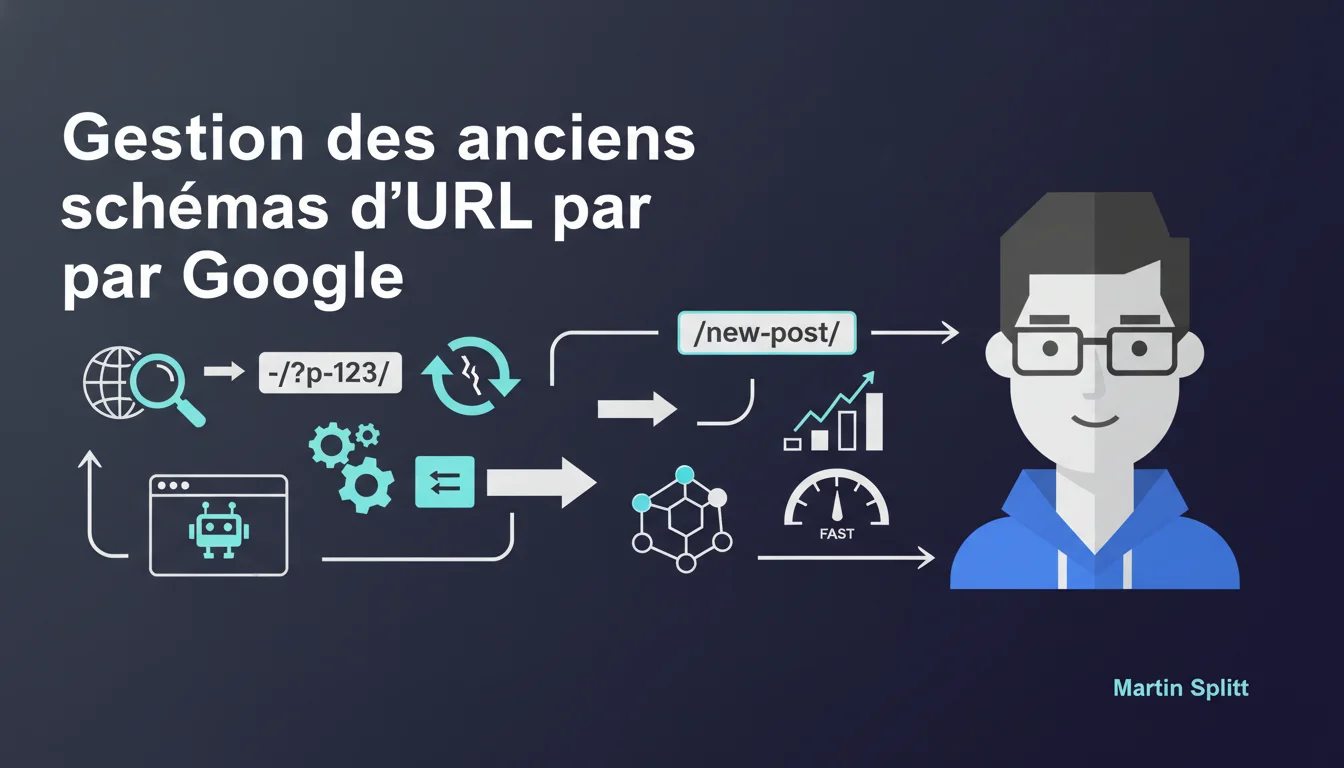
Google may persist in crawling and indexing your old URL structures even after a migration, simply because these URLs remain referenced elsewhere on the web. 301 redirects are not always sufficient if external links continue to point to the old scheme. The solution? Actively track these residual external links and ensure that all old URLs correctly redirect to the new ones, without exception.
What you need to understand
What really happens when changing the URL structure?
When you migrate your site to a new URL scheme, you expect Google to quickly forget the old one. Wrong. Old URLs persist in the index and in the crawl budget as long as they are referenced somewhere on the web.
A link from an external blog from 2018, a mention on a forgotten forum, a backlink from a dusty directory — all these external signals tell Google that these URLs still exist. The bot follows these links, discovers your old URLs, and continues to treat them as active pages unless told otherwise.
Why don’t redirects automatically fix everything?
301 redirects are essential, but they only transfer the user and the bot to the new destination. They do not remove the old URL from the index overnight. Google must rediscover each URL to recognize the redirect, then consolidate the signals.
If your old scheme had thousands of URLs and only a fraction is crawled each week, the process can stretch over months. In the meantime, you waste crawl budget on dead URLs, and risk maintaining conflicting signals in the index.
How does Google handle these old URLs in practice?
Google does not rely solely on your XML sitemap or internal linking. The external web is a major signal. As long as third-party sites point to your old URLs, Googlebot will periodically visit them to check their status.
If you forgot to redirect certain variants (with or without trailing slashes, with or without parameters), you create ghost entry points that dilute your ranking signals. Worse: if some old URLs return a 404 or a soft 404, you permanently lose the PageRank accumulated on those pages.
- External backlinks remain active even if you change structure — they point to the old scheme until the source site updates them (which almost never happens).
- Redirects must cover all possible URL variants: with/without www, with/without trailing slash, http/https, UTM parameters, etc.
- The consolidation time directly depends on your crawl budget and the volume of external backlinks pointing to the old scheme.
- Google does not "publish" new URLs automatically until it has recrawled and validated the redirects — hence the importance of forcing the recrawl via Search Console.
SEO Expert opinion
Is this directive consistent with what we observe in the field?
Absolutely. Lengthy URL scheme migrations are classic. Google does not "switch" instantly from old to new, contrary to what many imagine. The engine aggregates signals, and as long as old external links exist, they continue to feed the old scheme.
We regularly see sites that, six months after a redesign, still have 30 to 40% of their crawl budget wasted on old URLs because no one has checked the external backlinks. [To verify]: Google does not communicate an official consolidation timeframe, but field observations show that it can last from a few weeks to several quarters depending on the size of the site.
What mistakes waste time and rankings?
The first mistake: believing that 301 redirects are sufficient. You are redirecting correctly, but if you do not force the recrawl via Search Console, Google will discover the redirects at its own pace — which is slowly. The result: you remain with a hybrid index for months.
The second mistake: not auditing URL variants. You redirect /page/ to /new-page/, but what about /page, /page?utm_source=twitter, /page#anchor? Each non-redirected variant is a hole in your consolidation strategy.
In what cases does this rule not fully apply?
If your site is young, with few external backlinks, the transition will be quick. Fewer external signals = less noise. Google recrawls your pages, notices the redirects, and switches within a few days.
But for an established site with thousands of backlinks accumulated over many years, it’s a different story. You will need to actively map incoming links and ideally contact high-authority sites to update their links. This takes time, but it drastically accelerates consolidation.
Practical impact and recommendations
How to audit and correct old URLs after migration?
First step: export all your old URLs from a pre-migration crawl (if you haven't done this, retrieve them from Search Console or a backlink tool like Ahrefs/Majestic). Cross-reference this list with your server logs to identify which old URLs still receive traffic or crawls.
Then, check that each old URL properly returns a 301 to the corresponding new URL. Test manually or automate with a tool like Screaming Frog in "List" mode to crawl only your old URLs and check the status codes.
What to do with external backlinks pointing to the old scheme?
Identify your top external backlinks via Ahrefs, Majestic, or Search Console ("Links to your site" section). Prioritize high-authority domains and contact them to request an update of the link to your new URL. This does not work every time, but on large sites, it can make a difference.
For links you cannot fix, ensure your 301 redirects are permanent and stable. Google will gradually transfer PageRank, but it will take time. Never delete these redirects, even after years — external backlinks do not disappear.
How to accelerate Google’s acknowledgment?
Force the recrawl of old URLs through Search Console by submitting individual URLs (if you have a few dozen) or by resubmitting your XML sitemap containing the new URLs. Google will recrawl, note the 301s, and consolidate signals faster.
Update your internal linking so that no internal link points to the old scheme. Even if your redirects work, each internal link to an old URL adds latency and dilutes the signal. A post-migration linking audit is essential.
- Crawl all old URLs and verify that each returns a permanent 301 to the corresponding new URL
- Export external backlinks from Ahrefs/Majestic and contact high-authority sites to update links
- Submit new URLs via Search Console and force the recrawl of old ones to accelerate consolidation
- Audit internal linking and remove any link pointing to the old scheme
- Monitor server logs to identify old URLs still crawled and trace the source of links
- Keep 301 redirects in place indefinitely — external backlinks never completely disappear
❓ Frequently Asked Questions
Combien de temps Google met-il pour oublier complètement mes anciennes URL ?
Dois-je mettre à jour mon sitemap XML avec les anciennes URL ?
Que se passe-t-il si j'oublie de rediriger certaines variantes d'URL ?
Les redirections 301 transfèrent-elles 100 % du PageRank ?
Comment savoir si mes anciennes URL sont encore crawlées par Google ?
🎥 From the same video 19
Other SEO insights extracted from this same Google Search Central video · duration 57 min · published on 29/04/2020
🎥 Watch the full video on YouTube →
💬 Comments (0)
Be the first to comment.