
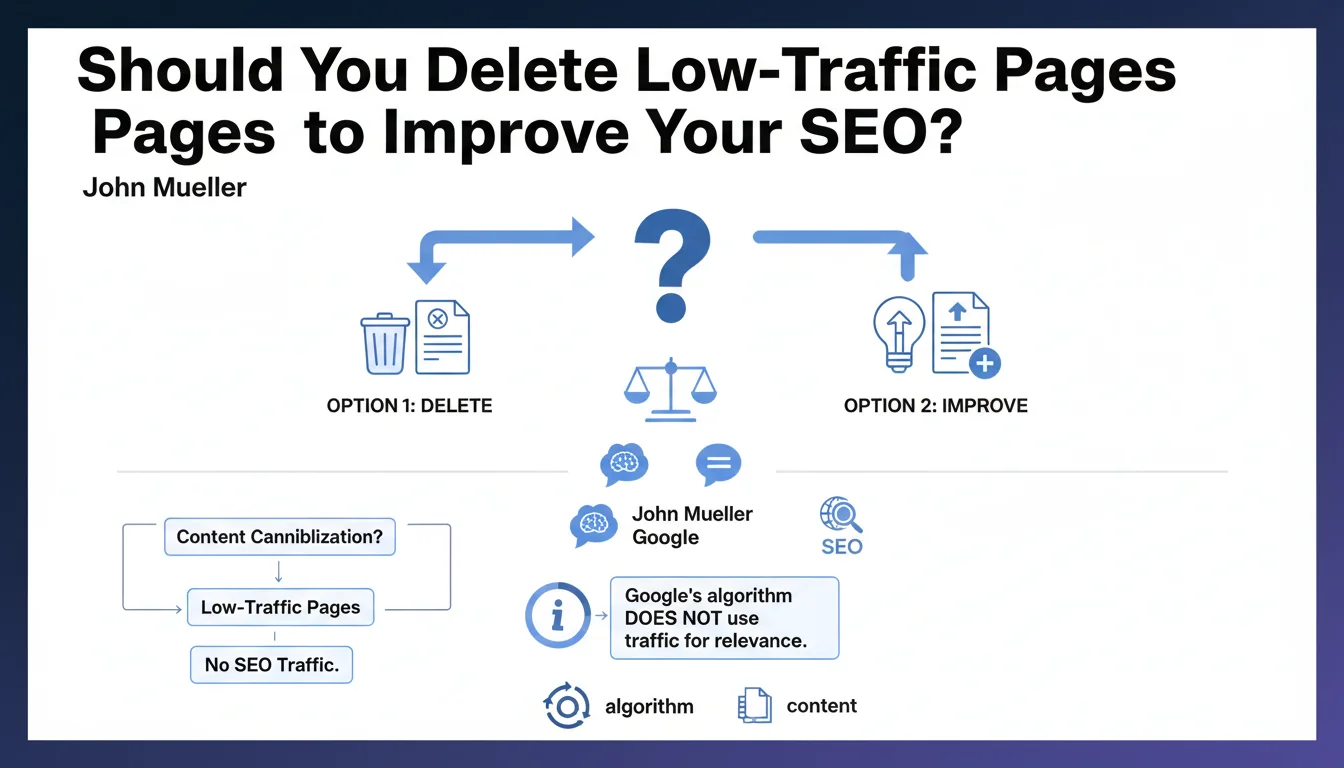
Official statement
What you need to understand
What is content cannibalization related to low traffic?
Content cannibalization refers to a situation where multiple pages on the same site compete for similar queries. In this specific context, it involves pages that generate little or no organic traffic.
Some SEOs consider these pages as a signal of overall poor site quality. The hypothesis is that this content would dilute domain authority and prevent strategic pages from ranking properly.
Does Google use traffic data to evaluate quality?
The official answer is clear: Google does not use traffic metrics from a page to determine its relevance or quality. The algorithm evaluates content based on other intrinsic criteria.
This clarification is crucial because it challenges a widely held misconception in the SEO community. Low traffic is not a cause, but rather a symptom of other potential problems.
What are the two recommended approaches for low-traffic pages?
The first approach consists of deleting or consolidating this content. This pruning strategy aims to concentrate authority on a reduced number of strategic pages.
The second approach, favored in this statement, is to improve existing content. This involves enriching, updating, and optimizing these pages to make them more relevant and useful.
- Google does not take into account a page's traffic to evaluate its quality
- Low traffic is a symptom, not the cause of a quality problem
- Two valid strategies: deletion or improvement of content
- Improving existing content is often preferable to deletion
- Content funnels toward strategic pages are a complementary approach
SEO Expert opinion
Is this statement consistent with field observations?
In practice, content pruning (content deletion) strategies often generate measurable positive results. This apparent paradox is explained by indirect factors not related to traffic itself.
In reality, removing obsolete, duplicated, or low-value pages improves crawl budget, clarifies architecture, and strengthens thematic coherence. It's these structural improvements that positively impact SEO, not the removal of "low traffic" per se.
The nuance is important: traffic is not a direct ranking signal, but the factors that cause low traffic (superficial content, poor optimization, lack of relevance) are indeed taken into account by Google.
What interpretation mistakes should be avoided?
The main mistake would be to systematically delete any page with little traffic. Some content generates few visits but fulfills important strategic functions: niche conversion pages, support content, long-tail informational pages.
A page with 10 visits per month can generate high-value conversions or contribute to the site's perceived expertise on a specific topic. Quantitative traffic is not the only relevant KPI.
In which contexts does deletion remain relevant?
Deletion is justified for obsolete, duplicated, or content without identifiable search intent. For example: old event pages, discontinued products, automatically generated content without added value.
In these cases, it's not about deleting due to "low traffic," but cleaning up content that no longer has a reason to be indexed. The conceptual distinction is fundamental for making the right decisions.
Practical impact and recommendations
How do you decide between improving and deleting a page?
Start with a qualitative audit rather than a quantitative one. Ask yourself these questions: does this page answer a real search intent? Is the content unique and does it provide value? Does the page have a function in the user journey?
If the answer is yes to these questions, improvement is preferable to deletion. If the content no longer has strategic utility, consolidation or deletion becomes relevant.
Also analyze the internal and external links pointing to these pages. A page with little traffic but many quality backlinks deserves to be improved rather than deleted.
What concrete actions can improve low-performing pages?
Improvement involves several complementary levers. Enrich the content with updated information, recent data, concrete examples, and relevant visuals.
Optimize on-page elements: title, meta description, Hn structure, strategic internal linking. Ensure the page targets a clear search intent and that the content fully addresses it.
Strengthen internal linking from your strategic pages to this content. Create coherent thematic clusters that distribute authority and clarify your semantic architecture.
- Audit each low-traffic page individually to understand the real cause of the problem
- Check indexing and crawling in Search Console before any decision
- Evaluate strategic value beyond simple traffic volume
- Prioritize content improvement for pages with identifiable potential
- Consolidate or redirect obsolete, duplicated, or content without added value
- Create internal linking funnels toward strategic pages
- Measure impact over 3-6 months before evaluating action effectiveness
- Never use traffic as the sole decision criterion
💬 Comments (0)
Be the first to comment.