
Official statement
What you need to understand
What is Google's official position on URL stability?
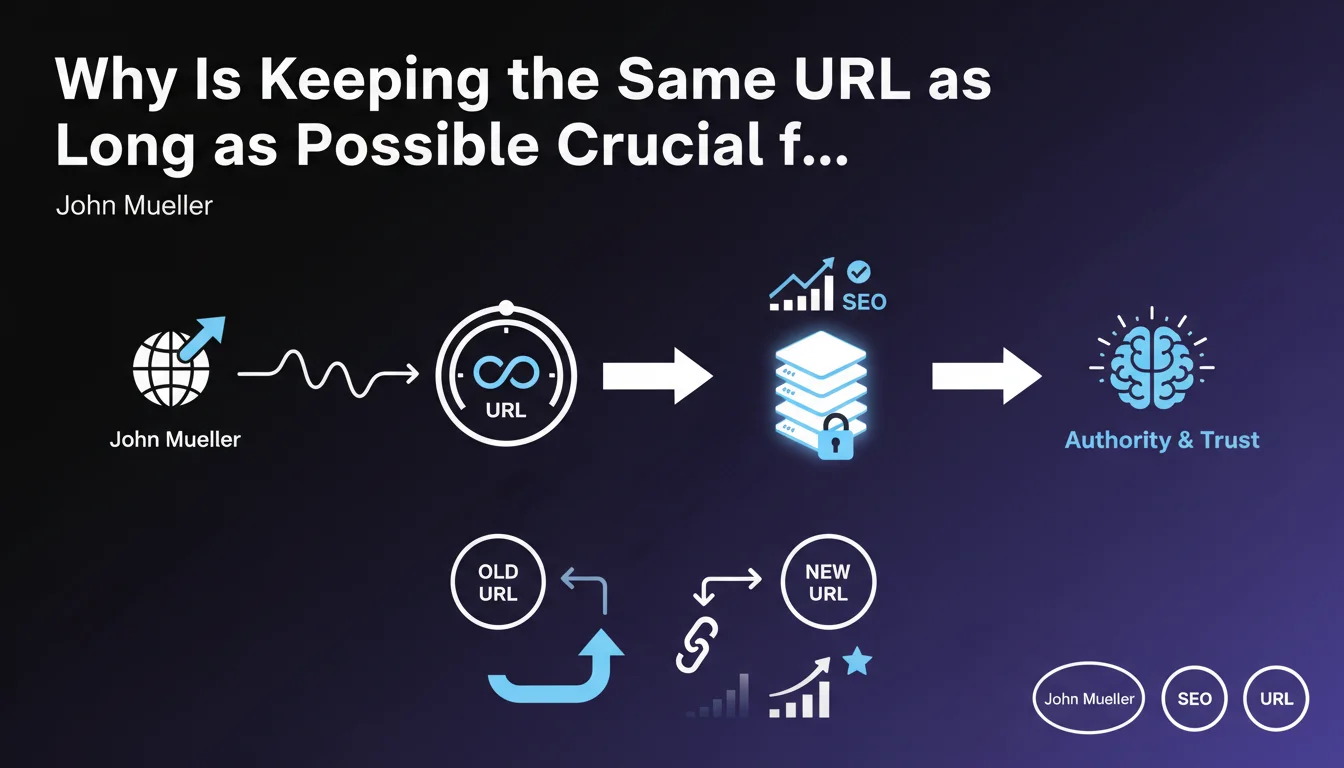
Google explicitly recommends keeping the same URL for a web page for as long as possible. This statement confirms that the stability of web addresses is a factor considered by the search algorithm.
Every URL modification requires a 301 redirect, which can lead to a temporary loss of ranking and dilute the SEO juice accumulated over time. The more stable a URL remains, the more authority and trust signals it accumulates.
Why does URL modification represent a risk for SEO?
Changing a URL generates several technical problems: risks of 404 errors, loss of backlinks if redirects are not properly configured, and possible dilution of PageRank during multiple redirect chains.
Redirects are also tracked with a limited crawl budget. The more redirects you create, the more crawl resources you consume that could be used to index new or updated content.
When should URL structure definition be thought through?
The URL structure must be defined before the site's first launch. It's a strategic decision that impacts SEO in the long term and is costly to modify later.
This initial thinking must integrate: navigation logic, content hierarchy, future site scalability, and SEO best practices regarding optimized URL structure.
- Fundamental principle: URL stability is a confirmed SEO performance factor by Google
- Main risk: Every URL modification introduces technical risks and potential authority loss
- Critical timing: URL structure must be thought through beforehand, before site launch
- Justified exceptions: Domain migration, platform redesign, or major restructuring may require changes
SEO Expert opinion
Is this recommendation consistent with practices observed in the field?
Absolutely. Empirical data confirms that pages with stable URLs for several years generally perform better than those that have undergone frequent modifications. Sites that have migrated without precautions often temporarily lose 20 to 40% of their organic traffic.
I regularly observe that sites maintaining their historical URLs benefit from an age effect valued by Google. Pages established for a long time naturally accumulate more trust signals: backlinks, user interactions, citations across the web.
What important nuances should be added to this rule?
Keeping a URL doesn't mean maintaining obsolete or poor-quality content. The URL can remain stable while the content is regularly updated and improved. This is actually the ideal combination: content freshness and address stability.
Certain situations fully justify a URL change: correcting an aberrant structure, switching to HTTPS, site internationalization, or major architecture redesign. The important thing is then to manage redirects professionally.
In which specific cases does this rule not strictly apply?
For news sites or ephemeral content, the logic differs. A dated URL (example: /2024/01/article) can lose relevance and it's sometimes preferable to create new content with a new URL rather than artificially maintaining an old one.
E-commerce sites with seasonal or temporary products must also adapt this rule. It's often better to properly delete an obsolete product page (with a 410) than to maintain it with irrelevant content.
Practical impact and recommendations
What should you do concretely to optimize your URL stability?
Start with a thorough audit of your current URL structure. Identify inconsistencies, overly long URLs, those containing unnecessary parameters, or an illogical structure that might require future correction.
Then establish a clear and documented naming convention for your entire team. This charter must define: URL format (with or without date, with or without category), allowed characters, handling of accents and special characters, recommended maximum length.
What critical mistakes must be absolutely avoided?
Never modify a URL without implementing a permanent 301 redirect. This is the most frequent and most damaging error: it generates 404 errors, causes loss of traffic and accumulated authority.
Avoid redirect chains (A→B→C). Each additional redirect dilutes the transmitted authority and slows down loading time. Always redirect directly to the final destination.
Don't give in to the temptation to modify your URLs to integrate new keywords every year. On-page optimization of content and tags is much more effective and less risky than a URL modification.
How can you verify that your site follows URL stability best practices?
Use Google Search Console to identify 404 errors and problematic redirects. Examine the index coverage report to detect redirected pages and verify they are properly managed.
Analyze your history with tools like Screaming Frog or Sitebulb to map all your redirects. A healthy site should have minimal redirects, mainly to the canonical version (www or non-www, HTTP to HTTPS).
- Define a logical and sustainable URL structure BEFORE site launch
- Document a URL naming charter for the entire editorial team
- Implement a 301 redirect for every modified URL, without exception
- Regularly verify the absence of multiple redirect chains
- Audit 404 errors monthly via Google Search Console
- Prioritize content updates rather than URL modifications
- Only change URLs for major and justified strategic reasons
- Maintain a complete history of all URL modifications performed
💬 Comments (0)
Be the first to comment.