
Official statement
What you need to understand
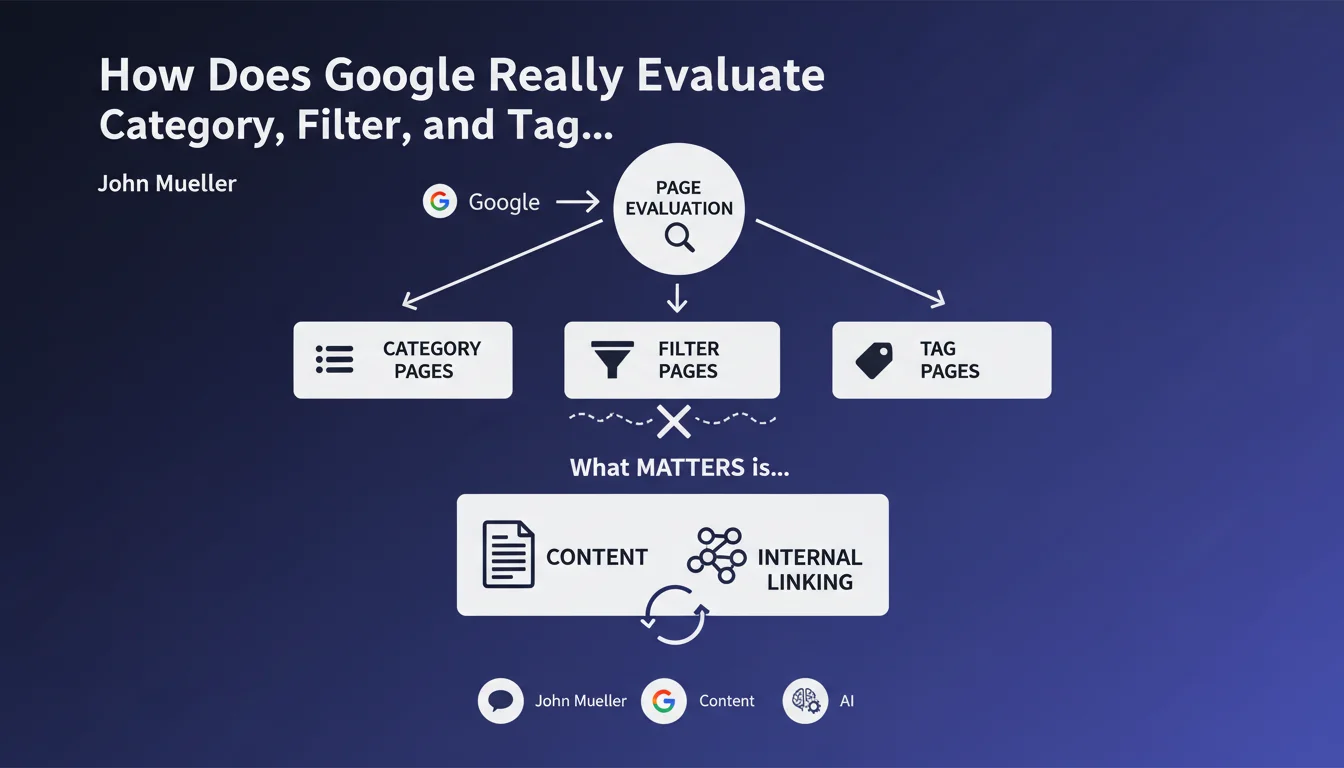
Google has clarified a fundamental question that concerns many SEO practitioners: the search engine does not technically distinguish between different types of listing pages. Whether it's a category page, a filtered results page (facets), an internal search page, or a tag page, Google treats them identically.
What really matters to Google is the quality of the page's content and its accessibility within the site architecture. The engine analyzes the informational value offered to users, the relevance of the content, and how easily its robots can discover these pages through internal linking.
The main challenge therefore lies in the internal linking structure and how you prioritize access to your most important content. Google recommends highlighting the most relevant categories or filters from the homepage and creating natural entry points through editorial content.
- No differentiated treatment between category pages, filters, tags, or internal search
- Content and accessibility are the real evaluation criteria
- Internal linking structure determines the importance given to each page
- Prioritize strategic pages from high-authority zones (homepage, blog)
- Avoid excessive multiplication of these pages to limit duplicate content
SEO Expert opinion
This statement is perfectly consistent with field observations from recent years. Many e-commerce sites have found that well-constructed filter pages could outperform traditional category pages, simply because they better addressed users' search intent.
The essential nuance to add concerns managing the volume of generated pages. While Google doesn't make technical distinctions, it does penalize architectures that create an inflation of low-value pages. A site with 50 categories and 20 combinable filters can generate thousands of variations, most of which will provide no value to either users or crawl budget.
In practice, the most successful sites are those that drastically limit the number of these intermediate pages, only creating those that correspond to real user queries with significant search volume. The rest should be blocked via noindex or the robots.txt file.
Practical impact and recommendations
- Audit all your listing pages (categories, filters, tags, search) to identify those generating qualified organic traffic
- Analyze filter combinations that correspond to real user queries in Google Search Console and keyword research tools
- Enrich unique content on strategic listing pages (descriptions, editorial text, FAQs) to differentiate them
- Strengthen internal linking from the homepage and high-authority pages to your priority categories/filters
- Create editorial content (blog posts, guides) that naturally links to your important listing pages
- Implement a noindex strategy on low-value or redundant listing pages
- Limit navigation depth: important pages should be accessible within 2-3 clicks maximum from the homepage
- Use canonical tags intelligently to consolidate variations that are too similar
- Block crawling of infinite filter combinations via robots.txt and URL parameters in Search Console
- Monitor crawl budget to verify that Google isn't wasting time on valueless pages
In summary: Focus your efforts on a limited number of listing pages with high strategic value, enrich them with unique content, and facilitate their discovery through optimized internal linking. Decisively block everything else to avoid diluting your crawl budget.
Implementing this strategy requires in-depth analysis of your architecture, your Search Console data, and technical mastery of different crawl control levers. Given the complexity of these optimizations and the risks of errors that can significantly impact your visibility, support from a specialized SEO agency can prove valuable in establishing a personalized strategy adapted to your specific context and ensuring flawless implementation.
💬 Comments (0)
Be the first to comment.