
Official statement
What you need to understand
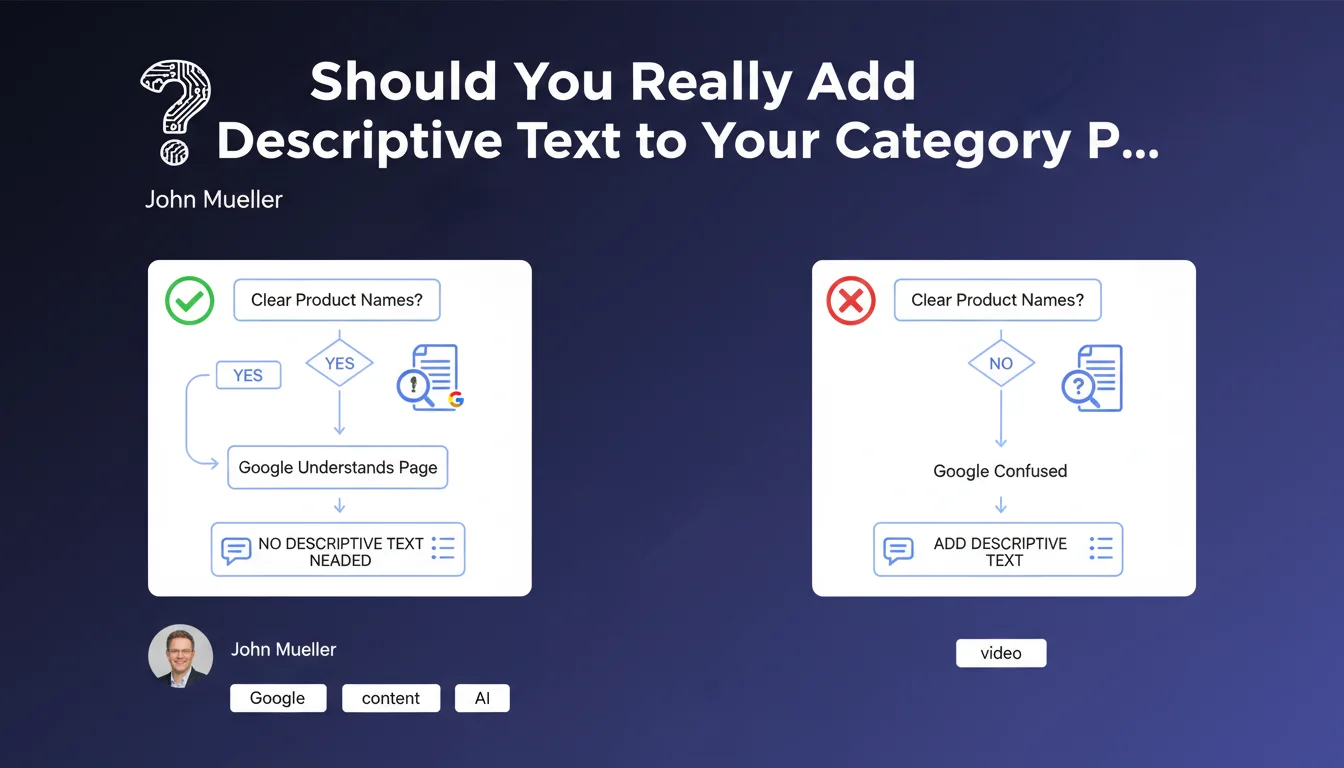
Google has clarified its position regarding textual content on category pages, particularly for e-commerce sites and blogs. The central question concerns the necessity of adding explanatory text above product or article lists.
According to recent statements, additional text is not strictly mandatory if the names of the listed products or articles are sufficiently explicit. For example, on a page displaying "Nike Running Shoes", "Adidas Running Shoes", "Puma Running Shoes", Google can automatically deduce that this is a running shoes category.
However, this approach has important limitations that must be well understood before applying it.
- The clarity of product names is decisive: they must be explicit and descriptive
- The algorithm must be able to deduce the page topic without ambiguity
- Descriptive text remains recommended in most cases to remove any ambiguity
- User experience also benefits from well-written introductory text
SEO Expert opinion
This statement reflects the growing sophistication of Google's algorithm in contextual page understanding. In practice, we do indeed observe that minimalist category pages can rank properly if product nomenclature is rigorous.
Nevertheless, this approach presents several significant risks that should not be underestimated. First, it assumes that your product names are perfectly optimized and consistent, which is rarely the case in reality. Second, it deprives the page of a valuable opportunity to target long-tail keywords and contextualize the offering.
Our experience shows that pages with explanatory content generally perform better on competitive queries. Additional text enriches the semantic field, improves internal linking, and answers users' implicit questions.
Practical impact and recommendations
- Audit your product/article names: verify that they are sufficiently descriptive and consistent to be understood in isolation
- Prioritize descriptive text on your main and strategic site categories (top 20% of traffic)
- Write a minimum of 100-200 words of unique and relevant content above your product or article lists
- Naturally integrate your target keywords in these descriptions to reinforce thematic relevance
- Test the minimalist approach only on very obvious categories with low strategic stakes
- Structure your text with appropriate HTML tags (H1, H2, paragraphs) to facilitate reading by bots
- Also consider user experience: well-written text helps conversion and reduces bounce rate
- Monitor the performance of your category pages in Search Console to adjust your strategy
The content strategy for category pages requires a nuanced approach that varies according to your sector, your competition, and your site's maturity. The trade-off between explanatory content and minimalist design often involves A/B testing and detailed data analysis. For sites with high commercial stakes, it can be wise to rely on an experienced SEO agency that will know how to adapt this recommendation to your specific context and implement a high-performing and sustainable category content strategy.
💬 Comments (0)
Be the first to comment.