
Official statement
What you need to understand
What's the relationship between a page's traffic and the value of its links?
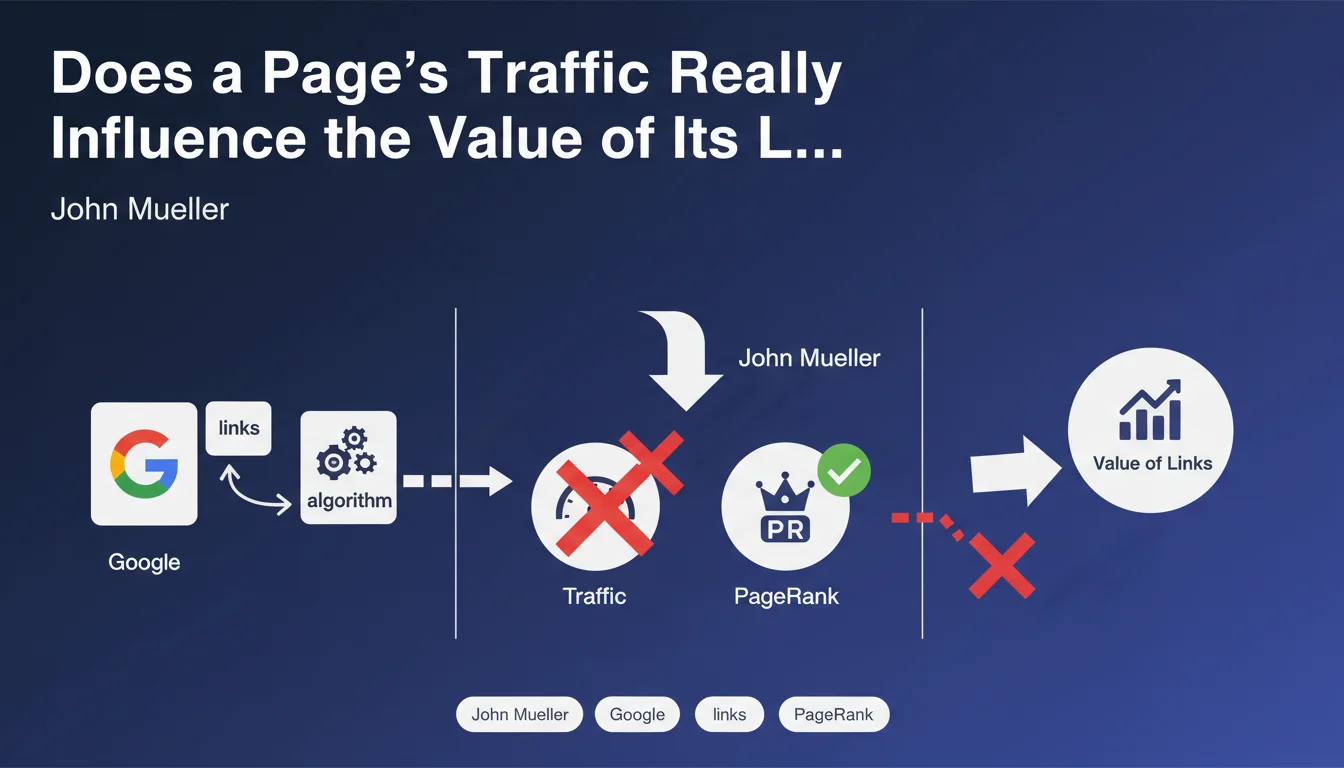
John Mueller clarified on Twitter a frequent misunderstanding: the traffic volume of a page has no direct influence on the weight of the links it transmits. This statement breaks a widespread myth in the SEO community.
Contrary to what many think, Google does not give more value to a link coming from a highly visited page. The search engine uses other criteria to evaluate the quality and authority of a link.
How does Google really evaluate the value of a link?
Google's algorithm relies primarily on PageRank, a system that measures a page's authority based on the quality and number of links it receives. This calculation does not take traffic metrics into account.
PageRank evaluates the link structure on the web and how authority propagates from one page to another. A page can have little traffic but a high PageRank if it receives quality links.
- A page's traffic does not directly influence the SEO value of its outbound links
- PageRank remains the determining factor for evaluating the authority transmitted by a link
- A low-traffic page can transmit as much authority as a highly visited page if its PageRank is similar
- The quality and relevance of a page's inbound links determine its ability to transmit authority
Why does this confusion between traffic and link value persist?
The confusion often comes from the observed correlation between traffic and authority. Pages with high traffic generally also have many quality backlinks, which creates a misleading association.
Many third-party SEO tools use estimated traffic metrics to calculate their own authority scores, reinforcing this confusion. These metrics do not reflect how Google actually evaluates links.
SEO Expert opinion
Is this statement consistent with field observations?
With 15 years of experience, I can confirm that this statement is perfectly consistent with results observed in the field. I've seen numerous sites benefit from links coming from low-traffic but high-authority pages.
Academic or technical resource pages, for example, generate little traffic but often possess a high PageRank. A link from these pages generally has a measurable impact on rankings, confirming that traffic is not the determining factor.
What important nuances should be added to this statement?
Be careful though: if traffic is not a direct factor, it remains an indirect indicator of quality. A page that naturally attracts traffic often receives more links, which increases its PageRank.
Moreover, a link from a high-traffic page can generate clicks and visits, which has undeniable marketing value even if it's not a direct ranking factor. The business impact should not be neglected.
In which cases does this rule seem counterintuitive?
Some SEOs observe that links from viral pages or highly shared news articles seem to have a rapid impact. This effect probably comes from the content's freshness and social signals, not from the traffic itself.
High-traffic pages in competitive niches also tend to be better optimized and more linked, creating a misleading correlation. It's their inbound link profile, not their traffic, that explains their ability to transmit authority.
Practical impact and recommendations
What should you concretely change in your link building strategy?
Stop prioritizing link opportunities based on the estimated traffic of source pages. Focus instead on the real authority of these pages, measured by their backlink profile.
Reevaluate your existing partnerships: a niche site with low traffic but with quality inbound links can be more valuable than a mainstream site with many visitors but little authority.
- Analyze the backlink profile of source pages rather than their traffic metrics
- Favor pages with inbound links from authoritative and relevant domains
- Don't neglect resource or academic pages with low traffic but high authority
- Use tools like Ahrefs or Majestic to evaluate a page's real authority
- Verify the thematic relevance between the source page and your content
What common mistakes should you absolutely avoid?
Don't refuse a link opportunity solely because the source site has limited traffic. Many SEOs miss valuable links by applying this erroneous filter.
Also avoid paying excessive prices for links from high-traffic but low-authority pages. These links often cost more without providing proportional SEO benefits.
Beware of third-party tools that mix traffic and authority in their scores: learn to distinguish the true authority indicators like the number and quality of referring domains.
How can you audit and optimize your existing link profile?
Conduct a comprehensive audit of your current backlinks by analyzing the estimated PageRank or domain authority of source pages. Identify underexploited opportunities from low-traffic but high-authority pages.
Develop an evaluation methodology based on objective authority criteria: number of referring domains, quality of these domains, thematic relevance, and age of links.
For complex sites or large-scale link building strategies, in-depth analysis of link profiles and identification of truly relevant opportunities require sharp technical expertise. These optimizations require a fine understanding of algorithms and constant monitoring of Google's evolutions. Support from a specialized SEO agency can prove judicious to implement a truly effective link building strategy, avoiding common pitfalls and maximizing the return on investment of each link obtained.
💬 Comments (0)
Be the first to comment.