
Official statement
What you need to understand
What is Google's official position on displaying link types?
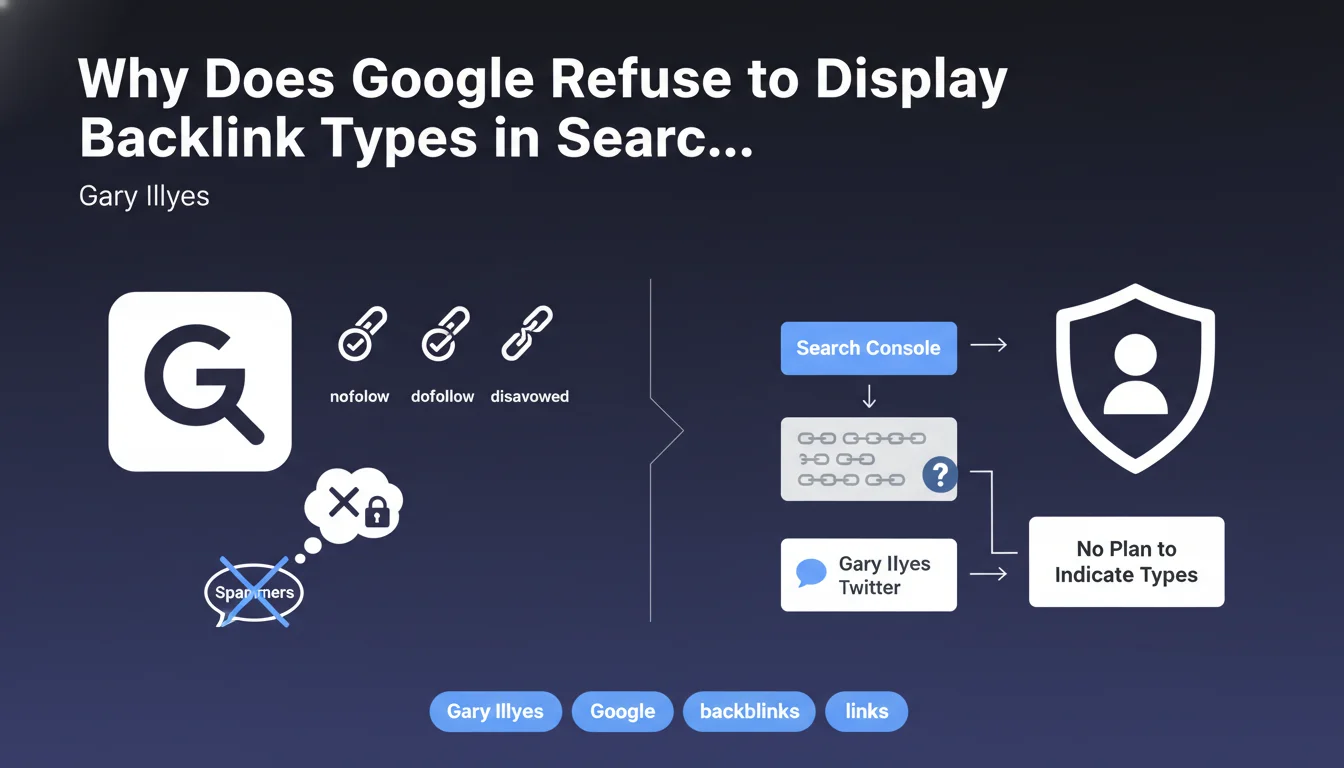
Google has clearly indicated that it does not plan to add a visual distinction between different types of links (dofollow, nofollow, disavowed) in the Search Console interface. The justification put forward is to avoid facilitating the work of spammers.
This position may seem paradoxical since only the authenticated webmaster has access to this data. The spam protection argument therefore seems difficult to defend from a logical standpoint.
Why does this limitation create problems for SEO professionals?
The absence of differentiation forces SEO professionals to manually export and analyze thousands of backlinks. This task becomes particularly time-consuming on sites with a significant link profile.
SEO professionals currently have to use third-party tools or check each link individually to determine its status, even though Google already has this information in its systems.
What are the implications of this decision for backlink analysis?
This technical limitation transforms a simple task into a complex and repetitive process. Webmasters waste valuable time that could be devoted to more strategic optimizations.
- No direct visibility on nofollow links in the Search Console interface
- Inability to quickly filter disavowed links already processed
- Need for external tools to obtain an overview of the link profile
- Analysis time multiplied to identify problematic links
- Risk of errors during manual exports and cross-referencing
SEO Expert opinion
Is Google's justification really credible?
The spam protection argument doesn't hold water from a technical perspective. A spammer who controls a malicious site can easily check the attribute of links they create by consulting the source code of the target page.
The real reason could be more prosaic: Google probably wants to limit the resources allocated to Search Console and prevent webmasters from artificially over-optimizing their link profile. This opacity maintains a certain gray area in backlink management.
What are the real consequences of this limitation?
This lack of transparency paradoxically pushes SEO professionals toward paid third-party solutions like Ahrefs, Majestic or Semrush. These tools provide exactly the visibility that Google refuses to offer.
We also note that less experienced webmasters have more difficulty identifying toxic links, which can harm their SEO. The opacity ultimately only penalizes the least equipped professionals.
Is this approach consistent with Google's overall strategy?
There is a certain contradiction in Google's communication. On one hand, the company encourages transparency and pushes webmasters to create quality content. On the other, it maintains opacity on data that is nevertheless essential for optimization.
This posture is part of a broader strategy where Google maintains control of information and keeps webmasters dependent on its tools and sometimes vague recommendations.
Practical impact and recommendations
How can you effectively work around this Search Console limitation?
The first solution is to regularly export backlink data from Search Console and cross-reference it with third-party tools. Create a consolidated database to track the evolution of your link profile.
Use automation scripts to check link attributes (dofollow/nofollow) on your main backlinks. Tools like Screaming Frog can analyze pages pointing to you in bulk.
What mistakes should you absolutely avoid in backlink management?
Never disavow links without having verified their real negative impact. Excessive disavowal can deprive you of links that, while imperfect, contribute positively to your authority.
Avoid focusing solely on quantitative metrics. A nofollow backlink from an authoritative site can generate qualified traffic and strengthen your credibility, even if it doesn't transmit PageRank.
What should you implement concretely to monitor your link profile?
Establish a monthly monitoring process combining Search Console data with at least two third-party tools. This multi-source approach will give you a more complete and reliable view.
- Export the complete backlink list from Search Console monthly
- Use at least two third-party tools (Ahrefs, Majestic, Semrush) to cross-reference data
- Create a consolidated dashboard with the evolution of referring domains
- Identify and classify new backlinks according to their quality and attribute
- Maintain an up-to-date disavow file and submit it only if necessary
- Monitor abnormal spikes in new links that could signal negative SEO
- Analyze the distribution of anchor text to detect over-optimization
- Document voluntary link building actions to differentiate natural from artificial acquisition
💬 Comments (0)
Be the first to comment.