
Official statement
What you need to understand
Why is it impossible for Google to count all the links on the web?
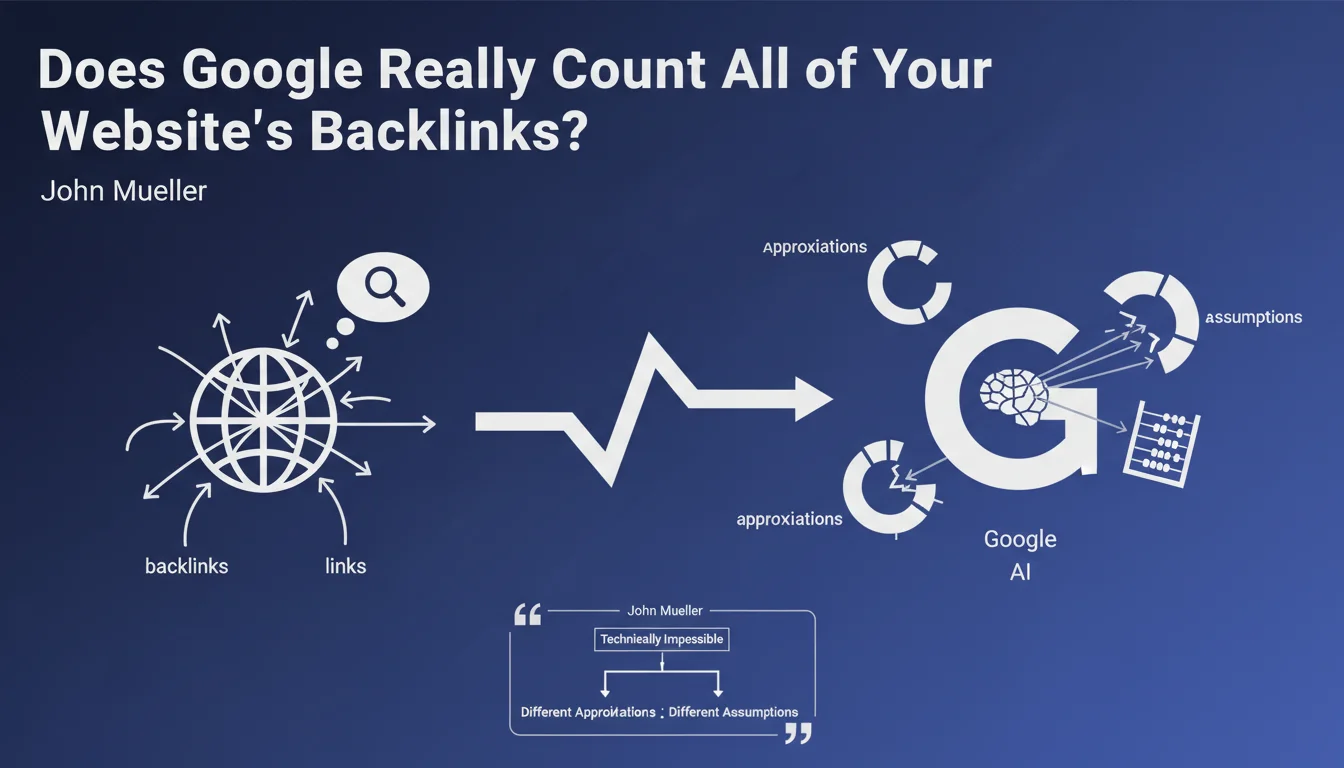
John Mueller's statement reveals a fundamental technical reality: the web has become too vast and complex for exhaustive link counting to be possible. With billions of web pages created, modified and deleted every day, no system, not even Google's, can capture the entire link graph in real time.
Each search engine therefore makes sampling and approximation choices based on its own algorithms, computing power and priorities. Google does not crawl all pages on the web, does not detect all links, and does not reassess them all at the same frequency.
What does this actually mean for backlink analysis?
This statement confirms that all link analysis tools work with partial data. Whether it's Google Search Console, Ahrefs, Majestic or Moz, each has its own incomplete index and uses different methodologies to discover and evaluate links.
This explains why you observe significant discrepancies between these different tools. None holds the absolute truth, because absolute truth simply doesn't exist in this context.
What are the implications for your link building strategy?
- No tool will show you all your backlinks, not even Google Search Console
- Metrics like total link count are approximations to be taken with a grain of salt
- Google itself works with samples and estimates to evaluate a site's popularity
- Quality trumps quantity, because even Google doesn't count all links
- Variations between tools are normal and shouldn't alarm you excessively
SEO Expert opinion
Is this statement consistent with practices observed in the field?
Absolutely. This transparency from John Mueller confirms what experienced SEO experts have been observing for years. Google Search Console data often shows fewer backlinks than third-party tools, and vice versa. Some powerful links never appear in any tool, while others persist in databases long after they've disappeared.
I've regularly observed that sites achieve ranking improvements after acquiring links that don't appear in any tracking tool. This demonstrates that Google detects and values signals that our SEO tools don't capture.
What critical nuances should be applied to this statement?
If Google doesn't count all links, we shouldn't conclude that link building has become less important. On the contrary, it means Google has developed sophisticated methods to evaluate link quality from representative samples.
Google likely uses advanced weighting and filtering algorithms that give more weight to certain signals than others. A link from an authoritative and relevant source will have a disproportionate impact compared to hundreds of low-quality links.
In what contexts does this limitation have the most impact?
This approximation particularly affects niche sites and new sites. If Google doesn't frequently explore your sector, your new backlinks may take much longer to be discovered and taken into account.
For e-commerce sites with millions of pages, this also means certain sections may receive links that are never accounted for. What matters is building a solid architecture where external links benefit the entire site through good internal linking.
Practical impact and recommendations
How can you adapt your link building strategy to this reality?
Focus on acquiring high-quality links rather than quantity. Since Google works with samples, each visible and powerful link has an amplified impact in its evaluation system.
Prioritize links from thematically relevant sources recognized in your sector. These sites are more likely to be regularly crawled by Google, increasing the probability that your backlinks will be detected and valued quickly.
Don't rely on a single analysis tool. Use multiple data sources (Google Search Console, Ahrefs, Majestic) to get a more complete picture, even if it remains approximate. Look for trends rather than absolute numbers.
What critical mistakes must you absolutely avoid?
Don't panic if you don't see all your links in Google Search Console. The absence of a link in a tool doesn't mean it's not being taken into account by Google. The reverse is also true: the presence of a link in a tool doesn't guarantee its impact.
Avoid focusing on vanity metrics like total referring domains. These numbers are approximate and can vary enormously depending on the tool used. Instead, focus on the evolution of your organic traffic and positions on strategic keywords.
Don't attempt to exploit this limitation by thinking Google won't see your spam techniques. Pattern detection algorithms work effectively even on partial data, and penalties can be severe.
What approach should you adopt to maximize your backlinks' impact?
- Prioritize quality over quantity: one link from an authoritative site is worth more than 100 mediocre links
- Diversify your sources: obtain links from different types of sites (media, blogs, institutional)
- Ensure thematic relevance: contextual links in your domain have more impact
- Optimize your internal linking: redistribute the power of external links to your strategic pages
- Monitor trends rather than absolute numbers: evolution matters more than the exact count
- Use multiple tracking tools: combine Google Search Console with at least one third-party tool
- Focus on business results: qualified traffic, conversions and positions on your priority keywords
- Maintain competitive intelligence: analyze the link profiles of your well-ranked competitors
💬 Comments (0)
Be the first to comment.