
Official statement
What you need to understand
Is There an Automatic Correlation Between a Link's Age and Its SEO Value?
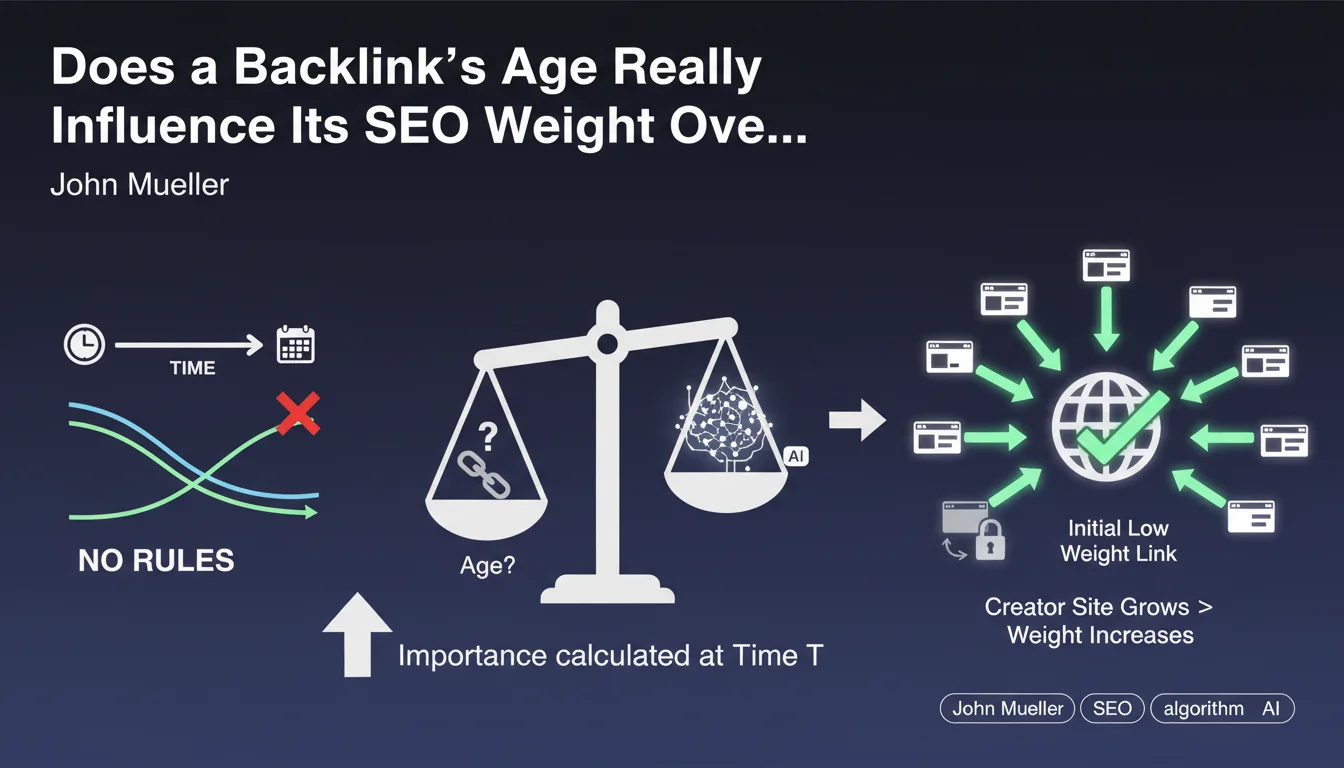
The answer is clear: no, there is no predefined rule that would automatically increase or decrease a backlink's value based on its age. Contrary to a common belief in the SEO community, Google does not calculate a link's strength using a formula based solely on the time elapsed since its creation.
What truly matters is the link's importance evaluated at a given moment T by Google's algorithm. This evaluation is dynamic and can evolve considerably over time, in either direction.
How Can a Backlink's Value Evolve Over Time?
A link can see its SEO weight increase if the source site gains authority and thematic relevance. For example, a backlink obtained from an emerging blog can become very valuable if that blog becomes a reference in its field.
Conversely, an initially powerful link can lose its value if the source site deteriorates: lower quality content, traffic loss, thematic shift, or algorithmic penalties.
What Really Determines a Backlink's Strength?
Google performs a continuous analysis of link quality taking into account multiple factors: the source site's authority, contextual relevance, the link's positioning on the page, and the overall evolution of the referring site's profile.
- Age alone is not a valuation criterion for backlinks
- A link's value is regularly reassessed by Google
- A backlink can gain or lose power depending on the source site's evolution
- It's the quality at the present moment that counts, not seniority
- The algorithm performs a dynamic contextual analysis of the link profile
SEO Expert opinion
Is This Statement Consistent with What SEOs Observe in Practice?
Absolutely. This position corresponds perfectly to what we've been observing for years during backlink profile audits. Sites regularly see their old links gain or lose effectiveness without their age being the determining factor.
I've personally witnessed cases where backlinks 5-7 years old suddenly contributed to significant ranking gains, simply because the source site had published viral content and gained authority. The reverse is equally common: historical links become toxic when the referring site drifts toward questionable practices.
What Important Nuances Should Be Added to This Analysis?
First crucial point: even though age is not a direct factor, old quality links statistically have a better chance of having survived multiple algorithmic updates. This makes them indirect trust indicators.
Second nuance: a link's age can influence its perceived stability by the algorithm. A backlink that remains constant for years, coming from a stable site, sends a signal of lasting and natural relationship.
In Which Cases Does This Rule Have Exceptions?
There are specific situations where temporality plays a role: for current events or time-sensitive topics (QDF - Query Deserves Freshness), Google may favor recent signals, links included.
Furthermore, in the context of manipulation detection, the sudden appearance of numerous backlinks can trigger algorithmic vigilance, while progressive and natural acquisition will be better received. But again, it's the pattern that matters, not the age itself.
Practical impact and recommendations
How Should You Manage Your Backlink Profile Considering This Reality?
The absolute priority is to adopt continuous monitoring of your link profile. Don't just acquire backlinks and then forget about them. Regularly analyze the qualitative evolution of sites that reference you.
Use tools like Ahrefs, Majestic or SEMrush to monitor the evolution of referring domains' metrics: their traffic, authority, and positioning. A declining site can drag your own performance down.
Focus your efforts on obtaining links from sites with strong growth potential rather than systematically favoring established giants. A link from a quality emerging media outlet can become extremely valuable.
What Critical Mistakes Should You Absolutely Avoid?
Never disavow links solely because they are old. This is a common mistake that can cost you valuable backlinks. Age is not a toxicity criterion.
Also avoid neglecting your old partners in favor of constantly seeking new links. A site that has been referencing you for a long time and continues to evolve positively represents a strategic asset to cultivate.
- Conduct a quarterly audit of your referring domains' qualitative evolution
- Identify referring sites that are gaining authority and strengthen these relationships
- Monitor ownership changes or editorial line shifts of source sites
- Disavow only links from objectively toxic sites, never based on age criteria
- Document the history of each strategic backlink and its evolution over time
- Favor regular and natural acquisition rather than massive one-time campaigns
- Maintain lasting relationships with quality sites that reference you
How Can You Implement an Evolving Link Building Strategy?
Develop a long-term relational link building approach. Rather than considering each backlink as an isolated transaction, build partnerships with players whose growth you anticipate.
Integrate into your process a thorough due diligence phase: analyze not only a potential site's current state, but also its trajectory, the quality of its recent content, and its strategic positioning in its ecosystem.
💬 Comments (0)
Be the first to comment.