
Official statement
Other statements from this video 2 ▾
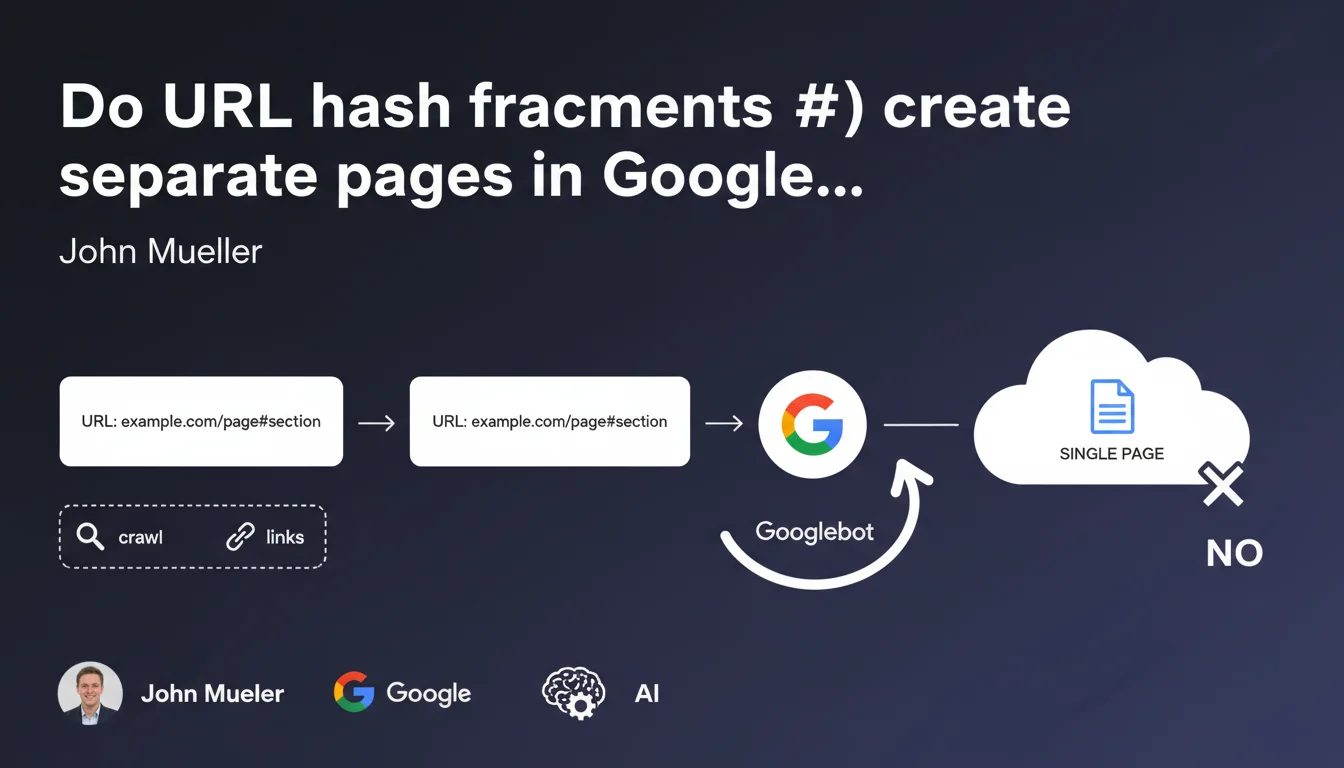
Google treats URLs with hash fragments (#) as a single and identical page, regardless of what comes after the #. The hash only serves to point to a specific section on the client side in the browser, but has no impact on crawling or indexing. For Google, example.com/page and example.com/page#section1 are strictly identical.
What you need to understand
What is the technical difference between the base URL and the hash fragment?
A URL containing a hash symbol (#) is divided into two distinct parts. The part before the hash constitutes the actual page address that the server processes. The part after the hash is what's called an anchor fragment that tells the browser to scroll the page to a specific HTML element bearing that identifier.
Concretely? If you visit example.com/article#conclusion, the server loads exactly the same page as for example.com/article. The browser then handles positioning the viewport automatically to the element with the ID "conclusion". No separate HTTP request is sent for the part after the hash.
How does Google handle these fragments during crawling?
Googlebot sees only a single URL when it encounters links with different hash fragments pointing to the same base page. The crawler completely ignores the part after the #, because this information is never transmitted to the server in HTTP requests. This is a specificity of the HTTP protocol itself.
In practice, if your site contains 50 internal links to /pricing#tarif-pro, /pricing#tarif-entreprise, and /pricing#tarif-freelance, Google will crawl and index only /pricing. Multiple fragments do not fragment your crawl budget nor create duplicate content risks.
Why is this distinction important for indexing?
This statement underscores a fundamental principle: one page means one indexed piece of content, one PageRank distribution, one ranking opportunity. You cannot optimize differently the version with #section1 and the one with #section2, because Google does not differentiate between them.
This has direct implications for your internal linking strategy and how you structure your long-form content. If you are trying to create distinct SEO entry points for different topics, hash fragments are clearly not the solution.
- The hash fragment (#) is processed client-side (in the browser), never sent to the server
- Google considers all fragment variations as a single canonical URL
- No duplicate content risk, but no possibility for distinct SEO targeting either
- Fragments do not influence crawling, indexing, or ranking
- Useful for UX (intra-page navigation), neutral for SEO
SEO Expert opinion
Does this statement match real-world observations?
Absolutely. Tests have shown for years that Google indeed treats hash fragments as purely cosmetic elements from an indexing perspective. If you review your server logs, you'll notice that the part after the # never appears in Googlebot requests. This is consistent with how the HTTP protocol works.
The confusion often arises because some JavaScript frameworks (notably older versions of Angular) used hash-based URLs to simulate client-side routing. In those specific cases, Google developed particular mechanisms (such as the #! scheme now abandoned), but the principle remains: without JavaScript that modifies the DOM, the fragment stays invisible to crawling.
What nuances should be added to this statement?
First nuance: if your site uses JavaScript to load different content depending on the fragment, Google can theoretically see it during JavaScript rendering. But even in that case, it will index the content under the base URL, not under the hash variants. The URL distinction remains invalid for indexing.
Second point — fragments have an indirect impact on SEO through UX metrics. A user arriving via a link with anchor #conclusion lands directly on the answer they're looking for, which can improve engagement time and reduce pogo-sticking. These behavioral signals can influence ranking, even if the technical URL remains unique.
In what scenarios does this rule create problems?
The classic case: you have an exhaustive FAQ on a single page, and you want each question/answer to rank individually on specific long-tail queries. With hash fragments, impossible. Google indexes the overall page, not the sections.
Solution? Create truly distinct pages for each major question, or use an accordion content system with Schema.org FAQPage markup. FAQ rich snippets can give visibility to sub-sections without creating separate real URLs — but Google decides when and how to display them.
Practical impact and recommendations
What should you do concretely with this information?
First step: audit your internal linking. If you've scattered your internal links across 15 different fragment variations pointing to the same base page, you're unnecessarily diluting the authority you're passing. Better to concentrate all links on the canonical URL without a fragment, or at minimum on a single main fragment per page.
Next, review your keyword targeting strategy. If you thought you'd rank differently on "freelance pricing" with #freelance and "enterprise pricing" with #enterprise, abandon that idea completely. Either you create two truly distinct pages, or you accept ranking globally on "pricing" with a single well-structured page.
How to optimize the use of fragments without harming SEO?
Fragments remain excellent for improving user experience on long-form content. Clickable table of contents, navigation to specific sections in your emails or social posts — all of this improves engagement with zero SEO risk since Google indexes the base URL anyway.
Advanced technique: use hash fragments combined with Schema.org markup (for example ItemList or HowTo with anchors) to suggest to Google the internal structure of your page. This can influence the display of sitelinks or the generation of jump links in the SERPs, even if Google remains the master of its own choices.
- Verify that your canonical URLs do not contain hash fragments
- Consolidate your internal links on clean URLs without #, except for justified UX usage
- Never rely on fragments to create distinct SEO entry points
- Use fragments to improve intra-page navigation (tables of contents, anchors)
- If you need to segment content for SEO, create truly separate pages
- Implement structured Schema.org markup to help Google identify important sections
- Monitor your logs to confirm that Googlebot sees only one URL per base page
When should you consider professional assistance?
Managing URL architecture and internal linking finely quickly becomes complex on medium to large-sized sites. Between crawl budget concerns, authority consolidation, and keyword targeting strategy, structural decisions have major impact on your organic performance.
If you identify architecture issues on your site — fragmented URLs, diluted linking, poorly segmented content — bringing in a specialized SEO agency can significantly accelerate resolution. A thorough technical audit and personalized restructuring plan avoid costly mistakes and maximize the efficiency of your optimizations.
❓ Frequently Asked Questions
Est-ce que Google suit les liens avec fragments hash pour découvrir du contenu ?
Les fragments hash peuvent-ils causer du contenu dupliqué ?
Peut-on utiliser les fragments hash pour le tracking sans impact SEO ?
Comment faire ranker différentes sections d'une longue page sur des mots-clés distincts ?
Les sitelinks Google peuvent-ils pointer vers des fragments hash ?
🎥 From the same video 2
Other SEO insights extracted from this same Google Search Central video · published on 26/10/2022
🎥 Watch the full video on YouTube →
💬 Comments (0)
Be the first to comment.