
Official statement
Other statements from this video 5 ▾
- □ Faut-il vraiment surveiller les accès Search Console de vos prestataires SEO ?
- □ Faut-il systématiquement retirer les anciennes agences de Search Console ?
- □ Pourquoi retirer tous les jetons de vérification des anciens utilisateurs dans Search Console ?
- □ Faut-il vraiment limiter les accès des outils SEO à la lecture seule dans la Search Console ?
- □ Pourquoi l'accès délégué est-il préférable aux mots de passe partagés avec vos prestataires SEO ?
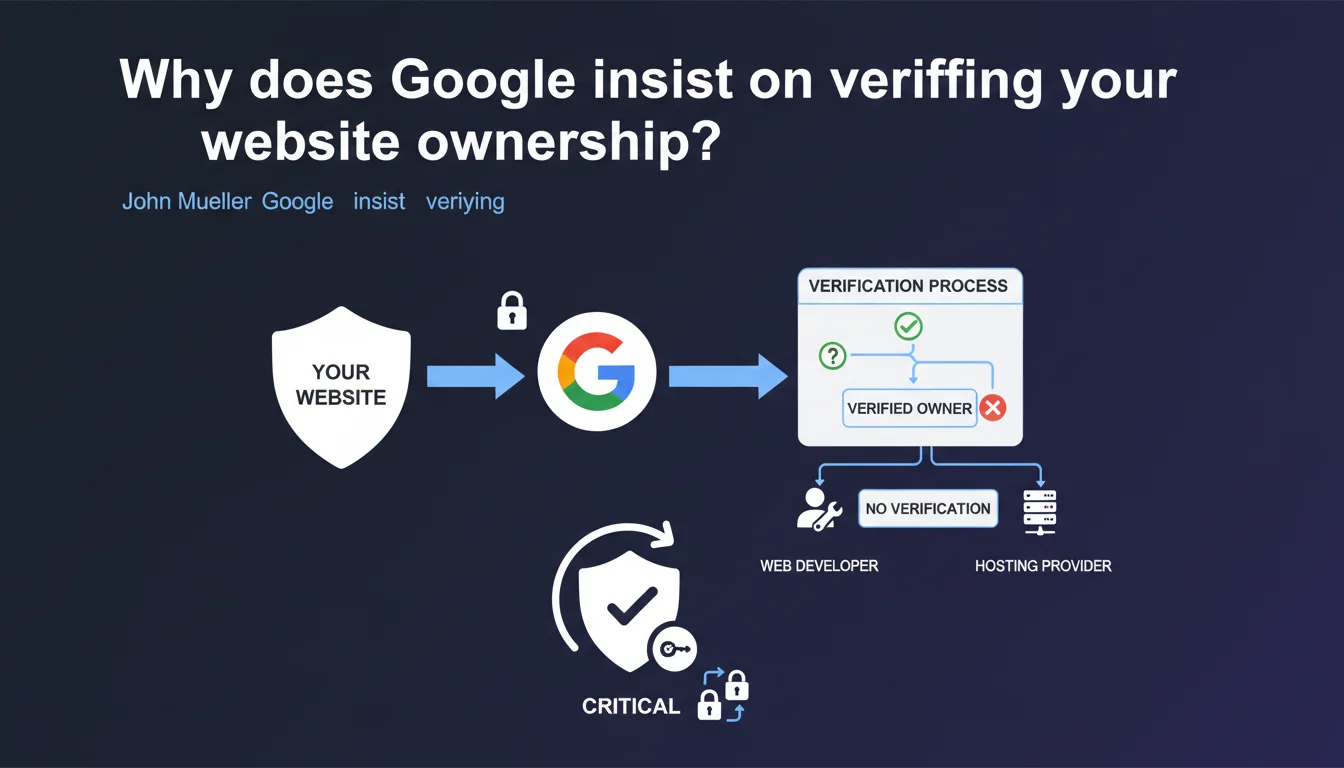
Google officially recommends that you be the verified owner of your own website through Search Console. John Mueller describes this verification as "critical," but the statement remains unclear about the actual consequences of non-verification or shared ownership with a service provider.
What you need to understand
What does "verified owner" really mean to Google?
Ownership verification in Search Console allows Google to identify who has legitimate control of a site. This validation is done through several methods: HTML file, meta tag, Google Analytics, Tag Manager, or DNS record.
The term "verified owner" refers to the user who holds full administrative rights in Search Console, not simply read-only access or a restricted user account. Google clearly distinguishes between the website owner (you) and technical service providers (agency, developer, hosting company).
Why is this recommendation emerging now?
Mueller doesn't say it explicitly, but this emphasis suggests that Google is observing problematic situations: owners excluded from their own Search Console, total dependency on a service provider who retains control, or inability to respond quickly to critical alerts.
The phrasing "if this is not the case, verify with your developer or hosting provider as soon as possible" reveals a frequent reality: many website owners don't even know who technically holds verified ownership of their domain.
What are the concrete implications of unverified ownership?
- Loss of access to Search Console data if the service provider ends the contract or disappears
- Inability to receive security alerts or manual penalties directly
- Total dependency to submit a disavow file or fix critical indexing errors
- Risk of manipulation or extraction of strategic data by a third party without your control
- Blocked access in case of dispute with the agency or developer who refuses to transfer ownership
SEO Expert opinion
Is this statement truly new or just a reminder?
Let's be honest: Google has never officially made organic search rankings conditional on ownership verification. A site without a verified owner in Search Console can index and rank normally. Mueller's statement is more about operational best practice than a ranking factor.
What stands out is the word "critical." Mueller rarely uses this term without reason. Either Google is preparing a feature that will require verified ownership (schema validation, manual actions on certain features), or the Search Console team is observing a surge in problems related to orphaned or hijacked properties. [To verify]
In which cases does verified ownership become truly critical?
Verified ownership becomes essential in three specific scenarios: site migration (changing redirect tools, validating address changes), manual action (you must be able to submit a reconsideration request), and security events (hacking, malware, phishing).
For a stable site without major technical projects, the absence of verified ownership remains a latent risk rather than an immediate disadvantage. But this risk can materialize brutally during a crisis — and then it's too late to resolve access issues.
What nuances should be added to this recommendation?
Google doesn't distinguish between contexts: a small business with a brochure website doesn't have the same stakes as an e-commerce generating €500K monthly revenue. The "criticality" is therefore relative to your dependence on search.
Practical impact and recommendations
How do you verify that you are the owner of your site?
Log into Google Search Console with your professional Google account. Select your property and go to Settings > Users and permissions. Verify that YOU appear as "Owner" (not "User with full access" or "Restricted user").
If your agency or developer is the only owner, immediately request a ownership transfer or add yourself as owner through a method you control directly (DNS or meta tag on the site). Prioritize DNS validation if you manage your DNS zone — it's the most durable verification method.
What should you do if you currently have no access to Search Console?
Contact your current service provider and demand immediate owner access. If the service provider refuses or delays, that's a major red flag about the contractual relationship. You have the legal right to control your own analytics and search data.
At the same time, verify that you have access to your domain registrar (where the domain name is purchased) and your hosting. Site ownership begins with mastery of these two components — Search Console is just the monitoring layer.
What mistakes should you avoid when managing access?
- Never share your personal Google account with a service provider — create dedicated access instead
- Don't verify ownership solely through Google Analytics or Tag Manager (the service provider can revoke access)
- Avoid depending on an HTML file uploaded by the developer (it can disappear during an update)
- Never leave a former service provider as the only verified owner after contract termination
- Document who has access to what in an internal registry (especially for larger organizations)
Verified ownership of your site in Search Console is not a ranking factor, but an operational prerequisite for managing your SEO independently. Google won't penalize an unverified site, but you're exposing yourself to risks of dependency and loss of control.
Practically speaking: verify today that YOU are the owner, not just your agency. And if you discover you have no access or the configuration is opaque, it's probably a sign that a SEO governance overhaul is needed.
These checks may seem simple on the surface, but they often touch on technical aspects (DNS, redirects, migrations) and contractual matters (access rights, intellectual property) that require specialized expertise. If you feel overwhelmed or your digital ecosystem is complex (multiple subdomains, several service providers, heterogeneous technical stack), calling in a specialized SEO agency for a governance audit and personalized support can help you avoid costly mistakes and permanently secure your search presence.
❓ Frequently Asked Questions
Est-ce qu'un site sans propriétaire vérifié dans Search Console sera pénalisé par Google ?
Peut-on avoir plusieurs propriétaires vérifiés pour un même site ?
Quelle méthode de vérification est la plus sécurisée ?
Mon agence SEO doit-elle être propriétaire de mon site dans Search Console ?
Comment récupérer la propriété si mon ancien prestataire refuse de me donner l'accès ?
🎥 From the same video 5
Other SEO insights extracted from this same Google Search Central video · published on 26/07/2023
🎥 Watch the full video on YouTube →
💬 Comments (0)
Be the first to comment.