
Official statement
What you need to understand
What is Google's link labeling system?
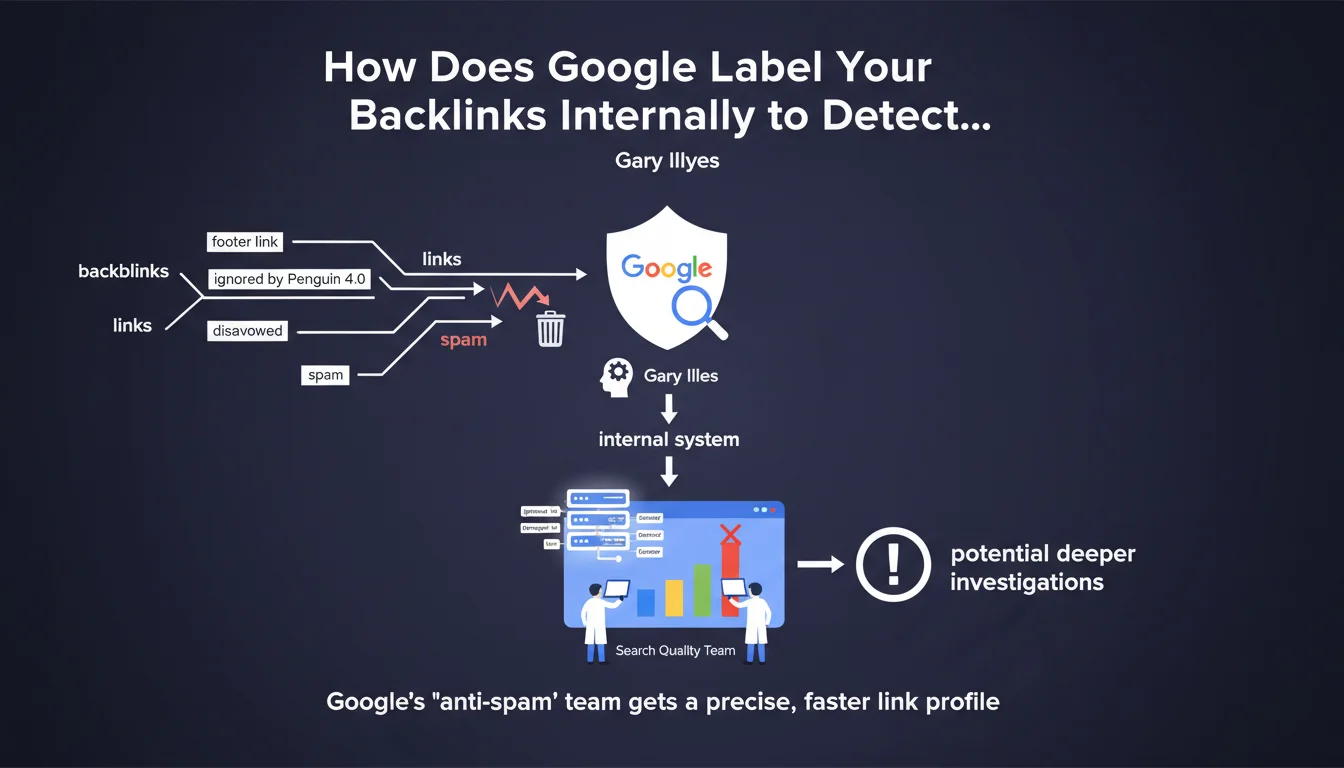
Google has an internal automated classification tool for backlinks pointing to each website. This system assigns specific labels to each link: footer link, link disavowed via Search Console, link ignored by the Penguin 4.0 algorithm, etc.
This information reveals that Google doesn't just analyze links one by one during an investigation. The SQT (Search Quality Team) can instantly visualize a site's link profile with pre-established categories. This considerably accelerates their anti-spam investigations.
Why did Google develop this classification system?
This system allows Google's anti-spam team to have a quick and synthetic overview of a site's link profile. Instead of having to manually analyze thousands of backlinks, experts can immediately identify suspicious patterns.
The objective is to optimize the work of manual teams who must decide whether a site deserves a manual action (penalty). This operational efficiency allows Google to process more cases and refine its spam detection.
What types of labels are applied to backlinks?
According to this statement, labels include at minimum: footer links, links ignored by Penguin 4.0, and links disavowed by the webmaster. It's likely that other categories exist.
- Google automatically categorizes each backlink according to its nature and quality
- The anti-spam team can visualize these classifications to accelerate investigations
- Disavowed links are tracked and labeled in this system
- Penguin 4.0 ignores certain links rather than penalizing, and these links are identified
- Link placement (footer, sidebar, content) is taken into account in the classification
SEO Expert opinion
Does this revelation change our SEO practices?
No, this statement confirms what experienced SEOs have suspected for years. It was obvious that Google couldn't manually process billions of links without an automated classification system.
What's interesting is the official confirmation that certain links are simply "ignored" rather than triggering penalties. This validates Penguin's modern approach which devalues rather than penalizes. For practitioners, this means that the obsession with link disavowal is often disproportionate.
What additional information does this system likely reveal?
Beyond the mentioned labels, this internal system probably contains much more granular classifications. We can imagine labels like: suspected paid link, PBN network link, natural editorial link, reciprocal link, etc.
Google certainly has a quality score per link and can visualize the temporal evolution of a site's link profile. This historical view allows detection of artificial link building campaigns that create abnormal spikes.
Does this labeling affect automatic ranking in SERPs?
This is a crucial distinction to understand. This label system primarily serves the manual investigations of the SQT team, not necessarily automatic algorithmic ranking.
Ranking algorithms (including Penguin) have their own link evaluation systems. These labels are rather a diagnostic tool for humans at Google. However, it's likely that some of these classifications also feed automatic algorithms.
Practical impact and recommendations
What should we do differently with this information?
First, stop panicking about every bad link pointing to your site. If Google labels them as "ignored by Penguin," they don't harm your ranking. The algorithm simply devalues them.
Second, focus your efforts on acquiring natural editorial links in the main content of pages. These links are probably labeled positively and have a real impact on your ranking.
Third, if you use the disavow file, know that Google tracks this action. Massively disavowing without valid reason could signal an attempt to hide questionable past practices.
What mistakes should we avoid in light of this statement?
Don't waste your time systematically disavowing all low-quality links. Google probably already ignores them automatically. Disavowal should be reserved for extreme cases: massive negative SEO attacks or explicit spam campaigns.
Avoid easily detectable artificial link patterns: over-optimized anchors, systematic footer links, massive reciprocal exchanges. These patterns are probably automatically labeled and attract the attention of the anti-spam team.
- Prioritize acquiring editorial links in main content
- Vary link anchors naturally
- Only disavow links that are clearly spam or from negative attacks
- Avoid artificial link placements (footer, systematic sidebar)
- Monitor your link profile evolution to detect anomalies
- Document your link building campaigns to justify your profile if necessary
- Analyze the diversity and naturalness of your backlink sources
How should we audit our link profile with this perspective?
Adopt Google's point of view: analyze your backlinks by categories (placement, site type, anchor, context). Identify patterns that could be negatively labeled. Use tools like Ahrefs, Majestic or SEMrush to segment your profile.
Look at the temporal evolution of your link acquisitions. Suspicious spikes or repetitive patterns are warning signals. Check the proportion of natural editorial links versus footer links, directories or exchanges.
💬 Comments (0)
Be the first to comment.