
Official statement
What you need to understand
What is Google's official position on international links?
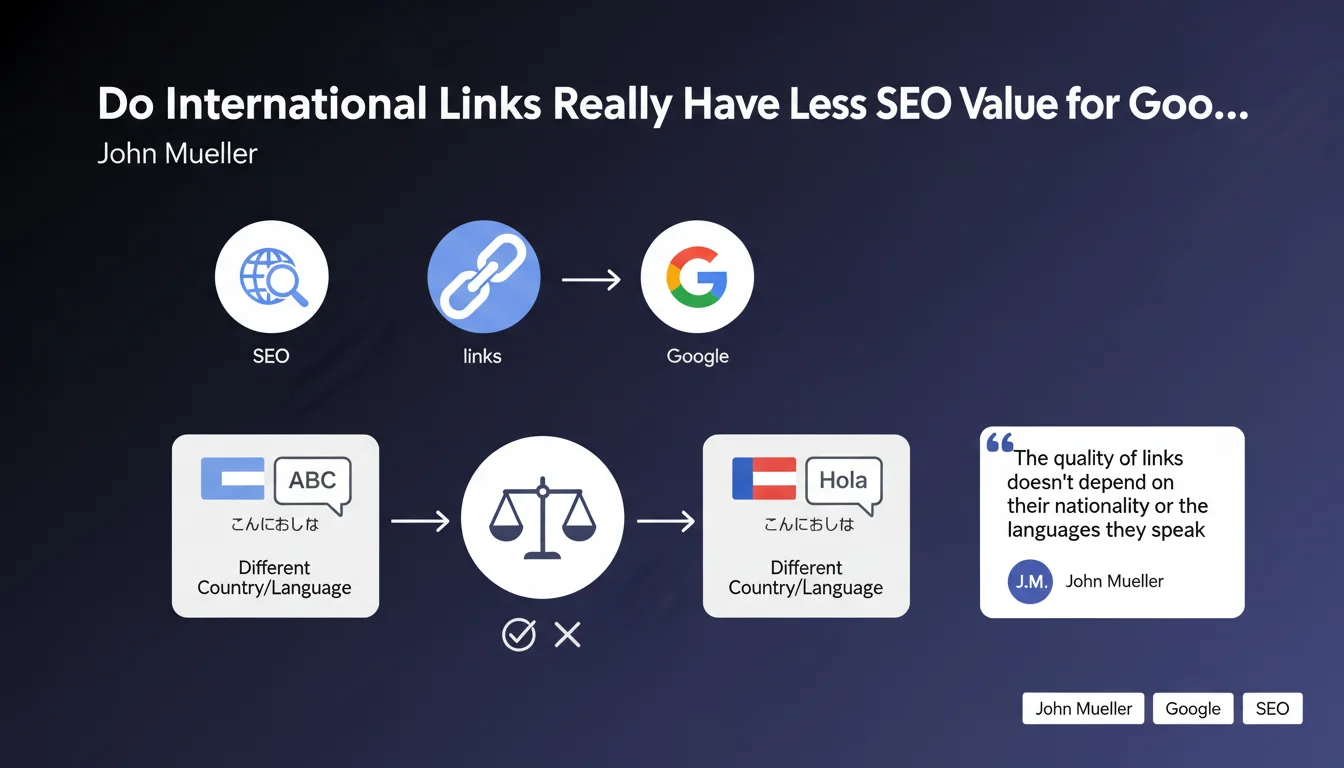
Google has clearly stated that the quality of a link depends neither on the nationality of the site nor on the language in which it is written. A backlink from a foreign site can have exactly the same value as a local link.
This statement aims to dispel a widespread myth in the SEO community that links from the same country or language would systematically carry more weight. Google evaluates links based on intrinsic quality criteria, regardless of their geographical origin.
What are the real quality criteria for a backlink according to Google?
Google focuses on factors such as the authority of the source domain, thematic relevance between contents, and the overall editorial quality of the site. The language or country of origin are not determining criteria.
The algorithm rather analyzes the contextual coherence of the link, its natural placement within the content, and the credibility of the site transmitting it. An editorial quality link from a German site can outperform a mediocre link from a French site.
How does this approach integrate into the overall link building strategy?
This Google position encourages international diversification of link profiles. Sites can benefit from backlinks coming from multiple geographical areas without fearing a penalty or devaluation.
- A link's nationality does not affect its qualitative evaluation
- Google prioritizes thematic relevance over geographical origin
- Multilingual and international links are treated equitably
- A geographically diversified backlink profile can be beneficial
- Authority and editorial quality remain the priority factors
SEO Expert opinion
Does this statement align with what SEO professionals observe in practice?
In practice, this statement from Google indeed corresponds to what I have been observing for several years on international projects. Sites receiving links from quality foreign sources suffer no penalty and fully benefit from their SEO juice.
However, there is an important nuance: even if Google does not discriminate by nationality, contextual relevance remains crucial. A link from a Chinese site to French content may be less effective if the target audiences have no common ground, not because of the language, but due to lack of thematic coherence.
What subtleties should be understood beyond this statement?
While nationality does not directly count, certain indirect signals can influence perceived value. For example, artificial link patterns are easier to detect when they come massively from geographical areas with no logical connection to the target site.
Moreover, for local SEO and geolocated results, Google may value proximity signals. A Parisian restaurant will benefit more from local citations, but this relates to a different mechanism than pure link quality evaluation.
In which contexts does this rule require nuanced interpretation?
For e-commerce sites with multiple national versions, the structure of international internal links must be carefully managed. Even if Google does not penalize cross-border links, a vague architecture can create cannibalization problems between language versions.
Local news sites constitute another particular case: their authority is often built on proximity signals, even if technically a quality international link retains its value. The balance between local and international links must correspond to the natural logic of the sector.
Practical impact and recommendations
How can you concretely optimize your international link building strategy?
You can now expand your backlink prospecting without geographical restrictions. Focus on editorial quality and thematic relevance rather than the site's origin. A link from an authoritative Spanish blog is worth as much as a French equivalent.
Prioritize partnerships with international sites in your niche, even if they do not share your language. What matters is that the content remains coherent and the link is contextual. This approach naturally enriches your link profile.
What mistakes should you avoid when managing multilingual links?
Do not fall into the trap of systematically refusing foreign link opportunities for fear of devaluation. This fear no longer has any foundation according to Google's official statements.
Also avoid artificially creating links from multiple countries solely to diversify geographically. Google detects these unnatural patterns. Diversification must flow organically from your content strategy.
- Accept quality link opportunities regardless of their geographical origin
- Check thematic relevance before linguistic concordance
- Naturally diversify your backlink profile without forcing geolocation
- Do not disavow quality international links on principle
- Analyze classic authority metrics (DR, traffic, editorial quality)
- Maintain coherence between your content and link sources
- Use hreflang correctly if you manage multiple language versions
How can you audit and adjust your existing strategy?
Conduct a comprehensive audit of your current backlink profile by analyzing geographical and linguistic distribution. Identify whether you have neglected quality international opportunities due to lack of awareness of this rule.
Reassess your selection criteria for partnerships and guest posts. If you were filtering by language or country, broaden these criteria while maintaining requirements for quality and thematic relevance.
💬 Comments (0)
Be the first to comment.