
Official statement
Other statements from this video 4 ▾
- □ Peut-on vraiment payer Google pour améliorer son crawl ou son classement ?
- □ Pourquoi Google divise-t-il son fonctionnement en exactement trois étapes distinctes ?
- □ L'indexation est-elle vraiment le mécanisme par lequel Google comprend vos pages ?
- □ Les attributs de page augmentent-ils vraiment la visibilité dans Google ?
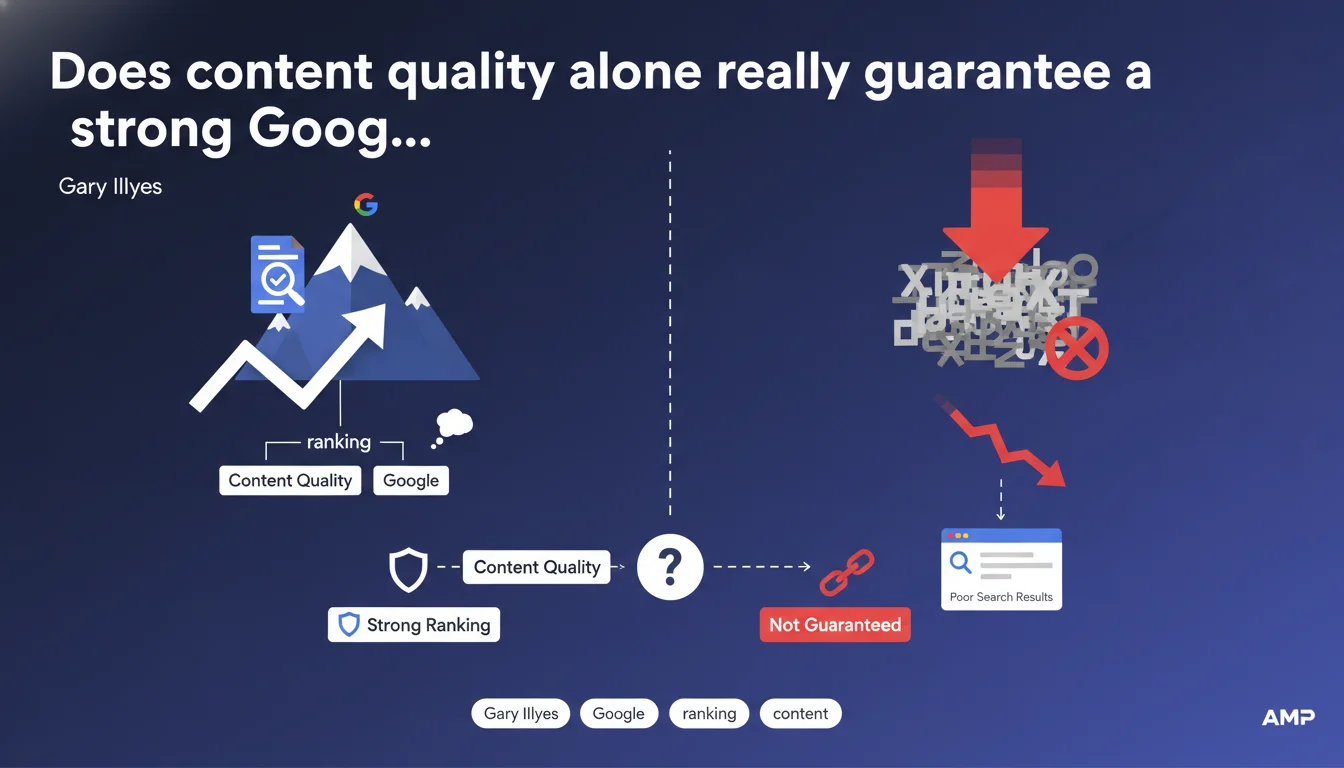
Google states that content quality directly determines visibility in search results. Text spam and nonsensical content are penalized. However, this claim remains vague about the specific criteria that define this "quality."
What you need to understand
Gary Illyes reminds us here of an obvious fact: Google prioritizes high-quality content in its ranking. But behind this statement lies a more nuanced reality than it first appears.
The example given — "large amounts of nonsensical text" — clearly targets text spam practices and automated generation without added value. It's a signal sent to those still betting on raw volume rather than relevance.
What exactly does Google mean by "quality"?
This is where things get fuzzy. Google provides no measurable criteria here to define this quality. Depth of treatment? Demonstrated expertise? Alignment with search intent?
We can assume it's a mix of E-E-A-T signals, user satisfaction (time spent, bounce rate), and the content's ability to precisely answer a query. But Gary Illyes remains deliberately vague.
Does this statement change anything for SEO practitioners?
Not really. All serious SEOs have known for years that mediocre content doesn't hold up on competitive queries. What's missing is a clear evaluation framework.
Google's message remains consistent: create for users, not for the algorithm. Except that in practice, you need to understand the algorithm to optimize effectively.
- Content quality directly influences ranking, officially confirmed
- Text spam and content generated in bulk without value are penalized
- Google does not define specific measurable criteria for evaluating this quality
- The emphasis is on user intent and relevance, not volume
- This statement is part of the ongoing E-E-A-T approach and quality updates
SEO Expert opinion
Is this statement really actionable for an SEO professional?
Let's be honest: no. Saying that "quality matters" without explaining how Google measures it is like saying "run faster" without explaining the technique.
What would have been useful? Concrete examples of what differentiates "quality" content from average content in the algorithm's eyes. Metrics. Thresholds. But Google deliberately maintains this gray area to prevent manipulation.
Does the field confirm this vision?
Yes and no. We do observe that sites with hollow or mass-generated content lose positions, especially since Core Updates focused on quality.
But — and this is where it gets tricky — we also see mediocre content ranking well if it has other strong signals: domain authority, powerful backlinks, age. Quality alone doesn't always suffice. [To verify] : Gary Illyes says quality "strongly determines" visibility, but he doesn't say it's the only factor.
What nuances need to be added?
First, the notion of quality is relative to the query. "Quality" content for an informational search is completely different from what's expected for a transactional query.
Second, Google probably evaluates quality through indirect signals: user behavior, click-through rate, session time. Not just semantic analysis of the text.
Practical impact and recommendations
What should you concretely do to improve "quality" in Google's eyes?
Focus on search intent. Analyze the top 10 for your target queries: what type of content does Google value? What depth? What format?
Then, go beyond the competition. Add exclusive data, case studies, original visuals. Everything that demonstrates real expertise and brings unique value.
Finally, monitor engagement metrics in Search Console and Analytics. If your pages have low CTR or low time spent, it's a signal that Google might interpret as a lack of quality.
What mistakes must you absolutely avoid?
Don't fall into the trap of volume for volume's sake. Publishing 50 mediocre articles will never be worth 5 truly in-depth and useful pieces of content.
Also avoid simply paraphrasing competitors. Google is increasingly good at detecting "me-too" content that adds nothing new.
And above all, don't rely solely on generative AI to produce at scale. Content generated without strong editorial oversight often has that "absurdity" that Gary Illyes points out.
How can you verify that your content passes Google's quality test?
- Compare your content to the top 3 on the SERP: do you provide more value?
- Verify that each page answers a specific intent, not multiple at once
- Integrate proof of expertise: sources, data, practical cases, testimonials
- Analyze user behavior via Search Console: CTR, impressions, average positions
- Audit your old content and consolidate or delete what adds nothing
- Test readability: short sentences, clear structure, well-spaced paragraphs
- Avoid unnecessary jargon and hollow phrasing that dilutes your message
Content quality is a central lever, but remains difficult to objectify. Focus on user intent, depth of treatment, and proof of expertise. Eliminate weak or redundant content.
These optimizations require careful analysis of your niche, your competitors, and your audience's specific expectations. If you lack the time or resources to conduct this in-depth audit, support from a specialized SEO agency can help you structure a solid editorial strategy and avoid costly mistakes.
❓ Frequently Asked Questions
Qu'est-ce que Google considère comme du « texte absurde » ?
La qualité du contenu peut-elle compenser un faible nombre de backlinks ?
Comment Google mesure-t-il concrètement la qualité d'un contenu ?
Faut-il supprimer les contenus anciens peu performants ?
Les contenus générés par IA sont-ils considérés comme du « texte absurde » ?
🎥 From the same video 4
Other SEO insights extracted from this same Google Search Central video · published on 15/02/2024
🎥 Watch the full video on YouTube →
💬 Comments (0)
Be the first to comment.