
Official statement
Other statements from this video 4 ▾
- □ Peut-on vraiment payer Google pour améliorer son crawl ou son classement ?
- □ La qualité du contenu suffit-elle vraiment à garantir un bon positionnement Google ?
- □ Pourquoi Google divise-t-il son fonctionnement en exactement trois étapes distinctes ?
- □ Les attributs de page augmentent-ils vraiment la visibilité dans Google ?
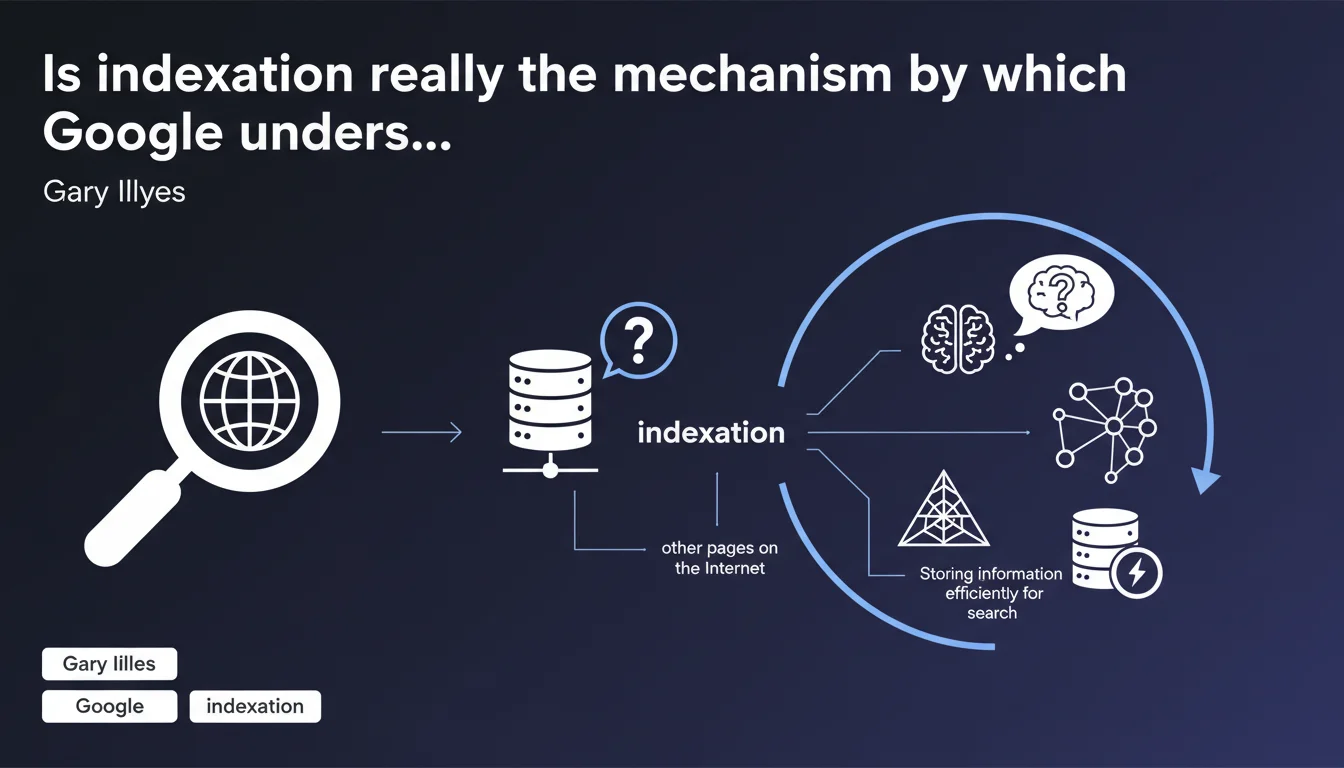
Gary Illyes reminds us that indexation goes far beyond storage: it's the process by which Google analyzes a page's content, establishes its relationships with other web content, and structures this data to make it searchable. This expanded definition extends indexation beyond simple inclusion in the index, incorporating semantic and contextual understanding.
What you need to understand
Why does Google emphasize the notion of "understanding" in indexation?
Gary Illyes's statement sets an important framework: indexation is not simply adding a URL to a database. It's an analytical process where Google breaks down content, identifies entities, extracts semantic signals, and maps connections between pages.
This nuance shifts perspective: if you simply "get your pages indexed" without working on their structure, semantic clarity, and internal linking, you're missing the essentials. Google can technically index a page while understanding it poorly — or not at all.
What specifically does "its relationship with other pages on the Internet" mean?
Google doesn't treat a page in isolation. It analyzes backlinks, internal link context, thematic co-occurrences, and rebuilds a knowledge graph to position each piece of content within an informational ecosystem.
This means an orphaned page, even if technically indexable, loses much of its understanding potential. Conversely, a page well-anchored in coherent internal linking benefits from reinforced semantic context.
Does search efficiency really depend on storage method?
Yes, and it's rarely discussed. Google doesn't store your pages as-is: it extracts optimized representations (tokens, embeddings, graphs) to accelerate queries. A poorly structured page, filled with informational noise, or whose signals are contradictory, complicates this process.
Result: even if indexed, it may be underutilized during ranking phases. Indexation isn't binary — there are degrees of quality in how Google understands and stores your content.
- Indexation incorporates semantic analysis, not just crawling and storage
- A page indexed but poorly understood has limited ranking impact
- Internal linking and backlinks directly influence contextual understanding
- HTML structure, metadata, and editorial clarity facilitate signal extraction
SEO Expert opinion
Is this expanded definition of indexation consistent with real-world observations?
Yes — and it explains why some indexed pages (visible in Search Console) never rank. Being in the index doesn't mean Google understands what you're talking about, or how to position you relative to other resources.
We regularly observe indexed pages with catastrophic rankings, often because their semantic structure is weak: no <h1>-<h6> hierarchy, ambiguous content, missing internal linking. Google stores them, but doesn't know what to do with them.
What nuances should be added to this statement?
Gary Illyes remains deliberately vague about the quality thresholds required for a page to be "well understood". [To verify]: Google has never communicated clear metrics distinguishing superficial indexation from deep indexation with rich understanding.
Similarly, the notion of "relationship with other pages on the Internet" encompasses dozens of signals (backlinks, unlinked mentions, co-citations, thematic proximity, domain authority…) without specifying their respective weight. We know it matters, but it's impossible to quantify.
In which cases does this logic not fully apply?
Sites with high domain authority sometimes benefit from "tolerant" indexation: Google understands their pages better even when structure is average, thanks to historical context and accumulated external signals.
Conversely, a new or low-authority site must provide ultra-clear semantic signals to expect thorough understanding. Equity isn't total — history matters.
site: or Search Console) with "being well understood by the index". The first is technical, the second is semantic — and the second is what actually impacts your traffic.Practical impact and recommendations
What should you concretely optimize to improve page understanding?
Start with HTML structure: logical <h1>-<h6> hierarchy, semantic tags (<article>, <section>, <aside>), clean metadata (title, meta description, Open Graph, Schema.org). Google relies heavily on these signals to segment and understand content.
Next, work on internal linking: each page should connect to other thematically close content, with descriptive anchor text. An isolated page loses context — and therefore understanding.
What mistakes should you absolutely avoid?
Don't publish "technical" pages (filters, URL parameters, duplicates/near-duplicates) without thinking through indexability. Each indexed page consumes crawl budget and dilutes your site's overall understanding.
Also avoid ambiguous or overly generic content: if Google can't clearly identify the main topic, it won't be able to position you effectively. Editorial clarity isn't a luxury — it's a technical prerequisite.
How can you verify that Google understands your pages well?
Use Google Search Console: analyze the queries generating impressions. If they're off-topic, Google misinterpreted your content. Compare search intentions with what you intended to target.
Also test the "URL Inspection" tool and look at the rendered version: if critical elements (text, links) aren't visible, that's a warning sign. Finally, monitor your click-through rate: many impressions but low CTR can indicate a gap between what Google understands and what you're trying to say.
- Structure each page with a clear and logical
<h1>-<h6>hierarchy - Implement Schema.org to enrich semantic understanding
- Strengthen internal linking with descriptive and contextual anchor text
- Eliminate low-value pages or disindex them via
noindex - Analyze actual queries in Search Console to detect misunderstandings
- Test the rendered version in the "URL Inspection" tool
❓ Frequently Asked Questions
Une page indexée mais qui ne ranke pas est-elle vraiment comprise par Google ?
Le maillage interne influence-t-il vraiment la compréhension d'une page par Google ?
Faut-il privilégier l'indexation rapide ou la qualité de compréhension ?
Comment savoir si Google a bien compris le sujet principal de ma page ?
Les métadonnées Schema.org aident-elles vraiment Google à mieux comprendre une page ?
🎥 From the same video 4
Other SEO insights extracted from this same Google Search Central video · published on 15/02/2024
🎥 Watch the full video on YouTube →
💬 Comments (0)
Be the first to comment.