
Official statement
What you need to understand
Why is Google considering removing the disavow tool?
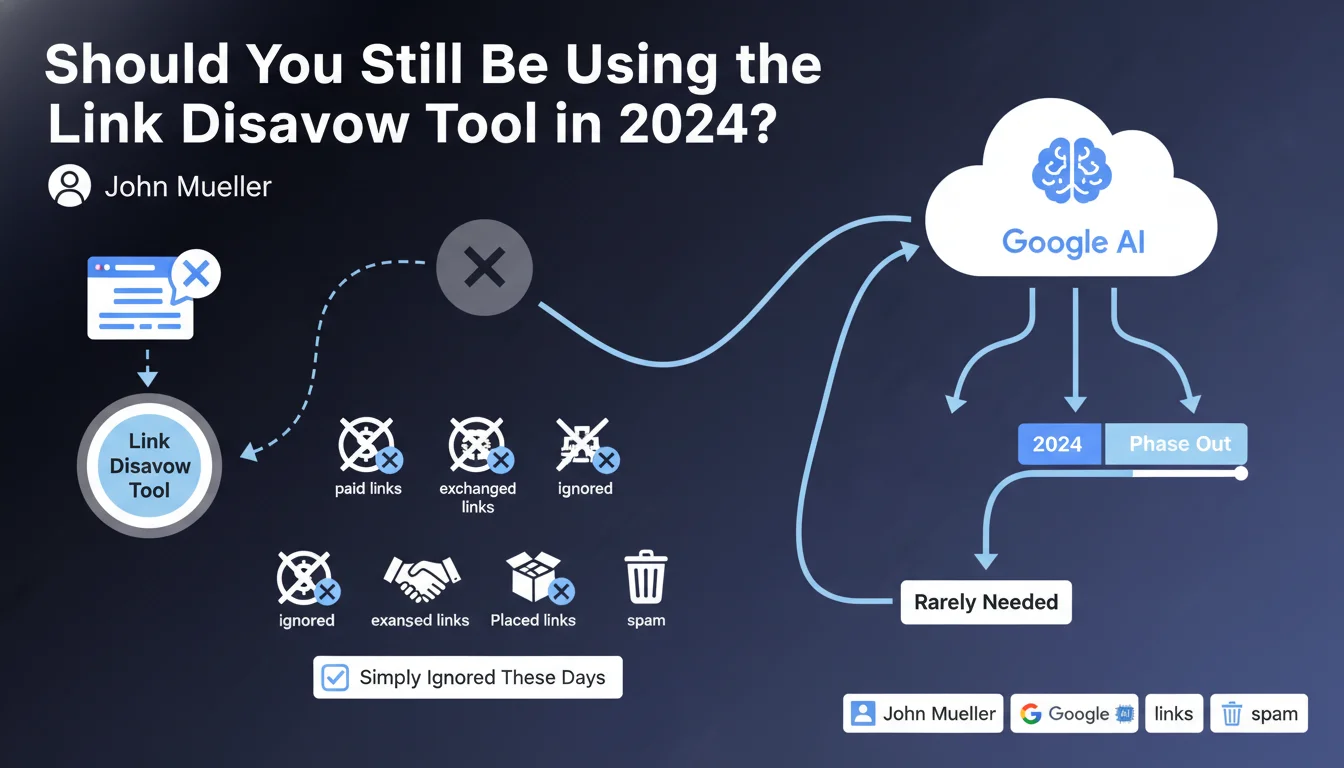
Google claims that its link filtering algorithm is now sufficiently advanced to automatically ignore the majority of toxic links. The disavow tool, launched in 2012 after Penguin, was an emergency solution to allow penalized sites to "clean up."
Today, the search engine claims it can identify and neutralize spam, paid, exchanged, or artificial links without manual intervention. This evolution demonstrates increased confidence in Google's machine learning capabilities.
What does "spam links are ignored" actually mean in practice?
When Google "ignores" a link, it means it neutralizes it in its PageRank calculation. The link provides no benefit, but also doesn't generate a negative penalty for the target site.
This approach marks a major shift: rather than penalizing sites that are victims of negative SEO or past questionable practices, Google simply prefers to devalue unnatural signals.
In which rare cases does the tool remain necessary according to Google?
John Mueller mentions "rare" situations without specifying them precisely. We can assume these involve massive negative SEO campaigns, documented manual penalties, or sites that have practiced large-scale black hat in the past.
- The disavow tool could be gradually removed by Google
- Most artificial links (spam, paid, exchanged) are now automatically ignored
- Google relies on its filtering algorithm rather than manual intervention
- Cases genuinely requiring disavowal are becoming exceptional
- This evolution reflects the maturity of Google's detection algorithms
SEO Expert opinion
Is this statement consistent with practices observed in the field?
After 15 years of observation, I can confirm that Google's tolerance for artificial links has increased considerably. Automatic Penguin penalties have virtually disappeared since the "real-time" version of 2016, when the algorithm shifted to a devaluation rather than penalization mode.
However, beware: this leniency primarily concerns sites that are victims of bad links. Sites that actively continue manipulative practices remain exposed to manual actions. The nuance is crucial.
What risks remain despite this reassuring statement?
First risk: confusing "ignored" with "harmless." A massive toxic link profile can still trigger a manual review if the webspam team detects it. Manual actions haven't disappeared.
Second risk: this tolerance may evolve. Google has already changed its position on numerous topics. Basing your entire link building strategy on this temporary clemency would be imprudent.
In what cases does the disavow tool remain relevant today?
The tool retains its usefulness for sites that have received a documented manual penalty for artificial links. In this specific case, disavowal is part of the prerequisites for the reconsideration request.
It also remains relevant in cases of massive, documented negative SEO, particularly if you notice a correlation between an influx of toxic links and a visibility drop. These situations remain rare but real.
Practical impact and recommendations
What should you actually do with the disavow tool today?
If you've never used the disavow tool and your site doesn't have a manual penalty, don't touch it. Inaction is now the best practice for the majority of sites.
If you have an active disavow file from years ago, you can consider gradually removing it. Start by removing the least toxic domains and observe the impact on your SEO performance over 2-3 months.
How can you identify if your site genuinely requires disavowal?
Use Google Search Console to verify the absence of manual actions. This is the only reliable indicator. Third-party tools that display "toxicity scores" are often excessively alarmist.
Analyze your inbound link profile: if you observe thousands of links from obviously spammy sites that appeared suddenly, and a temporal correlation with a traffic drop, then and only then does a thorough investigation make sense.
What link building strategy should you adopt given this evolution?
Focus your efforts on acquiring natural editorial links from thematically relevant sites. Quantity matters less than quality and contextualization.
Definitively abandon risky practices: massive link buying, private blog networks (PBNs), systematic triangular exchanges. Google may ignore them, but they no longer provide any competitive advantage.
- Check for the absence of manual penalties in Google Search Console
- Don't create a disavow file if you don't already have one
- Gradually remove existing disavow files and monitor performance
- Stop obsessively monitoring "toxicity scores" from third-party tools
- Redirect time budget toward acquiring quality editorial links
- Document any massive negative SEO with dates and measurable impacts
- Maintain awareness of Google's algorithmic evolutions
- Prioritize content marketing and digital PR strategies
💬 Comments (0)
Be the first to comment.