
Official statement
What you need to understand
What exactly is the mobile interstitial penalty?
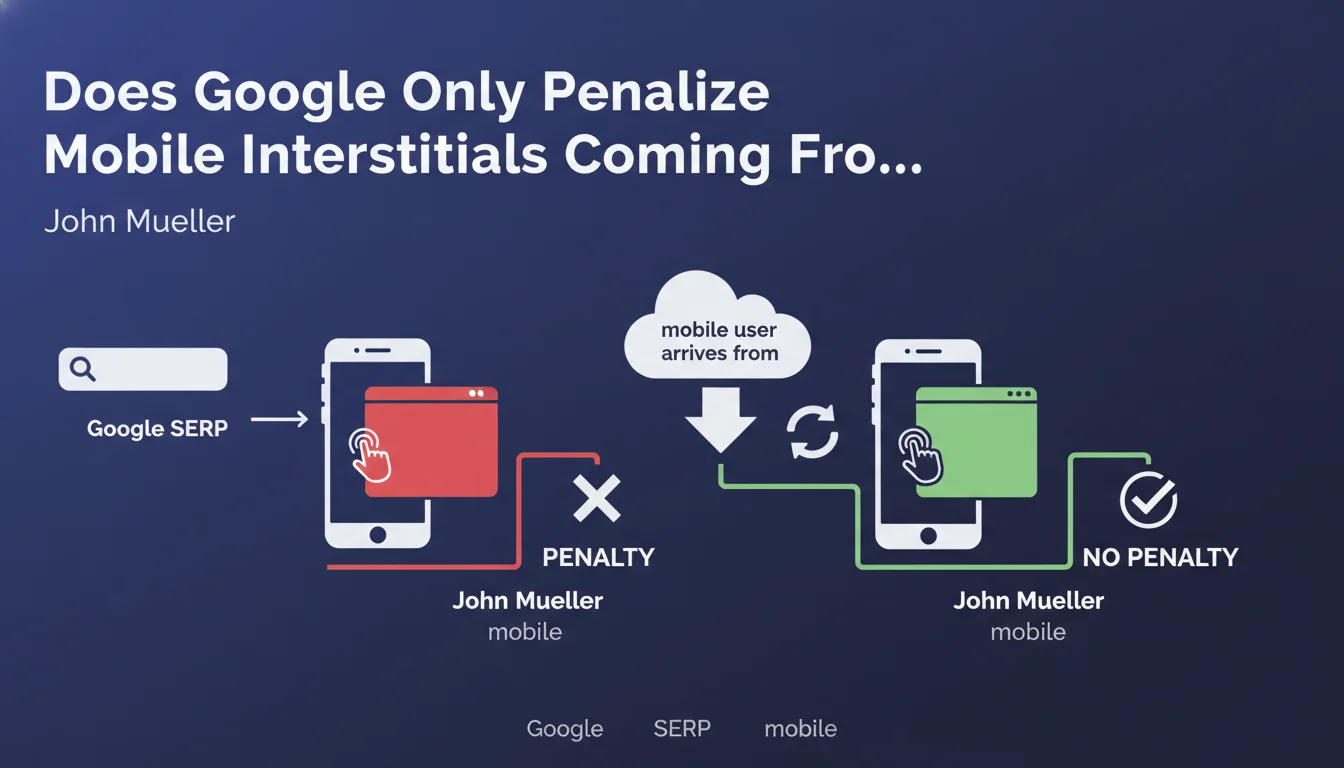
Google has implemented a specific penalty for intrusive interstitials displayed on mobile. This sanction targets pop-ups and intermediate pages that disrupt the user experience when accessing content.
The clarification provided is crucial: this penalty only concerns interstitials displayed upon arrival from a Google search results page. It does not apply to internal navigation once the user is on your site.
Why does Google distinguish between SERP traffic and internal navigation?
Google positions itself as the guardian of user experience for traffic it sends to websites. When a mobile user clicks on a search result, they expect to immediately access the promised content.
On the other hand, once on the site, the user has already established a relationship with the brand. Google considers that the webmaster has more legitimacy to request attention during internal navigation.
Are there any exceptions to this rule?
Not all interstitials are penalized, even from SERPs. Legal obligations remain authorized: cookie banners, age verification, or login for private content.
- Targeted penalty: only for arrivals from Google mobile search results
- Internal navigation preserved: freedom to display interstitials during on-site browsing
- Legal exceptions: GDPR compliance, age verification, restricted access authorized
- Critical size: small banners that are easily dismissible are not concerned
SEO Expert opinion
Is this statement consistent with real-world observations?
This clarification indeed corresponds to penalty analyses observed since 2017. Penalized sites systematically presented aggressive interstitials immediately upon landing from Google mobile.
However, the boundary remains blurry in certain cases. Is an interstitial appearing 3 seconds after arrival considered "immediate" or "internal navigation"? Google maintains an intentional gray zone to reserve itself a margin of appreciation.
What nuances should be brought to this rule?
The notion of "internal navigation" can be interpreted differently depending on technical configurations. A site with Single Page Application (SPA) architecture doesn't technically change pages during navigation.
Additionally, Google also evaluates the overall quality of user experience through Core Web Vitals. An interstitial authorized in internal navigation that massively degrades metrics can indirectly penalize the site.
Under what circumstances could this rule evolve?
Google regularly adjusts its criteria based on emerging abusive practices. If numerous sites circumvent the rule with interstitials delayed by a few seconds, an algorithm update could tighten the conditions.
Evolution toward a more holistic analysis of user journey could also make this distinction obsolete. Future algorithms might evaluate the complete experience rather than just the entry point.
Practical impact and recommendations
How can I verify if my site complies with this rule?
Test your site under real conditions from a mobile device. Perform a Google search and click on your result to observe exactly what the user sees upon landing.
Use the URL Inspection tool in Search Console and Google's mobile-friendly test. These tools report intrusive interstitial issues detected by bots.
Analyze your behavioral metrics in Analytics. An abnormally high bounce rate on mobile from organic traffic may indicate an interstitial problem even if not detected by tools.
What specifically needs to be modified on my site?
Remove or delay all pop-ups appearing immediately upon arrival from mobile search results. Favor less intrusive formats like fixed banners at the top or bottom of the page.
If you absolutely must display an interstitial for conversion reasons, wait until the user has interacted with the content (scroll, click, time spent) before triggering it.
Ensure that your legal banners (cookies, GDPR) are easily dismissible and don't occupy most of the screen. A clear and accessible close button is essential.
- Audit all interstitials and pop-ups present on the mobile site
- Differentiate behavior according to traffic source (SERP vs internal navigation)
- Implement a delay or interaction condition before display
- Verify compliance of legal banners (size, easy dismissal)
- Test the actual user journey from Google mobile
- Monitor Search Console metrics to detect reported issues
- Analyze impact on Core Web Vitals and Cumulative Layout Shift
- Document technical choices to justify retained interstitials
In summary: Google's interstitial penalty specifically targets intrusive pop-ups displayed upon arrival from mobile search results. You retain more freedom for internal navigation, but this distinction should not be a pretext to degrade user experience.
Compliance requires a precise technical approach to differentiate traffic sources and implement conditional display logic. These optimizations, combined with monitoring Core Web Vitals and behavioral signals, require pointed expertise. For sites with significant commercial stakes, support from a specialized SEO agency enables implementation of these complex adjustments while preserving your conversion objectives, with an optimal balance between compliance and business performance.
💬 Comments (0)
Be the first to comment.