
Official statement
What you need to understand
What exactly is the mobile penalty for intrusive interstitials?
In January 2017, Google rolled out an algorithmic penalty targeting mobile sites using intrusive interstitials. These elements block access to the main content as soon as the user arrives on the page.
Affected formats include full-screen pop-ups, banners that are difficult to close, or overlays that hide the main content. Google's goal was to improve mobile user experience by penalizing these practices deemed intrusive.
How long does it actually take to lift this penalty?
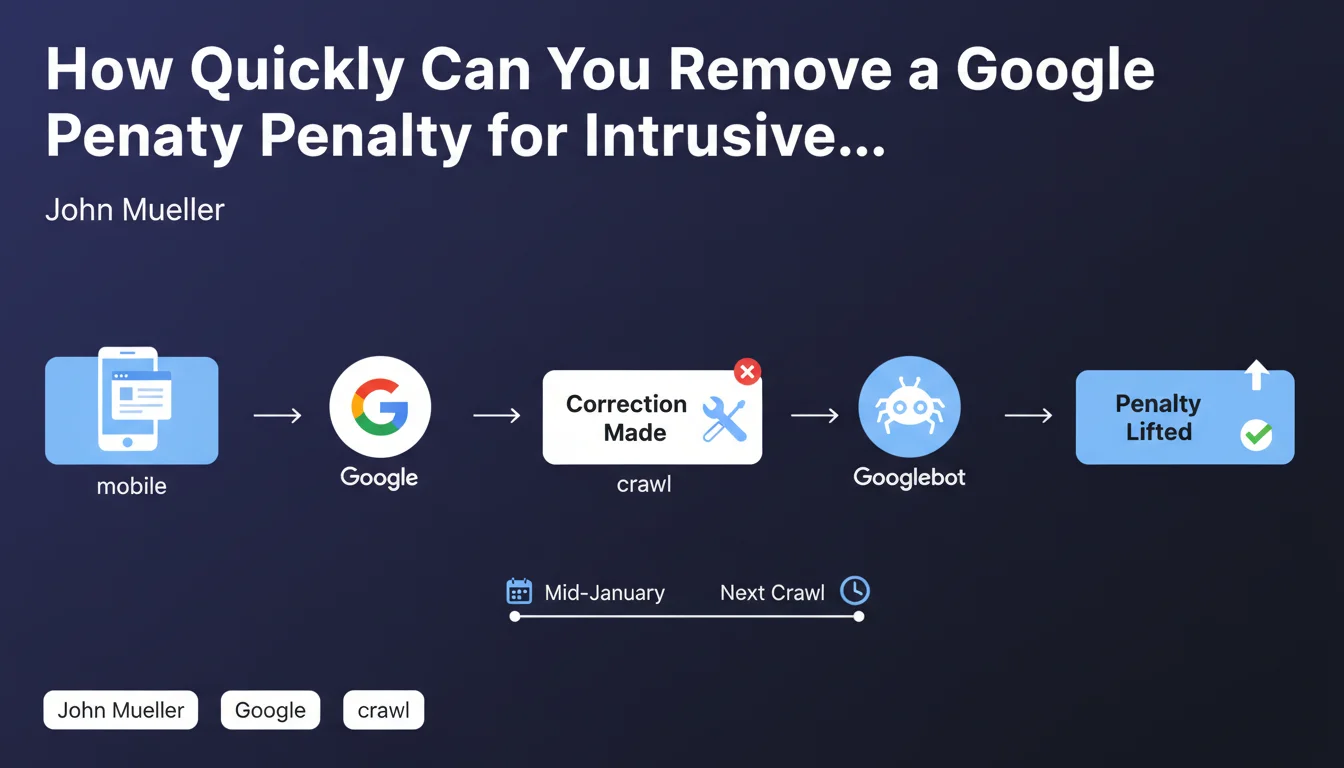
John Mueller provides an important clarification here: the penalty is lifted at the next crawl of the corrected page. There is therefore no wait for a global algorithmic update.
This speed is reassuring for webmasters who correct their mistakes. The system evaluates pages individually and in real-time, unlike certain penalties that require a longer re-evaluation.
Which interstitials are exempt from this penalty?
Google has specified that certain formats remain acceptable and do not trigger a penalty. Mandatory legal banners such as cookies or age verification are exempt.
Similarly, necessary user logins to access private or paid content are not penalized. Small discreet banners occupying a reasonable portion of the screen also remain tolerated.
- The penalty specifically targets intrusive interstitials on mobile
- Removal occurs at the next crawl after correction
- Legal and discreet formats are exempt
- Evaluation is done page by page, not at the entire site level
SEO Expert opinion
Does this statement align with real-world observations?
In my experience, this speed of penalty removal does indeed correspond to observations on numerous client sites. Once interstitials are removed or modified, rankings generally recover within 1 to 3 weeks.
However, the actual speed depends on the site's crawl frequency. A site with a limited crawl budget or complex architecture may wait longer before Googlebot revisits all affected pages. It's therefore sometimes necessary to force crawling via Search Console.
What important nuances should be considered?
The penalty really only applies to landing pages from search results. Interstitials on exit pages or during internal navigation are generally not penalized in the same way.
Furthermore, Google evaluates the actual impact on user experience. An interstitial that appears after a few seconds of content reading is better tolerated than an immediate pop-up completely blocking access.
When does this rule not fully apply?
For news sites with paywalls, Google has created exceptions via structured markup. These sites can block content access after a few paragraphs without suffering a penalty, provided they comply with First Click Free guidelines.
B2B sites with gated content (whitepapers, studies) sit in a gray area. If the form appears as a complete interstitial, it can technically be penalized, even though in practice the impact remains limited since these pages rarely target general informational queries.
Practical impact and recommendations
What should you do specifically to avoid this penalty?
Start by auditing all your mobile interstitials by navigating your site as a user would from Google. Test particularly the main landing pages of your SEO strategy.
Replace full-screen pop-ups with less intrusive alternative formats: sticky banners at the top or bottom, lateral slide-ins, or timed interstitials appearing only after 30-60 seconds of reading. These solutions preserve your conversions while respecting Google guidelines.
How can you verify that your site is compliant?
Use Google's mobile-friendly test tool which can flag certain interstitial issues. Also check Search Console to verify the absence of specific alerts on mobile experience.
Analyze your behavioral data in Google Analytics: an abnormally high bounce rate on mobile or very low engagement time may indicate an interstitial problem poorly received by users.
What mistakes should you absolutely avoid?
Don't attempt to hide interstitials only from Googlebot through cloaking. This practice is explicitly prohibited and can trigger sanctions far more serious than a simple interstitial penalty.
Also avoid dark patterns like tiny or deceptive close buttons. Beyond SEO considerations, these practices damage your brand image and your actual conversion rate.
- Audit all interstitials and pop-ups present on the mobile version
- Prioritize discreet banners (less than 15% of the screen)
- Delay overlay display (minimum 30 seconds of reading)
- Check for absence of penalties in Search Console
- Test actual user experience from a smartphone
- Monitor bounce rate and mobile engagement in Analytics
- Force recrawl of corrected pages via Search Console
- Document exempt formats (cookies, login, age)
💬 Comments (0)
Be the first to comment.