
Official statement
What you need to understand
Why does Google maintain this separation between its teams?
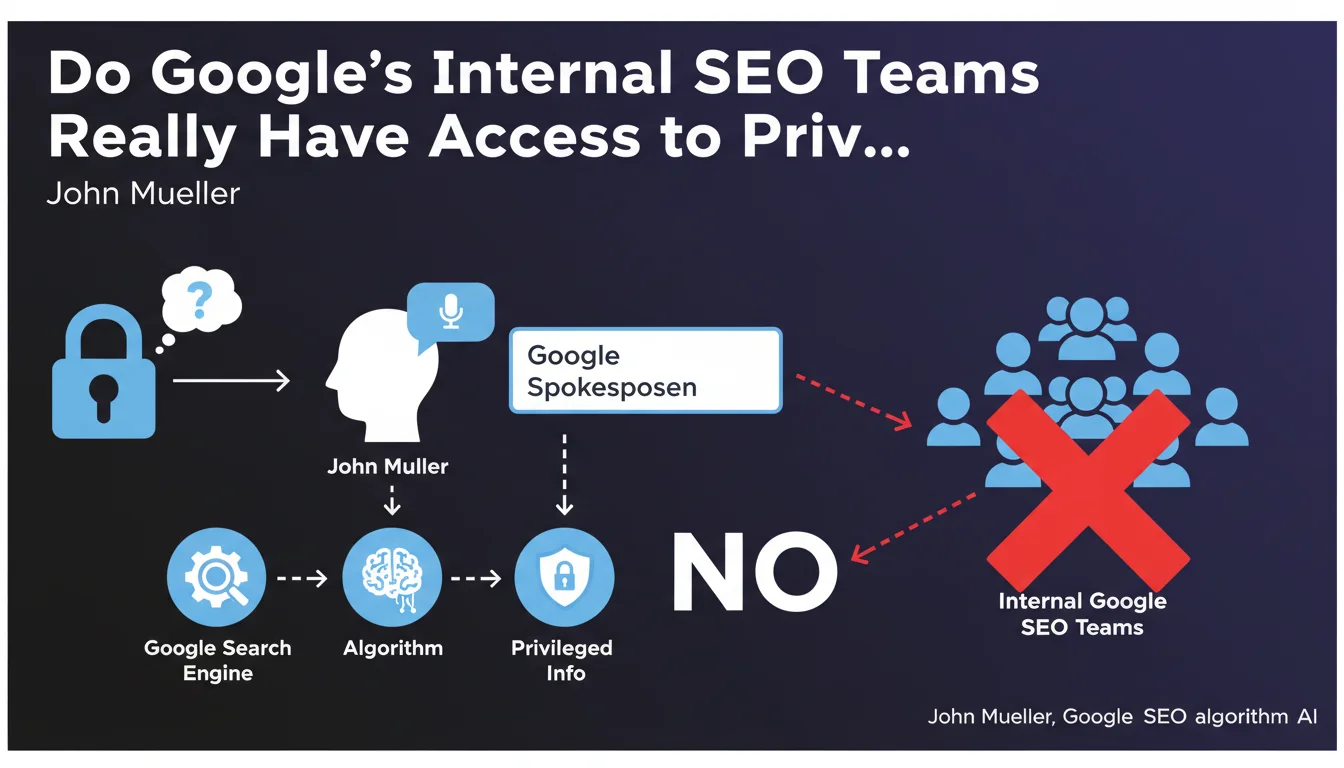
John Mueller revealed a surprising fact: Google's internal SEO teams who optimize the company's websites receive no privileged information from search engine engineers. This strict compartmentalization policy ensures that Google doesn't give itself any competitive advantage.
This separation applies even for basic technical questions like the timeframe for implementing a 301 redirect. Google's SEO professionals must therefore navigate with the same public information as all industry professionals.
What does this policy actually mean for search ranking fairness?
This statement confirms that Google applies its own rules fairly. The company's sites don't benefit from any preferential treatment or access to confidential information about how the algorithm works.
For SEO practitioners, this means that the playing field remains level. All optimizers, whether they work for Google or elsewhere, have access to the same public resources: official documentation, training videos, and spokesperson statements.
What are the implications for access to SEO information?
This policy demonstrates that the public information provided by Google constitutes the absolute reference. There is no secret documentation or shortcuts reserved for insiders.
- Equal access: all SEO professionals have access to the same official information
- Enhanced transparency: Google cannot favor its own sites without violating its principles
- Source credibility: public statements are the only reliable references
- No internal advantage: even Googlers must test and experiment like all SEO professionals
SEO Expert opinion
Is this statement consistent with practices observed in the field?
With 15 years of experience, I observe that this policy is indeed applied in reality. Google's sites sometimes suffer penalties or visibility drops, just like any other website. Google Business Profile has even experienced significant indexing problems.
This consistency reinforces the credibility of Google's official communications. If internal teams had to figure things out on their own for basic questions about 301 redirects, this proves that the information shared publicly is genuinely the only information available.
What nuances should be brought to this statement?
Nevertheless, there is a difference between privileged information and technical expertise. Google's internal SEO professionals work in an advanced technological environment with robust infrastructures, which gives them indirect advantages.
They also benefit from a cultural proximity to the quality standards that Google values: technical performance, user experience, accessibility. This immersion constitutes an asset, even without direct access to algorithm secrets.
In which cases can this transparency be questioned?
Although the policy is clear, certain gray areas persist. Large-scale algorithm tests necessarily require internal data. The question is whether these insights are totally isolated from operational SEO teams.
Furthermore, communication delays can create temporary asymmetries. Google's technical teams know about algorithm changes before their public announcement, even if this information doesn't officially circulate to internal SEO professionals.
Practical impact and recommendations
What should you actually do with this information?
Focus on Google's official sources: Search Central documentation, spokesperson videos, and official announcements. These resources constitute the most reliable and comprehensive knowledge base available.
Prioritize experimentation and testing rather than searching for secret advice. If Google's SEO professionals must themselves test the timeframes for implementing 301 redirects, it means the empirical method remains the most relevant.
What mistakes should you avoid in your SEO strategy?
Don't waste time looking for privileged information that doesn't exist. Obscure forums claiming to reveal Google insider secrets are generally unreliable sources based on speculation.
Also avoid overpaying for training claiming to have access to exclusive information. True SEO expertise is built on analyzing public data, methodical experimentation, and deep understanding of Google's quality principles.
How can you optimize your SEO approach with this knowledge?
Develop an optimization methodology based on fundamentals: content quality, user experience, technical performance, and topical authority. These pillars remain constant regardless of algorithm evolution.
- Follow only Google's official channels for your SEO information
- Document your own experiments and their measurable results
- Invest in the technical quality of your web infrastructure
- Prioritize user experience as the primary optimization criterion
- Build your topical authority through expert and in-depth content
- Systematically test changes before large-scale deployment
- Measure the impact of each optimization with precise analytical data
💬 Comments (0)
Be the first to comment.