
Official statement
What you need to understand
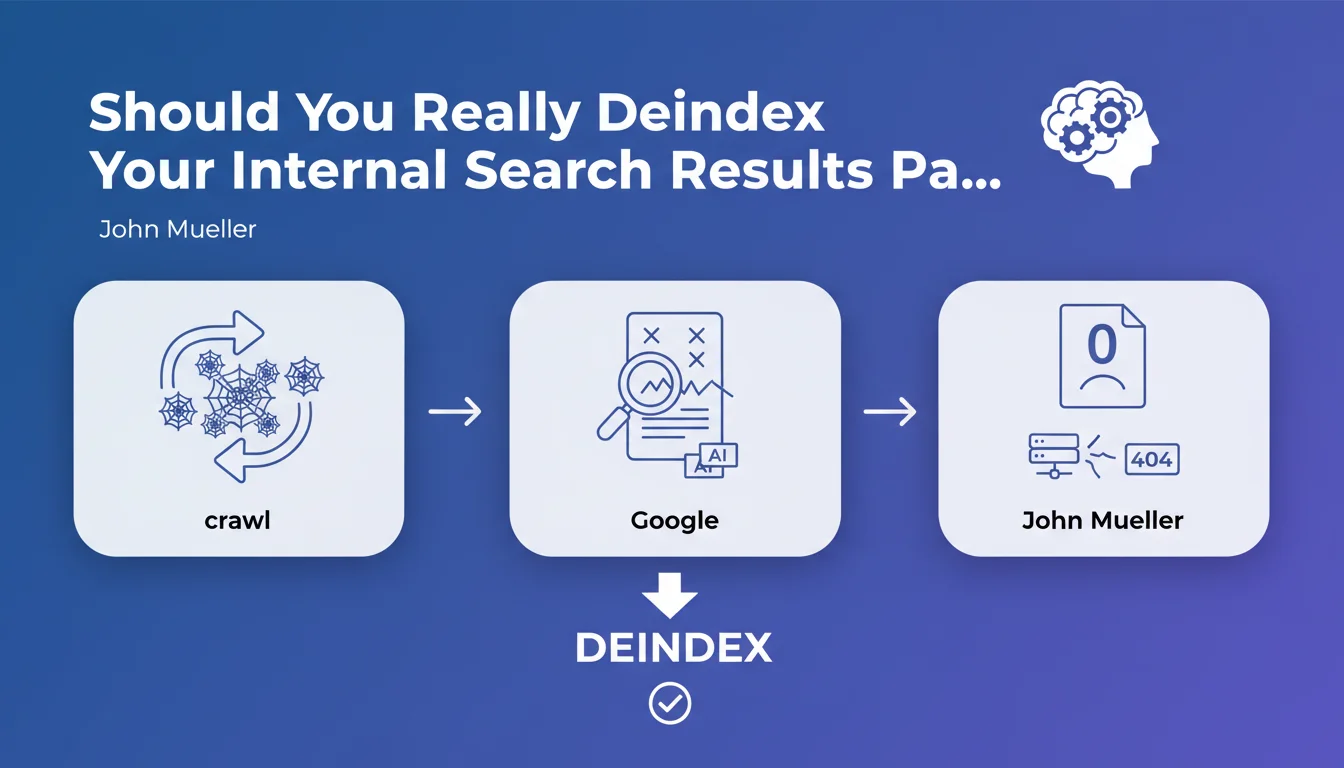
Results pages generated by a website's internal search engine pose three major problems for Google. They create infinite crawl spaces that exhaust the crawl budget allocated to your site.
These pages are generally considered low-quality content because they don't provide unique editorial value. They simply display results that exist elsewhere on the site.
The third problem concerns pages with no results (zero search results). These empty pages are detected as soft 404s by Google, which harms the overall quality of your indexation.
- Internal search engines generate infinite crawling that wastes the exploration budget
- Content is considered duplicate or low-quality
- Pages without results create problematic soft 404s
- Google explicitly recommends deindexing these pages
SEO Expert opinion
This recommendation is consistent with field observations. Sites that leave their internal search pages indexed often notice an inflation of indexed pages without any organic traffic gain.
However, beware of the gray zone mentioned: the boundary is blurry between an internal search page and a legitimate filtering page. On an e-commerce site, a page for "red shoes size 42" can be seen as a useful filter or as an internal search.
The golden rule: if the page answers a potential query from a Google user with optimized and unique content, it deserves indexation. If it's randomly generated by a user search, it should be blocked.
Practical impact and recommendations
- Block crawling of internal search URLs via robots.txt by identifying parameters (?s=, ?search=, ?q=, etc.)
- Add a noindex tag on internal search results page templates
- Use the URL parameters tool in Google Search Console to indicate parameters to ignore
- Audit your filter and category pages to differentiate pages with SEO value from internal searches
- Create a clear taxonomy: indexable categories vs. dynamic filters with noindex
- Monitor soft 404s in Search Console to detect pages without results
- Optimize real landing pages (categories, product pages) rather than relying on internal searches
- Implement clean pagination on legitimate category pages with rel="next"/"prev" or canonicals
In summary: Deindexing internal search engines is a technical best practice that protects your crawl budget and the quality of your indexation.
Implementation, however, requires a detailed analysis of your architecture to avoid mistakenly deindexing pages with high SEO potential. This distinction between legitimate pages and parasitic pages requires in-depth expertise in your industry.
Given the complexity of these decisions and their direct impact on your visibility, support from a specialized SEO agency can prove valuable in establishing a customized indexation strategy, adapted to your site's specificities and your market.
💬 Comments (0)
Be the first to comment.