
Official statement
What you need to understand
Why Doesn't Indexing Order Determine Content Originality?
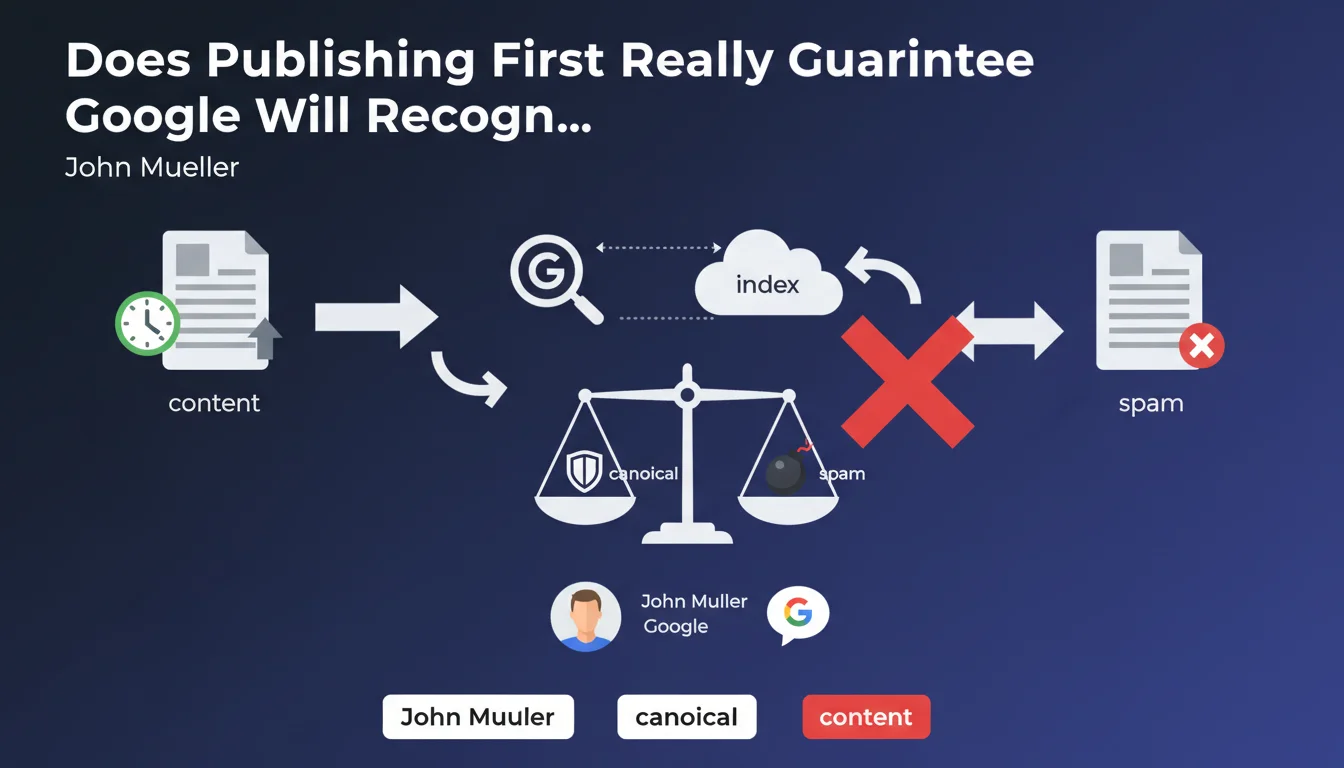
Google has clarified an important misconception: being indexed first doesn't make you the original author in the search engine's eyes. If a scraper or plagiarist copies your content and Google indexes it before your own page, that doesn't mean it will be considered the canonical source.
This statement is fundamental because it reveals that Google uses sophisticated algorithms to identify the true source of content, beyond the simple temporal criterion of indexation. The search engine deploys multiple signals to determine originality.
What Criteria Does Google Use to Identify Original Content?
Google relies on several trust and authority signals to distinguish the original from the copy. Page PageRank is one of the confirmed criteria: a page with established authority will have a better chance of being recognized as the original source.
Other factors likely come into play, such as domain history, publication frequency, author signals, or even site behavior patterns. Google deliberately remains silent about all these criteria to avoid manipulation.
What Happens When There's No Canonical Tag?
When no canonical tag is specified, Google must arbitrate alone between different versions of the same content. It's in this context that originality detection algorithms take on their full importance.
The search engine will analyze all available signals to choose which URL to display in search results. This algorithmic decision can sometimes be surprising, hence the importance of understanding the underlying mechanisms.
- Indexing order is not the determining criterion for originality
- PageRank and page authority play a major role in detection
- Google uses multiple signals not publicly communicated
- Canonical tags allow you to explicitly guide Google
- Indexing speed doesn't protect against plagiarism
SEO Expert opinion
Is This Statement Consistent with Field Observations?
Yes, this assertion corresponds perfectly to observations by SEO professionals for years. Numerous documented cases show authoritative sites regaining their original status even after being scraped and indexed second.
I've personally observed that sites with a solid link profile and established history generally recover their position as original author within a few days or weeks. Google's algorithms seem to perform continuous reassessments to refine their judgment.
What Important Nuances Should Be Added to This Statement?
The main nuance concerns Google's reaction time. Even if the algorithm eventually identifies the correct original, there can be a transitional period where the scraper enjoys an unfair advantage. During this time, your content may be penalized.
Another critical point: this algorithmic protection works better for established sites with authority. A new site without history or backlinks will have more difficulty proving its originality against a plagiarist with an older or better-ranked domain.
In What Cases Can This Automatic Detection Fail?
Problematic situations mainly arise with new sites without established authority. If you launch a blog and a powerful site immediately copies your content, Google may struggle to decide, at least initially.
Legitimately syndicated or republished content also poses challenges. Without appropriate canonical tags, Google may choose the syndicated version over the original if it appears on a more authoritative site. That's why syndication agreements should always include clear technical directives.
Practical impact and recommendations
What Should You Implement Concretely to Protect Your Content?
Prevention remains your best defense. Systematically use canonical tags on your own pages to eliminate any ambiguity. Gradually build your domain's authority through a coherent link-building strategy.
Set up scraping monitoring with tools like Copyscape or Google Alerts to quickly detect copies. The faster you intervene, the less damage there will be. Consider using truncated RSS feeds to limit automated content theft.
Structure your content with unique identification elements: internal citations, links to your other articles, brand elements. These signals help Google trace the content's origin.
What Critical Errors Should You Absolutely Avoid?
Never neglect correct implementation of canonical tags, even for your own pages. A misconfigured canonical can tell Google that another version is the original, shooting yourself in the foot.
Avoid massively republishing your own content on other platforms without precautions. Each republication should point to the original via a canonical, otherwise you create confusion for the algorithms yourself.
Don't underestimate the importance of indexing speed despite everything. Even if it's not the only criterion, quickly submitting your URLs via Search Console and having a well-crawlable site gives an advantage in the race against scrapers.
How Can You Check and Optimize Your Protection Against Duplicate Content?
Use Search Console to identify duplication issues that Google has detected. The "Coverage" section and reports on excluded pages often reveal surprises about URLs considered duplicates.
Perform regular searches with unique excerpts from your content in quotes to spot copies. Monitor particularly your best-performing articles, as they are the prime targets for scrapers.
- Implement self-referencing canonical tags on all your content pages
- Gradually build domain authority through quality backlinks
- Set up automated scraping monitoring with alerts
- Submit new content quickly via Search Console
- Use truncated RSS feeds to limit automated scraping
- Integrate unique brand elements into each piece of content
- Regularly check duplication reports in Search Console
- Act quickly when detecting copies (DMCA if necessary)
- Audit the technical configuration of canonicals across the entire site
💬 Comments (0)
Be the first to comment.