
Official statement
What you need to understand
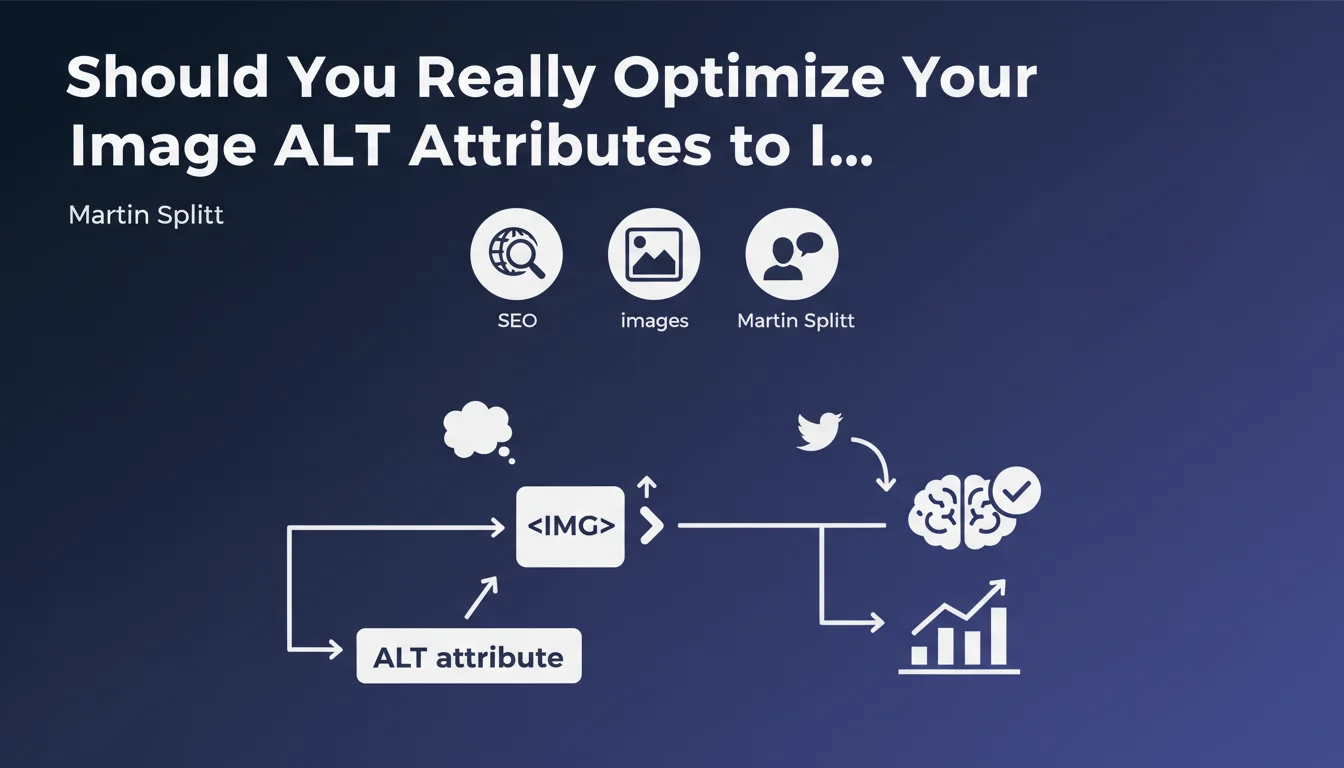
Martin Splitt, a Google representative, confirmed what many SEO practitioners have been observing for years: the ALT attribute of images carries real weight in organic search rankings. This official statement puts an end to certain uncertainties about the importance of this criterion.
Concretely, the ALT attribute (Alternative Text) allows Google to understand the content of an image and integrate it into its overall semantic analysis of the page. Without this textual information, Google's robots can only analyze the image visually, which remains less precise than text.
This confirmation highlights a recurring problem: many websites still neglect this basic optimization. Yet, this is a simple lever to activate that can generate additional traffic via Google Images and improve the thematic relevance of pages.
- The ALT attribute is a confirmed SEO signal by Google
- It must be filled in for all images with semantic value
- Decorative images can have an empty ALT (alt="")
- The optimization improves both classic SEO and ranking in Google Images
- Web accessibility also benefits from this best practice
SEO Expert opinion
This statement confirms what field observations have been demonstrating for a long time. Websites that properly optimize their ALT attributes generate significantly more traffic from Google Images and strengthen the semantic relevance of their content. This is not a marginal effect.
However, be careful not to fall into keyword stuffing in ALT attributes. Google penalizes this practice. The optimal approach is to naturally describe the image content by integrating the main keyword only when it makes sense. The description must remain primarily useful for a visually impaired user.
Finally, note that some images don't need descriptive ALT text: purely decorative elements (borders, separators, patterns) should have an empty ALT attribute to avoid polluting the screen reader experience.
Practical impact and recommendations
- Audit all your existing ALT attributes: identify images without ALT or with generic ALT text ("image1.jpg", "photo")
- Prioritize strategic pages: start with your landing pages, product pages, and main editorial content
- Write natural descriptions: 5 to 15 words precisely describing the image content
- Integrate your keywords intelligently: only when the natural description allows it, without forcing
- Differentiate semantic and decorative images: empty ALT (alt="") for purely aesthetic images
- Optimize infographics and charts: describe the main data, not just "infographic about X"
- Implement consistent templates for e-commerce sites (e.g., "[Product name] - [Viewing angle] - [Color]")
- Train your editorial teams: integrate this best practice into your web editorial guidelines
- Track the impact in Google Search Console: analyze the evolution of traffic via Google Images after optimization
Optimizing ALT attributes may seem simple in theory, but its systematic implementation on a medium or large-scale website represents considerable work. Consistency and quality of descriptions across thousands of images require a rigorous methodology and often technical developments to intelligently automate certain processes.
For complex websites or teams lacking internal resources, support from a specialized SEO agency allows you to structure this optimization effectively, avoid common mistakes, and establish sustainable processes adapted to your CMS and editorial workflows.
💬 Comments (0)
Be the first to comment.