
Official statement
What you need to understand
How Does the Treatment of Hidden Content Differ Before and After Mobile First?
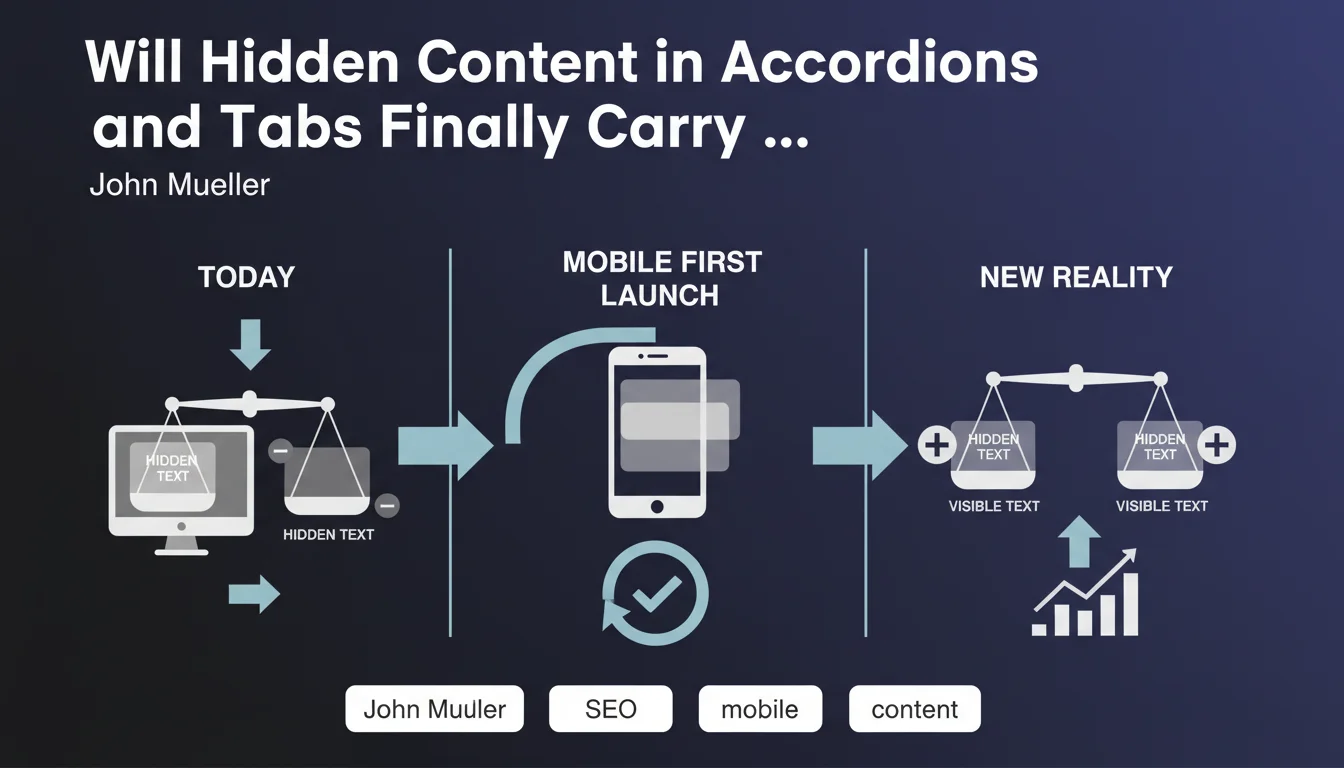
Historically, Google applied reduced weight to content present in tabs, accordions, or other hidden but accessible elements. This text was indexed, but considered less priority than directly visible content.
With the rollout of the Mobile First Index, this distinction disappears. Hidden but potentially visible content will now be treated with the same algorithmic weight as text displayed by default.
Why Did Google Decide to Change This Rule?
On mobile, screen space is limited. Designers massively use accordions and tabs to improve user experience without overloading the initial display.
If Google maintained a penalty on this hidden content, it would penalize good mobile UX practices. The change therefore reflects the algorithm's adaptation to the realities of the modern mobile web.
What Does This Concretely Mean for Indexing?
All sites already migrated to the Mobile First Index benefit from this evolution. Content in interactive elements now fully counts in the evaluation of a page's relevance and comprehensiveness.
- Content in accordions/tabs regains full algorithmic weight
- This rule only applies to content accessible to users (not content completely hidden in CSS)
- Migration to Mobile First is now generalized across the entire web
- This evolution favors sites with optimal mobile UX architecture
SEO Expert opinion
Is This Statement Consistent with Field Observations?
Absolutely. Since the progressive rollout of the Mobile First Index, numerous tests have confirmed that content in accordions gains visibility in search results. Pages rich in content structured via interactive elements perform better.
I have personally observed significant ranking gains on FAQ pages structured in accordions, particularly for long-tail informational queries. This statement officially confirms what practitioners have been observing for several years.
What Nuances Should Be Applied to This Rule?
Be careful not to confuse potentially visible content with completely hidden content. Text in display:none without possible interaction remains suspect in Google's eyes and can be ignored or penalized.
The content must be accessible through a click or clear user interaction. Accordions, tabs, "Read more" buttons are concerned. However, cloaking or concealment techniques remain strictly prohibited.
In Which Contexts Is This Evolution Particularly Advantageous?
Sites with detailed FAQ pages, product sheets rich in technical specifications, or educational content benefit enormously from this evolution. You can now structure information ergonomically without SEO sacrifice.
E-commerce sites can notably enrich their product pages with technical sections, user guides, and detailed reviews in accordions, while maintaining their full SEO potential.
Practical impact and recommendations
What Should You Optimize Immediately on Your Site?
Identify pages where you've deliberately limited content for fear of penalty on hidden text. Now is the time to reintegrate this content into well-designed interactive structures.
Audit your main pages to detect opportunities for semantic enrichment. FAQs, buying guides, comparisons can be considerably expanded with accordions without harming UX.
What Technical Errors Must You Absolutely Avoid?
Don't hide content with pure CSS techniques (display:none, visibility:hidden) without a clear display mechanism. Google could interpret it as an attempt at manipulation.
Ensure that your accordions and tabs are accessible (ARIA tags, focus management, keyboard usable). Technically inaccessible content could be ignored by Googlebot.
- Verify that your site is properly migrated to the Mobile First Index via Search Console
- Test the accessibility of your interactive elements with the Lighthouse tool
- Use Schema.org FAQPage markup for FAQ sections in accordions
- Inspect the HTML rendering via the URL Inspection tool in Search Console
- Avoid hiding essential content in the first paragraphs (keep solid initial visible content)
- Structure your hidden content with clear HTML headings (h2, h3) to help Google understand the hierarchy
How Can You Measure the Impact of These Optimizations?
Track the evolution of your positions on long-tail queries related to content added in accordions. Also monitor the indexation rate of your enriched pages.
Analyze engagement metrics (time on page, bounce rate) to ensure that adding hidden content genuinely improves user experience, not just SEO.
💬 Comments (0)
Be the first to comment.